


She applies paint to her face and sticks two feathers in her hair. He winds a red bandana around his head. They both wear stylized American Indian tunics that he has painstakingly made by hand. There are two microphones on stands, a small mixer, two speakers and a mini disc player churns out Andean background music. An oil generator hums, generating electricity for the performance to come.
It's midweek in Ximending, Taipei, and the crowds are thinner than usual because a gray sky is promising more rain. Nevertheless, Karito and his girlfriend carry on with their preparations. He sticks two sheets of yellow paper on the monitor, one with a list of about 30 songs, the other with lyrics to a tune that Shalina is having trouble remembering.
Brave Hearts by Paul la Roche sets the tone. It's a new-age Native American standard that has a familiar melody and is intended to get the crowd going. If there was a crowd, that is. Though it's a pedestrian area, taxis and pickup trucks are driving by. A two-man police patrol swoops past. People are busy shopping and it will be a while before they gather to listen and watch the couple.
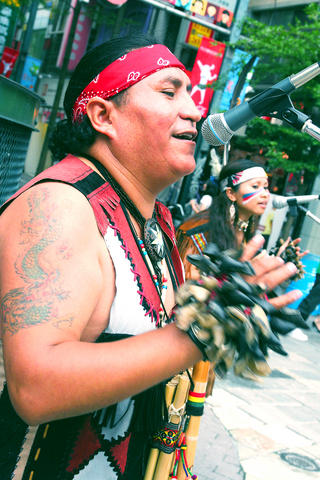
The 44-year-old Karito has a phoenix tattoo on one arm and a dragon on the other. He has beads around his neck and with his red-tinged skin and sharp features looks the part of an Andean folk musician, which is what he is. Flutes, pipes and percussion instruments dangle from his microphone stand and he takes turns to play them all.
Karito, real name Eduardo Uyuli Ramos, started playing the small guitar and flute in his native Bolivia when he was 7. He was brought up with his five brothers in Uyuni, a salt-mining city. His father worked at the hospital and his mother banned him from playing music when he was 12.
"She thought there was no future in it. She wanted me to go to college. At that time music was mainly played in bars by poor people who could do nothing else and it was associated with drinking and bad things," Karito says.

PHOTO: JULES QUARTLY, TAIPEI TIMES
After compulsory military service, Karito made it to university and studied economics for a year, before finding the courage to tell his mother he wanted to be an artist instead. Fortunately for Karito, the Bolivian government was promoting local folklore and offered full scholarships to musical students. His mother said he was old enough to follow his heart, so Karito did.
He studied music for three years when he was chosen to go to Austria and play at a festival. Then, the group went on tour in Europe for six months and the travel bug bit Karito. It was 1989 and since this time he has been a wandering minstrel, playing in bands, at concert halls, festivals and on the streets.
"I didn't want to go home. I wanted to travel more and show off my country's music and its culture. Inca music is about the Andes (South America's longest mountain range), the wind and the rain. You know, the wind makes melodies as it whistles through the rocks. I sing about how the flowers open after rain and the condor, how it soars and is free. This is our folklore. Some of our songs talk about our sadness, but most are about love and women."
In the past 18 years Karito has seen the world, been a member of five bands and produced around 15 albums. He first came to Taiwan in 1997 and has visited many times since. He met Shalina, whose real name is Sulistyowati, four years ago in Indonesia. She says of their first meeting at a Surabaya train station, "I saw a guy with a guitar who couldn't speak the language, so I helped him out."
Karito courted the 28-year-old and eventually met her parents, who agreed that she could join him on his musical journey. Then she went to Bolivia and learned about its culture. After overcoming her initial shyness she learned to play some instruments, dance and sing in Quechua (the original language of the Incas), hence her difficulty remembering the lyrics sometimes. They communicate in a mix of Spanish, Chinese and English.
Back in Ximending, Karito and Shalina are into their fourth or fifth song and a crowd of about 50 people has gathered. Kids, in particular, are spellbound by the performance. When they sing Ananau together, with its powerful chorus line, a tourist from China confides, "You know they're Aboriginals, don't you?"
"This happens quite often," Karito says, laughing. "Our music is similar because it comes from the mountains and from the heart. But in Bolivia we have many different kinds of rhythms, like the potosi, lambada and thinku. Thinku is a fight dance. People used to fight until someone died and then the farmers spread the blood on the ground, a sacrifice to the gods for good harvests. This was before the Spanish came (in the 16th century), when our gods were in nature."
"We also have sad songs because life can be tough in Bolivia. I worked in the salt mines for two years to pay tuition at university. We used coca leaves and cigarettes to keep us going. Many people died of tuberculosis in their 40s. But I don't sing so many of these songs when I perform, because I prefer to sing happy songs for the people."
"I don't want to return to Bolivia right now because I haven't lived there for so long. It has changed and I have changed. I've got used to traveling. When I was young, about 15, I worked with my father in the dispensary. My mother wanted me to be an office worker, but I would rather be an artist. For me it's not hard work when I sing and play, it makes me happy. If I could not do this I would be empty."
Karito is currently working on an album of his own songs and can be contacted at caritoed
@hotmail.com

Sept.16 to Sept. 22 The “anti-communist train” with then-president Chiang Kai-shek’s (蔣介石) face plastered on the engine puffed along the “sugar railway” (糖業鐵路) in May 1955, drawing enthusiastic crowds at 103 stops covering nearly 1,200km. An estimated 1.58 million spectators were treated to propaganda films, plays and received free sugar products. By this time, the state-run Taiwan Sugar Corporation (台糖, Taisugar) had managed to connect the previously separate east-west lines established by Japanese-era sugar factories, allowing the anti-communist train to travel easily from Taichung to Pingtung’s Donggang Township (東港). Last Sunday’s feature (Taiwan in Time: The sugar express) covered the inauguration of the

The corruption cases surrounding former Taipei Mayor and Taiwan People’s Party (TPP) head Ko Wen-je (柯文哲) are just one item in the endless cycle of noise and fuss obscuring Taiwan’s deep and urgent structural and social problems. Even the case itself, as James Baron observed in an excellent piece at the Diplomat last week, is only one manifestation of the greater problem of deep-rooted corruption in land development. Last week the government announced a program to permit 25,000 foreign university students, primarily from the Philippines, Indonesia and Malaysia, to work in Taiwan after graduation for 2-4 years. That number is a

This year’s Michelin Gourmand Bib sported 16 new entries in the 126-strong Taiwan directory. The fight for the best braised pork rice and the crispiest scallion pancake painstakingly continued, but what stood out in the lineup this year? Pang Taqueria (胖塔可利亞); Taiwan’s first Michelin-recommended Mexican restaurant. Chef Charles Chen (陳治宇) is a self-confessed Americophile, earning his chef whites at a fine-dining Latin-American fusion restaurant. But what makes this Xinyi (信義) spot stand head and shoulders above Taipei’s existing Mexican offerings? The authenticity. The produce. The care. AUTHENTIC EATS In my time on the island, I have caved too many times to

In a stark demonstration of how award-winning breakthroughs can come from the most unlikely directions, researchers have won an Ig Nobel prize for discovering that mammals can breathe through their anuses. After a series of tests on mice, rats and pigs, Japanese scientists found the animals absorb oxygen delivered through the rectum, work that underpins a clinical trial to see whether the procedure can treat respiratory failure. The team is among 10 recognized in this year’s Ig Nobel awards (see below for more), the irreverent accolades given for achievements that “first make people laugh, and then make them think.” They are not


 RSS
RSS