


American Robin Winkler (文魯彬) wears two hats. The 53-year-old is an environmentalist and capitalist.
He was ousted from his job as a commercial lawyer in Taiwan from the firm he had founded. Shortly after, he was diagnosed with terminal lung cancer and moved to Hualien. While there, he communed with nature, miraculously recovered, and realized that mankind has become pathologically destructive in its pursuit of success. He then became a crusader for the environment and a Taiwanese citizen to boot.
That's half the story. Long before the diagnosis, Winkler had been reading books such as Beyond Civilization (Daniel Quinn) and The Ecology of Commerce (Paul Hawken) — books that tap into things that he had "always felt but couldn't articulate." His firm had fallen apart in the first place because he had been giving away a lot of money.
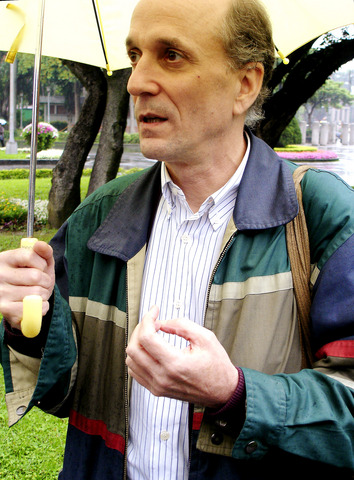
PHOTO: CHRIS PECHSTEDT, TAIPEI TIMES
His new business, Winkler Partners (博仲法律事務所) occupies Vice-President Annette Lu's former residence on Chongqing South Road, where a well-dressed staff serves "Fortune 500-type" clients — many of which engage in the kind of "unsustainable" practices that will make the century "pretty grim."
Winkler looks out of place there.
He takes commercial cases even less often than he dresses up.
One former employee describes him as a brilliant but demanding and sometimes harsh boss. He is extraordinarily articulate, maintains a professional carriage and claims to "not ever rest." ("The distinction between work and leisure is a really warped idea," he explains. "It's a culture of schizophrenia.")
Much of his work is through Wild at Heart (en.wildatheart.org.tw, 台灣蠻野心足生態協會), the small environmental legal-defense group holed up in what used to be Lu's staff's quarters and supported by the law firm. "This is how I make my money, and this is how I spend my money," Winkler likes to say as he flips over his double-sided business card, which represents an integral part of the firm's philosophy.
If there is a contradiction in using money from big international clients to fund an organization that is wary of the very idea of foreign investment, Winkler is philosophical about it.
He doesn't consider himself to be anti-business. On the contrary, he holds — somewhat perversely — that "no amount of effort by environmental groups, the government, or individuals can hope to stop the ruin ... The responsibility fall[s] to us — business."
This responsibility, he believes, is simple: "Identify what we're doing that's not sustainable and stop doing it." As to what exactly that would mean, "anyone who thinks they know is full of shit."
At the very least, though, it would mean giving up the idea of short-term growth as the primary focus of economic policy and business management ("'sustainable growth' is a contradiction in terms"). Winkler believes that a collision between civilization and the limits of natural resources is inevitable.
Such beliefs haven't always made him popular.
As an appointee to the EPA's environmental-impact assessment (EIA) commission, a body that regulates new construction and development projects, he has very publicly butted heads with the Executive Yuan over projects like the Central Taiwan Science Park (中部科學工業區), a much-touted economic growth engine. Winkler and other "environmentally committed" commissioners have been accused of overstepping their bounds. They retort that the government, unused to commissioners asserting political independence, is applying pressure "without any legal authority whatsoever."
The right to make statements like this without fear of deportation, or accusations of being a meddling foreigner, was part of what got Winkler, after more than 20 years as a foreigner, to give up his US passport for a Taiwanese one, in 2003.
It's a right he exercises in countless meetings, speaking to vast congregations or a single legislator in soft Mandarin, making a point of referring to "we Taiwanese."
He had romantic reasons for becoming Taiwanese as well. Having a US passport, and the ability to leave "if things get bad," is like being "in two places at once," and he wanted to be fully here, where he had spent half his life, built his career and met his wife, a Taiwanese-born publisher.
And, of course, there was Taiwan's environment, hectare for hectare one of the most diverse in the world. He had always loved it, down to the rain and humidity. When he first came to Taipei nearly 30 years ago, the capital's verdant surroundings were one of his chief reasons for staying.
Like the first Western environmentalists, Winkler is motivated by love. He believes that it is simply wrong to profit at the expense of the environment and the other beings that inhabit the Earth or future generations of inhabitants. He quotes the 2002 Basic Environment Act "almost like poetry":
"'Sustainable development' means satisfying contemporary needs without sacrificing the ability of future generations to satisfy their needs ... . In the event that economic, technological or social development has a seriously negative impact on the environment or there is concern of endangering the environment, the protection of the environment shall prevail."
Those words represent a victory of sorts, but after what he sees as the Democratic Progressive Party's neglect of its roots in the environmental movement, he doubts that any government can live up to them — at least not as long as business, in its current form, remains Taiwan's lifeline to the international community.
The opinion of the international community is no less dreary. Taiwan did terribly in Columbia and Yale universities' 2005 Environmental Sustainability Index, for example. One of the organizers admitted the ranking was probably harsh, but "where there's smoke, there's fire," Winkler said. And there is a lot of smoke in Taiwan. Of 146 countries surveyed, only North Korea fared worse.

Sept.16 to Sept. 22 The “anti-communist train” with then-president Chiang Kai-shek’s (蔣介石) face plastered on the engine puffed along the “sugar railway” (糖業鐵路) in May 1955, drawing enthusiastic crowds at 103 stops covering nearly 1,200km. An estimated 1.58 million spectators were treated to propaganda films, plays and received free sugar products. By this time, the state-run Taiwan Sugar Corporation (台糖, Taisugar) had managed to connect the previously separate east-west lines established by Japanese-era sugar factories, allowing the anti-communist train to travel easily from Taichung to Pingtung’s Donggang Township (東港). Last Sunday’s feature (Taiwan in Time: The sugar express) covered the inauguration of the

The corruption cases surrounding former Taipei Mayor and Taiwan People’s Party (TPP) head Ko Wen-je (柯文哲) are just one item in the endless cycle of noise and fuss obscuring Taiwan’s deep and urgent structural and social problems. Even the case itself, as James Baron observed in an excellent piece at the Diplomat last week, is only one manifestation of the greater problem of deep-rooted corruption in land development. Last week the government announced a program to permit 25,000 foreign university students, primarily from the Philippines, Indonesia and Malaysia, to work in Taiwan after graduation for 2-4 years. That number is a
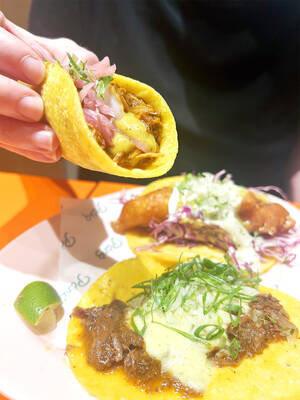
This year’s Michelin Gourmand Bib sported 16 new entries in the 126-strong Taiwan directory. The fight for the best braised pork rice and the crispiest scallion pancake painstakingly continued, but what stood out in the lineup this year? Pang Taqueria (胖塔可利亞); Taiwan’s first Michelin-recommended Mexican restaurant. Chef Charles Chen (陳治宇) is a self-confessed Americophile, earning his chef whites at a fine-dining Latin-American fusion restaurant. But what makes this Xinyi (信義) spot stand head and shoulders above Taipei’s existing Mexican offerings? The authenticity. The produce. The care. AUTHENTIC EATS In my time on the island, I have caved too many times to

In the aftermath of the 2020 general elections the Chinese Nationalist Party (KMT) was demoralized. The Democratic Progressive Party (DPP) had crushed them in a second landslide in a row, with their presidential candidate Tsai Ing-wen (蔡英文) winning more votes than any in Taiwan’s history. The KMT did pick up three legislative seats, but the DPP retained an outright majority. To take responsibility for that catastrophic loss, as is customary, party chairman Wu Den-yih (吳敦義) resigned. This would mark the end of an era of how the party operated and the beginning of a new effort at reform, first under


 RSS
RSS