


Sol LeWitt, whose deceptively simple geometric sculptures and drawings and ecstatically colored and jazzy wall paintings established him as a lodestar of modern American art, died Sunday in New York. He was 78 and lived mostly in Chester, Connecticut.
LeWitt helped establish Conceptualism and Minimalism as dominant movements of the postwar era. A patron and friend of colleagues young and old, he was the opposite of the artist as celebrity. He tried to suppress all interest in him as opposed to his work; he turned down awards and was camera-shy and reluctant to grant interviews. He particularly disliked the prospect of having his photograph in the newspaper.
Typically, a 1980 work called Autobiography consisted of more than 1,000 photographs he took of every nook and cranny of his Manhattan loft, down to the plumbing fixtures, wall sockets and empty marmalade jars, and documented everything that had happened to him in the course of taking the pictures. But he appeared in only one photograph, which was so small and out of focus that it is nearly impossible to make him out.
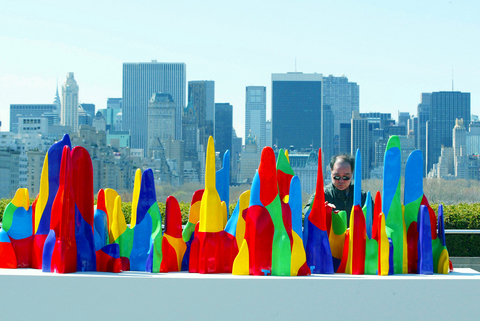
PHOTO: NY TIMES NEWS SERVICE
His work — sculptures of white cubes, or drawings of geometric patterns, or splashes of paint like Rorschach patterns — tested a viewer's psychological and visual flexibility. See a line. See that it can be straight, thin, broken, curved, soft, angled or thick. Enjoy the differences. The test was not hard to pass if your eyes and mind were open, which was the message of LeWitt's art.
He reduced art to a few of the most basic shapes (quadrilaterals, spheres, triangles), colors (red, yellow, blue, black) and types of lines, and organized them by guidelines he felt in the end free to bend.
Much of what he devised came down to specific ideas or instructions: a thought you were meant to contemplate, or plans for drawings or actions that could be carried out by you, or not.
Sometimes these plans derived from a logical system, like a game; sometimes they defied logic so that the results could not be foreseen, with instructions intentionally vague to allow for interpretation.
Characteristically, he would then credit assistants or others with the results.
With his wall drawing, mural-sized works that sometimes took teams of people weeks to execute, he might decide whether a line for which he had given the instruction "not straight" was sufficiently irregular without becoming wavy (and like many more traditional artists, he became more concerned in later years that his works look just the way he wished). But he always gave his team wiggle room, believing that the input of others — their joy, boredom, frustration or whatever — remained part of the art.
In so doing, LeWitt gently reminded everybody that architects are called artists — good architects, anyway — even though they don't lay their own bricks, just as composers write music that other people play but are still musical artists. LeWitt, by his methods, permitted other people to participate in the creative process, to become artists themselves.
To grasp his work could require a little effort. His early sculptures were chaste white cubes and gray cement blocks. For years people associated him with them, and they seemed to encapsulate a remark he once made: that what art looks like "isn't too important." This was never exactly his point. But his early drawings on paper could resemble mathematical diagrams or chemical charts. What passed for humor in his art tended to be dry. Buried Cube Containing an Object of Importance but Little Value (1968), an object he buried in the garden of Dutch collectors, was his deadpan gag about waving goodbye to Minimalism. He documented it in photographs, in one of which he stands at attention beside the cube. A second picture shows the shovel; a third, him digging the hole.
Naturally, he was regularly savaged by conservative critics.
By the early 1980s, he moved from Manhattan to Spoleto, Italy, seeking to get away from the maelstrom of the New York art world. (He had had a retrospective at the Museum of Modern Art in 1978.) His art underwent a transformation. Partly it grew out of what he saw in Italy. But it was all the more remarkable for also proceeding logically from the earlier work.
Eye-candy opulence emerged from the same seemingly prosaic instructions he had come up with years before. A retrospective in 2000, organized by the San Francisco Museum of Modern Art, which traveled to the Whitney Museum of American Art in New York and the Museum of Contemporary Art in Chicago, concluded with some of these newly colorful wall drawings. (LeWitt always called them drawings, even when the medium became acrylic paint.)
His description for a wall drawing, No. 766 — "Twenty-one isometric cubes of varying sizes each with color ink washes superimposed" — sounded dry as could be: but then you saw it and there were playful geometries in dusky colors nodding toward Renaissance fresco painting. Loopy Doopy (Red and Purple), a vinyl abstraction 15m long, was like a psychedelic Matisse cutout, but on the scale of a drive-in movie. Other drawings consisted of gossamer lines, barely visible, as subtle as faintly etched glass.
Some people who had presumed that LeWitt's Conceptualism was arcane and inert were taken aback. He began making colored flagstone patterns, spiky sculptural blobs and ribbons of color, like streamers on New Year's Eve, often as enormous decorations for buildings around the world. It was as if he had devised a latter-day kind of Abstract Expressionism, to which, looking back, his early Conceptualism had in fact been his response.
Sol LeWitt was born in Hartford, Connecticut, on Sept. 9 1928, the son of immigrants from Russia. His father, a doctor, died when he was six, after which he moved with his mother, a nurse, to live with an aunt in New Britain, Connecticut. His mother took him to art classes at the Wadsworth Atheneum in Hartford. He would draw on wrapping paper from his aunt's supply store.
He took a job at the book counter at the Museum of Modern Art, where he met other young artists with odd jobs there, including Dan Flavin, Robert Ryman and Robert Mangold. He noticed the nascent works of Flavin and also absorbed early art by Jasper Johns and Frank Stella.
Minimalism, a yet-unnamed movement, seemed like a fresh start. He decided to reduce art to its essentials, "to recreate art, to start from square one," he said, beginning literally with squares and cubes. But unlike some strict Minimalists, LeWitt was not interested in industrial materials. He was focused on systems and concepts — volume, transparency, sequences, variations, stasis, irregularity and so on — which he expressed in words that might or might not be translated into actual sculptures or photographs or drawings.
To him, ideas were what counted.
"Conceptual art is not necessarily logical," he wrote in an article in Artforum magazine in 1967. "The ideas need not be complex. Most ideas that are successful are ludicrously simple. Successful ideas generally have the appearance of simplicity because they seem inevitable."
To the extent that LeWitt's work existed in another person's mind, he regarded it as collaborative.
LeWitt, 78, died in New York on Sunday from complications of cancer.

Sept.16 to Sept. 22 The “anti-communist train” with then-president Chiang Kai-shek’s (蔣介石) face plastered on the engine puffed along the “sugar railway” (糖業鐵路) in May 1955, drawing enthusiastic crowds at 103 stops covering nearly 1,200km. An estimated 1.58 million spectators were treated to propaganda films, plays and received free sugar products. By this time, the state-run Taiwan Sugar Corporation (台糖, Taisugar) had managed to connect the previously separate east-west lines established by Japanese-era sugar factories, allowing the anti-communist train to travel easily from Taichung to Pingtung’s Donggang Township (東港). Last Sunday’s feature (Taiwan in Time: The sugar express) covered the inauguration of the

The corruption cases surrounding former Taipei Mayor and Taiwan People’s Party (TPP) head Ko Wen-je (柯文哲) are just one item in the endless cycle of noise and fuss obscuring Taiwan’s deep and urgent structural and social problems. Even the case itself, as James Baron observed in an excellent piece at the Diplomat last week, is only one manifestation of the greater problem of deep-rooted corruption in land development. Last week the government announced a program to permit 25,000 foreign university students, primarily from the Philippines, Indonesia and Malaysia, to work in Taiwan after graduation for 2-4 years. That number is a
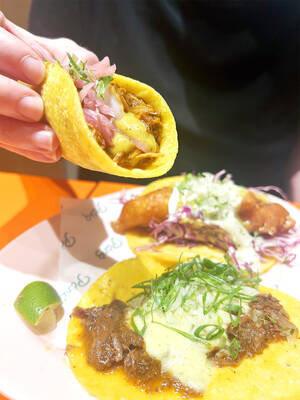
This year’s Michelin Gourmand Bib sported 16 new entries in the 126-strong Taiwan directory. The fight for the best braised pork rice and the crispiest scallion pancake painstakingly continued, but what stood out in the lineup this year? Pang Taqueria (胖塔可利亞); Taiwan’s first Michelin-recommended Mexican restaurant. Chef Charles Chen (陳治宇) is a self-confessed Americophile, earning his chef whites at a fine-dining Latin-American fusion restaurant. But what makes this Xinyi (信義) spot stand head and shoulders above Taipei’s existing Mexican offerings? The authenticity. The produce. The care. AUTHENTIC EATS In my time on the island, I have caved too many times to

In a stark demonstration of how award-winning breakthroughs can come from the most unlikely directions, researchers have won an Ig Nobel prize for discovering that mammals can breathe through their anuses. After a series of tests on mice, rats and pigs, Japanese scientists found the animals absorb oxygen delivered through the rectum, work that underpins a clinical trial to see whether the procedure can treat respiratory failure. The team is among 10 recognized in this year’s Ig Nobel awards (see below for more), the irreverent accolades given for achievements that “first make people laugh, and then make them think.” They are not


 RSS
RSS