


For more than 2,000 years, the Chinese have turned soybeans into tofu, a staple of the country's diet.
But as its economy grows, so does China's appetite for pork, poultry and beef, which require higher volumes of soybeans as animal feed. Plagued by scarce water supplies, China is turning to a new trading partner 24,140km away — Brazil — to supply more protein-packed beans essential to a richer diet.
China's global scramble for natural resources is leading to a transformation of agricultural trading around the world. Vanishing cropland and diminishing water supplies are hampering China's ability to feed itself, and the increasing use of farmland in the US to produce biofuels like ethanol is pushing China to seek more of its agricultural staples from South America, where land is still cheap and plentiful.
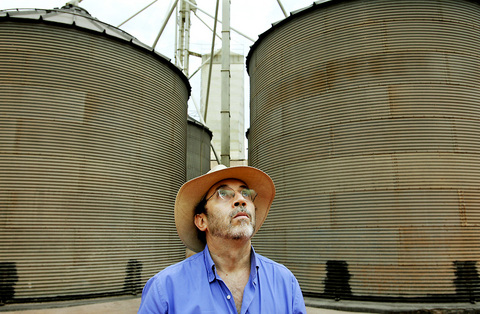
PHOTOS: NY TIMES NEWS SERVICE
"China is out there beating the bushes," said Robert Thompson, a professor at the University of Illinois who is a former director of agricultural and rural development at the World Bank. The goal, he said, is "to ensure they have access to long-term contracts for minerals and energy and food."
Once, the biggest bilateral food trade flowed between the US, the world's largest food exporter, and Japan. But countries with vast arable land available for expansion, particularly Brazil, are now racing to meet demand in China, whose population of 1.3 billion is 10 times larger than Japan's.
Farmers in the US have started planting far more corn for ethanol to the exclusion of other crops, including soybeans. But American farmers are not giving up their leading role in the grain trade easily, remembering how the US grain embargo by then-President Richard Nixon in the early 1970s helped spawn Brazil's soybean industry in the first place.
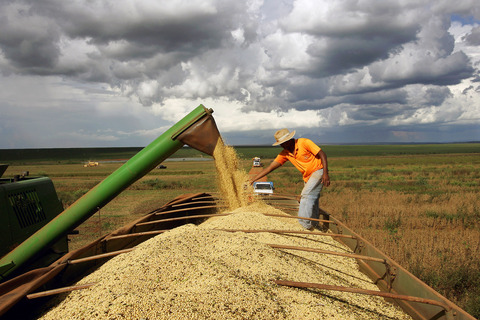
With a far superior system for transporting crops to global markets, American farmers still enjoy many advantages over their new competitors from Brazil and elsewhere in the developing world. Infrastructure and financing constraints in Brazil will keep the competition to feed China in flux for years to come.
The longer-term trends are emerging now. At the heart of the shift is the global competition for land to grow crops. Brazil, which currently farms about 70.8 million hectares, has room to double its available cropland to equal the scale of the US, analysts say, even without clearing any more of the Amazon rainforest.
"All of a sudden you have a global market for land, a competition between several different products for the same amount of land," said Sergio Barroso, president of the Brazil operations of Cargill, the biggest grain trader in the world. Brazil's soybean industry is losing hectares to sugar cane for ethanol production in some areas, he said, and is competing with corn, cotton and cattle.
"If you put it all together between feed and food," Barroso said, "it is going to be a tremendous challenge."
Expectations ran high three years ago when Hu Jintao, the president of China, visited South America and toasted a "strategic partnership" with his Brazilian counterpart, Luiz Inacio Lula da Silva, predicting trade between the two countries would double to US$20 billion. China pledged US$10 billion in investments, mostly in infrastructure.
To some extent, Brazilians have been disappointed in the follow-up. The Chinese have struggled with red tape in Brazil and hesitated while waiting for Brazilian rules to activate public-private investments. "Very little has happened," said Pedro de Camargo Neto, a former official in the Agriculture Ministry in Brazil who is now an agribusiness consultant.
But China has continued its buying spree in Brazil. The soybean trade between the countries has exploded. Last year Brazil sent nearly 11 million tonnes of beans to China, a 50 percent increase from the previous year and nearly double the amount shipped in 2004. Early indications are that Brazil has produced yet another record crop and analysts expect that China will devour most of the increase.
While the US remains the largest producer of soybeans, last year Brazil became the biggest exporter. This year the US will regain the crown, but soybean exports from the US are expected to fall by 23 percent by the 2009-2010 crop year, according to the Agriculture Department.
For all the gains here, though, the surge in exports to China has created a sense of unease among many in Brazilian agriculture, who worry the growing relationship will accelerate a development model in which Brazil is too reliant on sales of raw materials rather than higher-value products. And after long enjoying a trade surplus with China, Brazil's trade with China slipped into deficit in the most recent quarter as China stepped up its shipments of manufactured goods.
The challenge of supplying China is already showing signs of strain. A soybean boom turned to a bust the last two years for many farmers here in Mato Grosso, a state in western Brazil the size of Texas and Kansas that produces more than a third of the country's beans.
Near Rondonopolis, Rogerio Salles watched recently as a handful of combines harvested the last soybeans on his 7,081-hectare farm ringed by eucalyptus and rubber trees. "Just because we're producing a lot of beans here doesn't mean we're making money," he said.
The strong Brazilian currency and a bottlenecked transport system are conspiring against many Mato Grosso farmers. Most of the beans are trucked south more than 16,100km along two-lane highways chock full of potholes. At the main export ports, some ships wait at sea up to a month before finding docking space to load the beans.
"If major investments are not made in transport infrastructure, China cannot count on this region being a stable supplier to its market," Salles said. "There's a lot riding on this."
Moving soybeans from Mato Grosso to ports in Brazil costs more than four times what US farmers spend to transport beans from the Midwest to New Orleans and the Pacific Northwest. As a result, Brazilian farms receive far less for their crops than their American counterparts.
Brazil's agricultural sector has been dominated by large investors who bought huge tracts of land at cheap prices, and by multinational grain traders — like Minneapolis-based Cargill and Archer Daniels Midland, based in Decatur, Illinois — that have built storage, provided financing and lined up the overseas buyers.
Through his Maggi Group, Blairo Maggi, the governor of Mato Grosso, is the largest soybean grower in the world, and a major financier, with 161,874 hectares of his own under production.
"It has been all about a land grab in Brazil," said Daniel Basse, president of AgResource, an agricultural research consultancy.
For the farmers in Mato Grosso, prosperity has been hard to come by lately. Growers in the state amassed US$14.5 billion in debt the last two years. Farmers say they can no longer afford storage space, forcing them to sell their crops as soon as they are harvested, rather than wait for higher prices.
"You do all the work, you plant the right crops," Salles, the local farmer, said. "But even when you do everything right, you still lose."
The growers' desperation has allowed the major grain traders to tighten their grip. Brazilian farmers say they are paying up to 25 percent more for material like fertilizers provided by the traders, which are paid back with the crop. "We are becoming slaves of the big trading companies," said Ricardo Tomczyk, another farmer in Rondonopolis.
Jose Luiz Glaser, the general manager for grains and oilseeds at Cargill Brazil, said Cargill stopped financing several farmers in Mato Grosso last year after they failed to pay their bills.
Such orphaned farmers could soon find new Chinese benefactors, who are looking to make inroads in the clubby world of Brazilian agriculture, said Charles Tang, president of the Brazil-China Chamber of Commerce.
Brazilian farmers say they would welcome Chinese investment. But they worry about China's growing clout as a soybean buyer. Memories are still fresh of the 2004 "red beans" incident, when China rejected several shipments of Brazilian soybeans after claiming they were contaminated.
To try to counter growing Chinese influence, Brazilian producers are working with American growers to diversify their buyers. American soybean producers organized a joint trade mission with Mato Grosso farmers in December to India, another huge potential growth market.
The Chinese want to connect directly with Brazilian farmers, bypassing the multinational grain merchants. While they have yet to make a major purchase of cropland in Brazil, they are looking to invest in improved facilities and upgrade the antiquated rail system, which has not undergone significant improvement since the 1930s.
China began looking overseas for more soybean supplies in the mid-1990s when the scope of its land and water problems became clearer. Beijing has also chosen to use more of its arable farmland to grow fruits and vegetables, crops that make better use of China's cheap labor and scarcer water supplies to generate higher returns on the export market.
In northern China, where soybeans traditionally have been grown, water tables are dropping at a rate of 91cm to 3m a year, according to Wu Aimin, a researcher with the China Groundwater Information Center in Beijing.
"It takes a thousand tonnes of water to produce one tonne of grain," said Lester Brown, president of the Earth Policy Institute, an environmental research and advocacy group. "So the most efficient way to import water is in the form of grain."

Sept.16 to Sept. 22 The “anti-communist train” with then-president Chiang Kai-shek’s (蔣介石) face plastered on the engine puffed along the “sugar railway” (糖業鐵路) in May 1955, drawing enthusiastic crowds at 103 stops covering nearly 1,200km. An estimated 1.58 million spectators were treated to propaganda films, plays and received free sugar products. By this time, the state-run Taiwan Sugar Corporation (台糖, Taisugar) had managed to connect the previously separate east-west lines established by Japanese-era sugar factories, allowing the anti-communist train to travel easily from Taichung to Pingtung’s Donggang Township (東港). Last Sunday’s feature (Taiwan in Time: The sugar express) covered the inauguration of the

The corruption cases surrounding former Taipei Mayor and Taiwan People’s Party (TPP) head Ko Wen-je (柯文哲) are just one item in the endless cycle of noise and fuss obscuring Taiwan’s deep and urgent structural and social problems. Even the case itself, as James Baron observed in an excellent piece at the Diplomat last week, is only one manifestation of the greater problem of deep-rooted corruption in land development. Last week the government announced a program to permit 25,000 foreign university students, primarily from the Philippines, Indonesia and Malaysia, to work in Taiwan after graduation for 2-4 years. That number is a
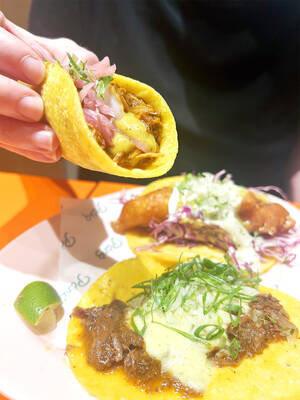
This year’s Michelin Gourmand Bib sported 16 new entries in the 126-strong Taiwan directory. The fight for the best braised pork rice and the crispiest scallion pancake painstakingly continued, but what stood out in the lineup this year? Pang Taqueria (胖塔可利亞); Taiwan’s first Michelin-recommended Mexican restaurant. Chef Charles Chen (陳治宇) is a self-confessed Americophile, earning his chef whites at a fine-dining Latin-American fusion restaurant. But what makes this Xinyi (信義) spot stand head and shoulders above Taipei’s existing Mexican offerings? The authenticity. The produce. The care. AUTHENTIC EATS In my time on the island, I have caved too many times to

In a stark demonstration of how award-winning breakthroughs can come from the most unlikely directions, researchers have won an Ig Nobel prize for discovering that mammals can breathe through their anuses. After a series of tests on mice, rats and pigs, Japanese scientists found the animals absorb oxygen delivered through the rectum, work that underpins a clinical trial to see whether the procedure can treat respiratory failure. The team is among 10 recognized in this year’s Ig Nobel awards (see below for more), the irreverent accolades given for achievements that “first make people laugh, and then make them think.” They are not


 RSS
RSS