


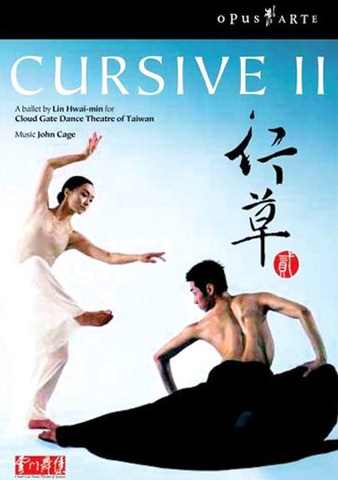
Taipei Times has already written extensively about Lin Hwai-min's (林懷民) Cursive trilogy for Cloud Gate Dance Theater. But the magnificent DVD of Cursive II contains a great deal more. In addition to the ballet itself, filmed without comment, you have remarks about the work by Lin, various dancers and TV director Ross MacGibbon. And before everything you see a long documentary, Floating on the Ground, about Lin's entire career. It's this wide-ranging film that makes this Opus Arte DVD unique, and indeed something in the nature of a major historical document.
The film begins with footage of Lin coaching members of the Zurich Ballet in his work Smoke. He was a new experience for most of them, working from the ground up rather than from the head down, as several of them remark. Then you see him in his home on the banks of the Danshui River talking about his career, plus dance and Taiwan's history.
The offspring of southern Taiwanese gentry, beginning life as a writer, founding Cloud Gate without any previous professional experience, gaining inspiration at the site of the Buddha's enlightenment at Bodhgaya in India, contemplating the harm done to Taiwan by the KMT after 1945 — Lin's testimony, spoken throughout in English, is both spiritual and political.

The shorter film specifically on Cursive II focuses mainly on John Cage's music, culled by Lin from the huge resource of his collected CDs. Dancers initially complained it lacked any tempo, but discovered that after creating their dances, and then having the music played alongside them, something bigger than either was created. MacGibbon comments that the music, hard to listen to on its own, becomes accessible when experienced alongside Lin's creations.
This DVD is an important introduction to the whole phenomenon of Lin's work, some of the most impressive in the contemporary dance world-wide. One Swiss critic comments that though he's seen good and bad work from all other choreographers, he's never seen anything except the best from Lin.
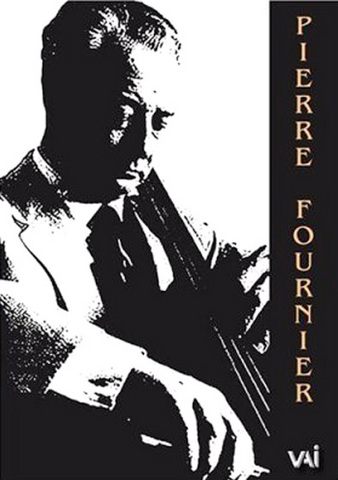
The Art of Pierre Fournier, with mono sound and filmed in black-and-white, consists of two programs made for Canadian TV in 1959 and 1960. Fournier, who died in 1986, was acclaimed in his lifetime for his smooth tone and self-effacing mastery. You appreciate these qualities immediately when watching this fine DVD — somehow all excitability vanishes from the system and Fournier's seriousness and commitment take you over.

He plays at first in a pool of light against some studio drapes, and his equilibrium, together with the serenity of Bach's Suite to Solo Cello No:3, stills all vagrant thoughts. He continues with some Kodaly, and then you see him with a pianist (Guy Bourassa) playing Schumann, Debussy and a melodic sonata by the rarely-heard 18th-century composer Francois Francoeur.
Fournier is the opposite of someone like Mischa Maisky — utterly reserved and undemonstrative, but as enduring as stone. This DVD, from the pioneering US company Video Artists International, is one to be cherished.
From the same company comes Masters of the Keyboard: The Next Generation, Volume 1. This features five young pianists who appeared at the Miami International Piano Festival in 2000 — Piotr Anderszewski, Denis Burstein, Kemal Gekic, Ilya Itin and Francesco Libetta. Each is seen briefly talking in English about what music means to him — in every case a lot — and then you watch each of them playing a couple of short items. At 53 minutes it's slightly short measure, but is nonetheless informative and engaging.
Finally, it's extraordinary what gems you can stumble on sometimes. Bellini's opera La Sonnambula [The Sleep-walker] is only available in two versions on DVD, one with Eva Mei from 2005, the other with Anna Moffo from 1956. The 2005 version is described by one amazon.com reviewer as being an "ultra-dumb production" with a "hacked up score" (there are apparently many cuts). But the old black-and-white version is amazing! Made for Italian TV, it's Moffo's first recorded performance, and despite some wooden acting here and there it has something really magical about it.
Moffo is girlishly natural as the heroine Amina. You might expect that, in that Shakespeare-worshipping era, she'd have echoes of the sleep-walking Lady Macbeth, but in fact it's Ophelia she recalls as she scatters flowers in her distress — her lover Elvion thinks she's unfaithful because she's wandered while unconscious into another man's bedroom.
In some ways, though, it's the baritone Plinio Clabassi who steals the show as Rodolfo, the long-lost lord-of-the-manor. Watch the track early on where he arrives back home and begins to recognize the landmarks — Vi ravviso, o luoghi ameni [I see you again, lovely places], one of Bellini's most heart-breaking melodies. Clabassi is very restrained, as if singing to himself, and behind him a mill-wheel endlessly turns — all our lives unstoppably running out. Two boys pass and nod to him just as he's remembering his own youth, now lost beyond recovery. And, in the corner of the frame, a worker takes his cap off, as if suddenly recognizing the returning lord.
It's a breath-taking sequence. The sound is surprisingly clear and even full, and Bellini fans — which in a perfect world would include everyone — should make sure they get hold of this fine historic recording.

Sept.16 to Sept. 22 The “anti-communist train” with then-president Chiang Kai-shek’s (蔣介石) face plastered on the engine puffed along the “sugar railway” (糖業鐵路) in May 1955, drawing enthusiastic crowds at 103 stops covering nearly 1,200km. An estimated 1.58 million spectators were treated to propaganda films, plays and received free sugar products. By this time, the state-run Taiwan Sugar Corporation (台糖, Taisugar) had managed to connect the previously separate east-west lines established by Japanese-era sugar factories, allowing the anti-communist train to travel easily from Taichung to Pingtung’s Donggang Township (東港). Last Sunday’s feature (Taiwan in Time: The sugar express) covered the inauguration of the

The corruption cases surrounding former Taipei Mayor and Taiwan People’s Party (TPP) head Ko Wen-je (柯文哲) are just one item in the endless cycle of noise and fuss obscuring Taiwan’s deep and urgent structural and social problems. Even the case itself, as James Baron observed in an excellent piece at the Diplomat last week, is only one manifestation of the greater problem of deep-rooted corruption in land development. Last week the government announced a program to permit 25,000 foreign university students, primarily from the Philippines, Indonesia and Malaysia, to work in Taiwan after graduation for 2-4 years. That number is a

This year’s Michelin Gourmand Bib sported 16 new entries in the 126-strong Taiwan directory. The fight for the best braised pork rice and the crispiest scallion pancake painstakingly continued, but what stood out in the lineup this year? Pang Taqueria (胖塔可利亞); Taiwan’s first Michelin-recommended Mexican restaurant. Chef Charles Chen (陳治宇) is a self-confessed Americophile, earning his chef whites at a fine-dining Latin-American fusion restaurant. But what makes this Xinyi (信義) spot stand head and shoulders above Taipei’s existing Mexican offerings? The authenticity. The produce. The care. AUTHENTIC EATS In my time on the island, I have caved too many times to

In a stark demonstration of how award-winning breakthroughs can come from the most unlikely directions, researchers have won an Ig Nobel prize for discovering that mammals can breathe through their anuses. After a series of tests on mice, rats and pigs, Japanese scientists found the animals absorb oxygen delivered through the rectum, work that underpins a clinical trial to see whether the procedure can treat respiratory failure. The team is among 10 recognized in this year’s Ig Nobel awards (see below for more), the irreverent accolades given for achievements that “first make people laugh, and then make them think.” They are not


 RSS
RSS