


The story of how Nixon came to meet Mao in 1972 has been told by journalists, historians and many of the principals themselves. It has been memorialized in film and mythologized as opera. "Nixon to China" must be one of the most widely understood terms of art in politics and diplomacy.
In that sense, the rapprochement between the US and China makes a compelling topic for Margaret MacMillan, a Canadian historian now widely noted for writing seamless, big-picture historical narratives. In her previous work, Paris 1919: Six Months That Changed the World, she examined the negotiations that followed World War I, showing how a varied cast of outsize egos literally redrew the map of the world.
In Nixon and Mao: The Week that Changed the World, MacMillan seeks to present the frigid week in February 1972 that former US president Richard Nixon spent in China in much the same way. She retells the tale engagingly, from Mao Zedong's (毛澤東) enigmatic outbursts, to Zhou Enlai's (周恩來) seductive diplomacy, to Henry Kissinger's obsessive distrust of the State Department.
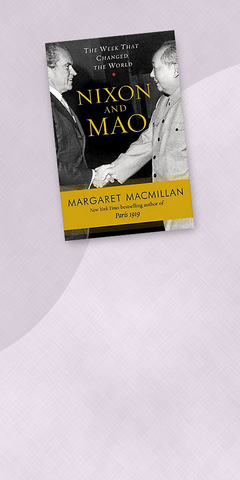
Yet the momentous event that changed the world is a common conceit for popular works of history, and it is an unsatisfying premise for examining the opening salvo of the complex and unsettled relationship between the US and China.
The re-establishment of relations was, of course, a milestone, but it was also an artifact of the Cold War. It did not alter history the way any of MacMillan's four protagonists, Nixon, Kissinger, Mao and Zhou, thought it would. MacMillan acknowledges as much, but she has the delicate task of treating her main actors as visionaries when none of them foresaw the outcome.
The US has yet to abandon Taiwan and force it to return to Chinese rule, perhaps China's most important goal in opening its door to Nixon. China did not pressure North Vietnam to make major concessions to end the Vietnam War on terms favorable to the US, one of Nixon and Kissinger's dominant concerns. Their common rival, the Soviet Union, took two decades to collapse.
One event that arguably did more to change the world came a few years later, after Mao and Zhou had died, Nixon had resigned in disgrace, and Kissinger no longer had a patron in the White House. That was when Deng Xiaoping (鄧小平) abandoned Maoist policies in both domestic and foreign relations and overhauled China's economy. Today China and America are no longer cards for each other to play. They have become giants warily circling each other in what could be the decisive contest of the 21st century.
In describing Kissinger's intensive negotiations over the wording of the Shanghai Communique during Nixon's visit, MacMillan reports that he urged his Chinese hosts not to waste time discussing trade. "The maximum amount of bilateral trade possible between us, even if we make great efforts, is infinitesimal in terms of our total economy," Kissinger said. MacMillan, with characteristic understatement, calls these "interesting predictions." In 2006 China's trade surplus with the US exceeded US$230 billion.
Yet it is clear that MacMillan did not write the book for the weighty reasons she claims. She wrote it because it is a gripping, old-fashioned drama from the "great men" school of history. It has larger-than-life characters whose motivations ranged from the sordid to the profound. They staked their reputations on bridging the chasm between the world's richest country and its most populous one at a time when far more modest strategic realignments seemed likely to upset the Cold War balance of power.
MacMillan explores the tectonic shift in the thinking of both top leaders that made the overture possible, then follows the intrigue of their tentative probes, through Poland, France and Pakistan, to open negotiations.
Mao, at the time still championing the Cultural Revolution that was tearing his country apart, determined that he liked dealing with "rightists" like Nixon. Nixon, whose red-baiting anti-communism carried him to the highest office in the land, fawned before Mao when invited to meet the chairman in his study.
Both men, perhaps especially Nixon, were self-conscious about making a grand historical gesture. But they acted out of weakness. Nixon could find no face-saving solution to the Vietnam War. Mao's boundless paranoia had focused on his chosen successor, Lin Biao (林彪), even as his own health deteriorated sharply. Both sides worried deeply about the Soviet Union.
MacMillan makes skillful use of the trove of archival information that has recently become public, mining it for detail that gives her narrative fullness and subtlety.
Nixon's presidential advance team left behind a Xerox machine when the Americans realized that the Chinese had to copy every diplomatic document manually. The Chinese insisted on having their own pilots fly Air Force One over Chinese territory, but they did not know how to use the advanced navigation system on the Boeing 707.
The theme that comes through most clearly is the mendacity and pettiness of the Nixon White House. Nixon and Kissinger schemed to exclude their own State Department from any significant role and competed with each other to get credit with the news media.
Kissinger, in a gesture that now seems recklessly generous, passed along to the Chinese reams of top-secret intelligence on the Soviet Union and India. That, and the fact that Nixon went to China without any assurance that Mao would meet him, signaled clearly that the Americans came as supplicants.
MacMillan presents much of this information unvarnished and remains aloof from the raging debate over the conspiratorial style of Nixon and Kissinger. About Face, by Jim Mann, and A Great Wall, by Patrick Tyler, a former Beijing bureau chief of the New York Times, offered more polemical versions of the same events. William Burr also analyzed much of the material in The Kissinger Transcripts.
MacMillan's dispassionate approach does not challenge the historical record. She also does not fulfill her own promise of showing how the world was forever altered. But Nixon's meeting with Mao was undeniably a shock, and MacMillan has written an electrifying account.

Sept.16 to Sept. 22 The “anti-communist train” with then-president Chiang Kai-shek’s (蔣介石) face plastered on the engine puffed along the “sugar railway” (糖業鐵路) in May 1955, drawing enthusiastic crowds at 103 stops covering nearly 1,200km. An estimated 1.58 million spectators were treated to propaganda films, plays and received free sugar products. By this time, the state-run Taiwan Sugar Corporation (台糖, Taisugar) had managed to connect the previously separate east-west lines established by Japanese-era sugar factories, allowing the anti-communist train to travel easily from Taichung to Pingtung’s Donggang Township (東港). Last Sunday’s feature (Taiwan in Time: The sugar express) covered the inauguration of the

The corruption cases surrounding former Taipei Mayor and Taiwan People’s Party (TPP) head Ko Wen-je (柯文哲) are just one item in the endless cycle of noise and fuss obscuring Taiwan’s deep and urgent structural and social problems. Even the case itself, as James Baron observed in an excellent piece at the Diplomat last week, is only one manifestation of the greater problem of deep-rooted corruption in land development. Last week the government announced a program to permit 25,000 foreign university students, primarily from the Philippines, Indonesia and Malaysia, to work in Taiwan after graduation for 2-4 years. That number is a
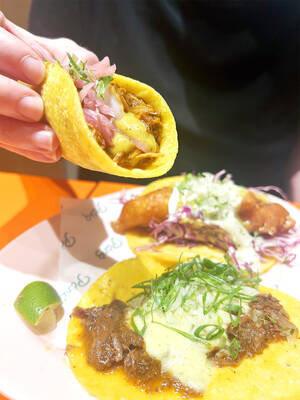
This year’s Michelin Gourmand Bib sported 16 new entries in the 126-strong Taiwan directory. The fight for the best braised pork rice and the crispiest scallion pancake painstakingly continued, but what stood out in the lineup this year? Pang Taqueria (胖塔可利亞); Taiwan’s first Michelin-recommended Mexican restaurant. Chef Charles Chen (陳治宇) is a self-confessed Americophile, earning his chef whites at a fine-dining Latin-American fusion restaurant. But what makes this Xinyi (信義) spot stand head and shoulders above Taipei’s existing Mexican offerings? The authenticity. The produce. The care. AUTHENTIC EATS In my time on the island, I have caved too many times to

In a stark demonstration of how award-winning breakthroughs can come from the most unlikely directions, researchers have won an Ig Nobel prize for discovering that mammals can breathe through their anuses. After a series of tests on mice, rats and pigs, Japanese scientists found the animals absorb oxygen delivered through the rectum, work that underpins a clinical trial to see whether the procedure can treat respiratory failure. The team is among 10 recognized in this year’s Ig Nobel awards (see below for more), the irreverent accolades given for achievements that “first make people laugh, and then make them think.” They are not


 RSS
RSS