


Akram Khan is no stranger to Taipei, or the capital's dance lovers. He's performed here twice as part of the Novel Hall Dance series. But his most recent visit was different he said, because he was seeing the country through the eyes of its own dancers.
Khan is fascinating to talk to because he's fascinated by almost everything. Fascinated is a word he uses over and over again when talking about his life, his work and his process of creation. He's intensely interested in other people, in how the human body works, in art, life and death; obsessed even, with finding out not just what is on the surface, but what's behind, what's underneath, what's kept in the dark.
As the noted dancer-choreographer talked, quickly and quietly, both at the Cloud Gate Dance Theater (雲門舞集) studio and at a press conference at the National Theater, the quicksilver sharpness of his mind and his innate inquisitiveness shone through.

PHOTOS COURTESY OF CLOUD GATE DANCE THEATER
Listening to him, it's not hard to understand why this London-born dancer/choreographer became the "boy wonder" of Europe's modern dance world in just a few short years; it's how he did so that takes some time coming to grips with.
He's clearly on the fast track. He's only 33 now and his travel schedule and choreographic commitments have been set for years.
He arrived to work with Cloud Gate in January. There's been enough of a gap between this year and his previous visits (in 2002 and 2004) that he's noticed the differences in Taipei. He was in Australia, Hong Kong and Japan before coming here. He returned to England early last month to get ready for shows in Paris and Vienna. He's in Hong Kong this weekend to perform with famed French prima ballerina Sylvie Guillem in his piece Sacred Monsters and then in Seoul next week for several performances before coming back to Taipei and more work ahead of the premiere of his latest work Lost Shadows by the Cloud Gate Dance Theater.
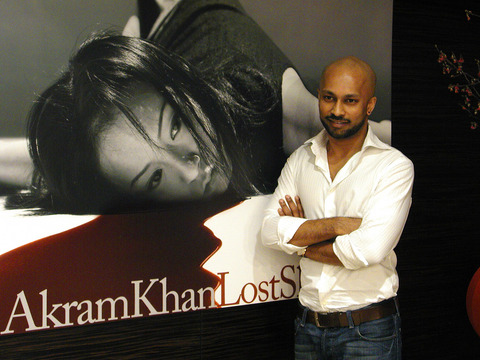
How did the son of Bangladeshi immigrants, grandson of a famous Indian mathematician-scientist, someone trained in classical Indian Kathak dance since childhood, go from a traditional dance background to starting his own contemporary dance company, to being awarded a MBE (Member of the British Empire) for his services to dance in 2005 — at age 31?
Khan frequently refers to the influence of both his immediate family and his community — the Bengali/Bangladeshi/Indian/expatriate/Moslem community, both in England and in Bangladesh.
Family, in the form of his mother, an aspiring dancer herself who could never perform in public because of her religion, who started teaching him folk dances when he was three and enrolled him with the famed Kathak teacher Sri Pratap Pawer when he was seven.

"Her passion [for dance] she wanted to pass on. Wanted to pass on [our] cultural roots," he said.
Family, in the form of his grandfather, whose influence was so strong on the young Khan, that not only was he sure he would also become a mathematician, but he saw the world in terms of numbers.
"When I was a child, I saw things in terms of mathematics — because I was rather isolated because the other boys were into academics, I wasn't, … I codified every human being around me," he said.
Luckily for the dance world, though, reality intruded on his dream of being a mathematician. In high school he failed his maths exam, and had to think of something else to do. But there was strong pressure from his community to follow an academic path, to be a "professional," to go to university. He did eventually go to university, but for an unconventional degree in dance.
Even though he had been dancing for most of his life, it wasn't as natural a choice as one might think. For a start, it hadn't always been the artistic side of dance that had kept him going to classes.
"I was the only boy amongst 20 girls, so why would I not want to do this? It wasn't because I was very good," he said with a big grin.
He's very modest. He was good enough by age 13 to take time out from school to perform with the Royal Shakespeare Company in Sir Peter Hall's The Mahabharata, for two years.
"At 18, when I realized I couldn't do anything else, I wasn't really good at anything else, I became more spiritual about it [dance], became more intense. The community was very tough on me," he said.
"Up to 18, I hadn't really taken it seriously although I trained every day. I decided to go into it deeply, to understand [it]. To embrace Indian dance, you have to embrace religion," he said.
He gave his first solo Kathak recital in London in 1992 and in 1994 he received a senior diploma from the Dance Board of India. Then he went off to university, first to De Montfort University in Leicester, England. There he was exposed to a whole new world of dance.
"I watched Pina Bausch, DV8 and felt completely lost. But that was when I first realized that this was what I wanted," He said.
After two years, he transferred to the Northern School of Contemporary Dance in Leeds to finish his bachelor's degree. He studied classical ballet, Graham, Cunningham and Alexander techniques and physical theater. After graduation, he choreographed and danced in several solo and duet works in London before getting a scholarship to study at Anne Teresa de Keermaeker's P.A.R.T.S. school in Brussels for six months.
But even while pursuing his interest in contemporary dance, he continued to perform Kathak recitals.
In 2000 he formed his company, with Farooq Chaudhry as producer. His first work, Rush was a critical success, and Khan quickly became an in-demand choreographer. But he is quick to credit Chaudhry for a lot of the success.
"It's a partner work, a vision of both of us together — he's an 'artistic' producer with the vision for the company; I create the work," Khan said.
His style was labeled "Contemporary Kathak," but Khan doesn't like to have his work labeled, or classified as a mix or blend of East and West. He describes it as "confusion rather than fusion."
"Initially it was the pattern that mattered. Now it's the space in between … between A and B," he said.
"Dance for me is a form of movement — it's in everything, in everything you do — the way you write, the way you sing," he said. "As a Kathak dancer I was trained as a dancer, actor and musician, because I wear bells [when dancing] to create music — it's not separated the way it is in the West."
Khan still has his company, but it doesn't have any dancers right now. He wanted to be free to create as the opportunity presented itself, rather than locked into something he had to do. Such as choreograph a section of pop star Kylie Minogue's Showgirl concert tour last summer.
"I don't want to feel imprisoned, don't want to be the father of 15 dancers — I want to be water rather than stone," he said.
"More and more I don't like to be pushed; if I want to do it … I want to.
When I hit 30 — not too long ago — the body is saying something, either you give up or you go deeper," he said.
One thing he wanted to do was work with Cloud Gate. Cloud Gate founder and artistic director Lin Hwai-min (林懷民) first invited him in 2002, after he had seen Khan's Kaash. It's just taken him five years to get here, because of scheduling demands. He said seeing the company perform Cursive III in Berlin really inspired him.
"I've been invited by several different European companies [to choreograph for them] but I declined. There was a profound connection with my own philosophy behind the company. Cloud Gate has a strongly rooted tradition, it is constantly changing [that tradition] and coming back to it," he said.
He began his work with the company by giving the 12 dancers (all women, no surprise there) two key words — death and crash — and asked them how they related to those words.
"I'm looking for universal stories, personal and universal … I'm interested in twisting a character to see the other side," Khan said.
Akram Khan will be talking more about his work next Saturday afternoon, at a forum with Lin, sponsored by Cloud Gate and the British Council, at the Gis Convention Center at National Taiwan University. The forum is open to the public, and advanced reservations can be made by registering online (www.cloudgate.org.tw/event/2007/forum) or by calling the company at (02) 2712-2102.
Taipei audiences will also have the chance to see Khan the dancer this fall, when he performs with Sidi Larbi Cherkaoui, as part of the Novel Hall Dance Series, from Sept. 21 to Sept. 23.
In the meantime, there's just three and a half weeks left to wait to see what Khan and the Cloud Gate dancers have been up to.

Sept.16 to Sept. 22 The “anti-communist train” with then-president Chiang Kai-shek’s (蔣介石) face plastered on the engine puffed along the “sugar railway” (糖業鐵路) in May 1955, drawing enthusiastic crowds at 103 stops covering nearly 1,200km. An estimated 1.58 million spectators were treated to propaganda films, plays and received free sugar products. By this time, the state-run Taiwan Sugar Corporation (台糖, Taisugar) had managed to connect the previously separate east-west lines established by Japanese-era sugar factories, allowing the anti-communist train to travel easily from Taichung to Pingtung’s Donggang Township (東港). Last Sunday’s feature (Taiwan in Time: The sugar express) covered the inauguration of the

The corruption cases surrounding former Taipei Mayor and Taiwan People’s Party (TPP) head Ko Wen-je (柯文哲) are just one item in the endless cycle of noise and fuss obscuring Taiwan’s deep and urgent structural and social problems. Even the case itself, as James Baron observed in an excellent piece at the Diplomat last week, is only one manifestation of the greater problem of deep-rooted corruption in land development. Last week the government announced a program to permit 25,000 foreign university students, primarily from the Philippines, Indonesia and Malaysia, to work in Taiwan after graduation for 2-4 years. That number is a

This year’s Michelin Gourmand Bib sported 16 new entries in the 126-strong Taiwan directory. The fight for the best braised pork rice and the crispiest scallion pancake painstakingly continued, but what stood out in the lineup this year? Pang Taqueria (胖塔可利亞); Taiwan’s first Michelin-recommended Mexican restaurant. Chef Charles Chen (陳治宇) is a self-confessed Americophile, earning his chef whites at a fine-dining Latin-American fusion restaurant. But what makes this Xinyi (信義) spot stand head and shoulders above Taipei’s existing Mexican offerings? The authenticity. The produce. The care. AUTHENTIC EATS In my time on the island, I have caved too many times to

In a stark demonstration of how award-winning breakthroughs can come from the most unlikely directions, researchers have won an Ig Nobel prize for discovering that mammals can breathe through their anuses. After a series of tests on mice, rats and pigs, Japanese scientists found the animals absorb oxygen delivered through the rectum, work that underpins a clinical trial to see whether the procedure can treat respiratory failure. The team is among 10 recognized in this year’s Ig Nobel awards (see below for more), the irreverent accolades given for achievements that “first make people laugh, and then make them think.” They are not


 RSS
RSS