


Traveling in modern Vietnam, you quite often meet Americans who fought in the Vietnam War. Two separate couples I encountered last year were there to visit children they had adopted and whose education they were paying for. This was clearly something in the way of a guilt offering, attempting to alleviate a sense of wrong-doing that the Catholic Church wisely attends to through the ritual of Confession.
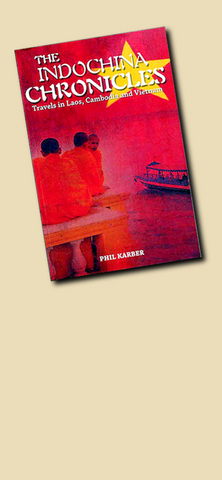
Arkansas-born writer and former businessman Phil Karber fought in the Vietnam War while still a teenager. In the late 1990s he went back, with his wife, to live in Hanoi, drawn to experience again a country first witnessed in very different circumstances. Then, in 2002, after four happy years there, he set off with an English artist friend to travel in leisurely fashion through Laos, Cambodia and Vietnam. It would be a journey, he writes, "where my memories would shape my impressions, and my own aging would be juxtaposed against an area I helped devastate."
The result makes absorbing reading. But it's not a book of soul-searching or mawkish regret. Instead, it's a mixture of stylish eloquence, bar-room tales, good-natured observations, and frank horror at what was done in the name of freedom.
The tour, not surprisingly, began and ended in Hanoi. First the two men traveled up to Kunming by train, then voyaged down the Mekong through Laos and Cambodia to the Mekong Delta. There they turned back north and traveled through Vietnam back to Hanoi overland.
Anyone who knows the region will immediately be carried back there by even Karber's most casual descriptions. Sitting on a plastic stool in a Vietnamese street at night drinking home-brewed beer (bia hoi, at some NT$20 a liter), watching the city traffic, mostly two-wheeled, negotiate intersections without the benefit of traffic lights, resisting the cries of cyclo (bicycle-rickshaw) drivers as the stars shine in the pollution-free night sky — innumerable moments in this book made me catch my breath in sadness at not being there even as I turned the pages.
Karber is probably a better writer than he knows. Of Hanoi he writes, "The traffic circle dinned as the Konika and Fuji electronic billboards flashed ads like screensavers ... Postcard boys latched onto tourists one last time before vanishing for the night ... The traffic heaved and swirled into a white blur of light, like the slow-shutter exposure of a comet." He expresses gratitude to editors for pruning an "overwritten" manuscript, but my suspicion is that itchy editorial fingers may have lost us some pearls of great price in the process.
But then Karber will characteristically relapse back into jokes about "Pancakers" (backpackers — because of their perceived fondness for banana pancakes) and "Buddha Bellies" (heavy drinkers). His English painter friend, Simon Redington, at one point remarks that the duty of an artist is to live an artist's life. Perhaps Karber should have taken to heart similar advice as applied to writers, and not spent so much time in his former business pursuits where he perhaps encountered low-caliber humor a couple of times too often.
Laos and Cambodia receive more cursory treatment than Vietnam. Luang Prabang is largely seen as a former Buddhist and royal enclave, while in Phnom Penh the pair concludes that it was "unsuitable to take one's pleasures in a city that had felt so much pain."
The book's more extended references to the Vietnam War almost all adopt a Vietnamese perspective. Remembering his days at a listening post on the Thai banks of the Mekong, Karber writes of the time "... inflicting mass carnage was known as pacification; the military invasion and occupation of another country was called liberation; and search-and-destroy really meant destroy-and-search. This reverse speak, coupled with the deceptions of the secret war, were tell-tale signs of a wider condition ... ."
A typical chapter is entitled May 5, 1968 and refers to a day of savage fighting in which a friend and fellow American resident in modern Vietnam, John Lancaster, lost the use of his lower body. Lancaster joins the duo in his wheelchair at Danang, and after a long description of the day's events 34 years before, the question arises as to whether the Vietnamese soldier who shot him survived. Lancaster, who now works for the legal rights of Vietnam's possibly 10 million disabled, replies "I feel certain he got wasted. They [marines] blasted the whole area once he showed himself. But maybe not. I hope like hell he made it."
This is not the Vietnam experienced by today's many young travelers, for whom the war is past history. To them the beaches of Mui Ne and Nha Trang, and the old cities of Hue and Hoi An, feature highest on the agenda. Such a perspective is not available to Karber, however, who has other, often very disturbing, memories.
Even so, the book is surprisingly upbeat in tone. It ends with an excursion on Russian "Minsk" motorbikes (much in evidence in Vietnam's northern hills) to Pac Bo near the Chinese border where Ho Chi Minh lived in hiding for a time. It was an "Arcadian communist beachhead," Karber concludes, and his group of expatriate bikers respectfully (but also jovially) lunch there on salami, processed cheese, baguettes and a bottle of French wine.
One omission from this otherwise excellent book is any extensive account of Saigon (Ho Chi Minh City). It's common enough to hear it denigrated in comparison with Hanoi, but for me this lively metropolis on which the French lavished so much love is the nicest city in Asia. It's really surprising that Karber finds it worth only a few casual and dismissive sentences. But perhaps if you're a Hanoi resident, decrying the bigger and richer Saigon is something that's done as a nightly ritual over the deceptively potent bia hoi.

Sept.16 to Sept. 22 The “anti-communist train” with then-president Chiang Kai-shek’s (蔣介石) face plastered on the engine puffed along the “sugar railway” (糖業鐵路) in May 1955, drawing enthusiastic crowds at 103 stops covering nearly 1,200km. An estimated 1.58 million spectators were treated to propaganda films, plays and received free sugar products. By this time, the state-run Taiwan Sugar Corporation (台糖, Taisugar) had managed to connect the previously separate east-west lines established by Japanese-era sugar factories, allowing the anti-communist train to travel easily from Taichung to Pingtung’s Donggang Township (東港). Last Sunday’s feature (Taiwan in Time: The sugar express) covered the inauguration of the

The corruption cases surrounding former Taipei Mayor and Taiwan People’s Party (TPP) head Ko Wen-je (柯文哲) are just one item in the endless cycle of noise and fuss obscuring Taiwan’s deep and urgent structural and social problems. Even the case itself, as James Baron observed in an excellent piece at the Diplomat last week, is only one manifestation of the greater problem of deep-rooted corruption in land development. Last week the government announced a program to permit 25,000 foreign university students, primarily from the Philippines, Indonesia and Malaysia, to work in Taiwan after graduation for 2-4 years. That number is a
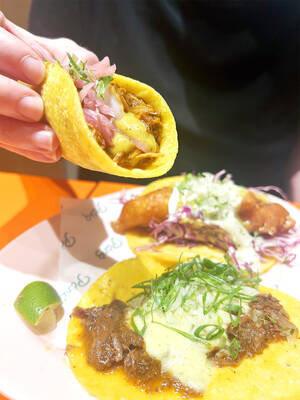
This year’s Michelin Gourmand Bib sported 16 new entries in the 126-strong Taiwan directory. The fight for the best braised pork rice and the crispiest scallion pancake painstakingly continued, but what stood out in the lineup this year? Pang Taqueria (胖塔可利亞); Taiwan’s first Michelin-recommended Mexican restaurant. Chef Charles Chen (陳治宇) is a self-confessed Americophile, earning his chef whites at a fine-dining Latin-American fusion restaurant. But what makes this Xinyi (信義) spot stand head and shoulders above Taipei’s existing Mexican offerings? The authenticity. The produce. The care. AUTHENTIC EATS In my time on the island, I have caved too many times to

In a stark demonstration of how award-winning breakthroughs can come from the most unlikely directions, researchers have won an Ig Nobel prize for discovering that mammals can breathe through their anuses. After a series of tests on mice, rats and pigs, Japanese scientists found the animals absorb oxygen delivered through the rectum, work that underpins a clinical trial to see whether the procedure can treat respiratory failure. The team is among 10 recognized in this year’s Ig Nobel awards (see below for more), the irreverent accolades given for achievements that “first make people laugh, and then make them think.” They are not


 RSS
RSS