


Lesbianism in China is the unexpected subject of this new novel, a bittersweet account of student life viewed through the eyes of a dutiful seventeen-year-old girl, Chen Ming, beginning her studies at the prestigious Guangzhou University. The same-sex love affair she experiences there, however tentatively, is presented as something that is fated to haunt her for the rest of her life.
However vigorous the movement for gay rights may be, and indeed is, in Hong Kong, February Flowers nevertheless constitutes a strong first offering from Pan MacMillan's new Picador Asia imprint, considering the widespread resistance to its topic in the Chinese world (Taiwan, of course, excepted).
At the start of the book the narrator's tone is deliberately flat. She's now working in the adult world, but clearly trying to forget something vital that happened to her in earlier life. As a result she's living a half-awake, over-formal existence. After the collapse of her marriage and taking a high-paying job as editor for a reference and textbook publisher, Chen Ming on the surface emphasizes her self-sufficiency. But she's also dissatisfied. "To me, it is just a job," expresses her jaded attitude. It's only when her thoughts turn to the loss of her youthful friend, Miao Yan, that light and excitement animate her, and the extent of her repression becomes apparent.
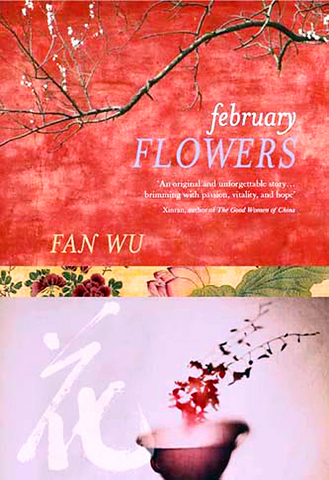
Their first meeting was banal enough. Miao Yan, a member of the Miao ethnic minority, bursts into her dormitory offering to sell Chef Kang noodles at the cut price of 50 fen a bag. More dramatically, she later appears in a bar, dancing on a table as a penalty for losing a party game. In a long-sleeved white dress, her hair pinned into a chignon at the back of her head, she looks to Chen like a goddess.
She quickly discovers that Yan's attitude to men in general is dismissive. In terms that with hindsight could be seen as encapsulating militant lesbianism in general, she tells Chen, "I can totally see through girls like you. You always dream about a handsome prince. Well, there aren't enough princes in this world, you know. Even if there were, you don't want to trust them. If you ask me, a woman's fatal weakness is to trust a man." The style may not be devastating, but you get the drift.
Thus begins Chen's ambiguous attitude to the opposite sex, and her fascination with the teasing, cajoling Miao Yan. Her burgeoning suspicion of males is further fueled by her parents and by two of her roommates, Pingping and Donghua, who view having boyfriends before the age of 18 as "dirty." When Chen reluctantly accepts Miao Yan's invitation to lunch, she has to run the gauntlet of wolf-whistles from male students watching from their dormitories. Again it's Miao Yan, not Chen, who silences them.
In what is perhaps representative local fashion — and not only in China — Chen has promised her parents not to date anyone before graduation. Even so, she dreams of love, which she typically sees as something sacred, indeed almost as a religious monument carved in stone. "I read about that kind of love in books," she says, "like the love between Catherine and Heathcliff in Wuthering Heights, which ... made me tremble with admiration and awe."
Even so, Miao Yan has dark secrets of her own. There was something between her and a math teacher at school, she tells Chen. She recalls the wet kiss he planted on her, rather incongruously leading him to go home and ask his wife for a divorce. But it also caused Miao Yan's father to beat her naked for being what he considered a whore.
"From that day on, I knew I'd never be serious with men in my whole life," Miao Yan declares. This only increases Chen's attraction. After witnessing another of her impromptu dance performances, she's totally stunned. "A strange dizziness struck me in a kind of ecstasy. I felt my blood pumping through my veins and crushing my organs. Never before in my life had I been so paralyzed by an unspeakable emotion and so incapable of expressing my thoughts."
Nevertheless, Chen finally settles for viewing Miao Yan as "a sister, as someone superior, dominant, sexy and mature." But she does everything she can to be with her, though by turns frustrated and thrilled by the intimacy they share. "I didn't know how to hold back; I just let my passion and will run their full course without worrying where I would end up," she declares.
Back in the dormitory, Chen finds herself being shown pictures of people copulating in a porn magazine by Pingping and Donghua. Her confusion is increased when she learns that sexual love between women was at that time viewed by the Chinese authorities as a form of mental illness. As a result of all this she's reluctant to act on her undeniably strong feelings for Yan Miao.
Once she turns 18 Chen longs to be a "proper woman" — which she considers means losing her virginity. Yet in the event she spends her birthday with one of Miao Yan's ex-lovers, watching him masturbate. Another relationship fails to get off the ground when her boyfriend understands how hopelessly addicted to the charismatic Miao Yan she has in fact become.
A chance encounter with a woman she meets in a bar further unsettles her, though pushing her towards acceptance of her feelings. She's seen many women like Chen, she tells her dismissively. They're timid, baffled, and simply don't have the guts.
The story concludes in the US with Chen approaching San Francisco's Golden Gate Bridge. In a classic playing out of "gay anguish" stories, she's tried repression, and is now trying to reactivate her past. She's heard that Miao Yan owns a boutique in Chinatown and finally resolves to find her. This is bizarrely seen as paralleling the tormented Heathcliff (a far from repressed figure) searching for Catherine in Wuthering Heights.
"I have plenty of time and energy to stroll every street, every block," muses Chen, "and in my mind's eye, there she is — appearing out of nowhere, just as she did when I saw her on the rooftop for the first time — examining a delicate dress with her long, thin fingers in the gentle light."
Fan Wu arrived in the US from China nine years ago and after graduation worked for Yahoo. But she wanted to get back to literature, her college major, and determined to try to write a novel in English. The happy result is a style that's engagingly animated throughout, especially when describing the details of student life. Initially, American publishers claimed the book's tone was too uncertain, but what February Flowers succeeds in being is an account of conflicting allegiances. But it also, despite the heroine's uncertainty and false starts, still manages to be by implication what those publishers perhaps wanted it to be from the beginning — a strong and intransigent lesbian coming-out story.

Taiwan’s overtaking of South Korea in GDP per capita is not a temporary anomaly, but the result of deeper structural problems in the South Korean economy says Chang Young-chul, the former CEO of Korea Asset Management Corp. Chang says that while it reflects Taiwan’s own gains, it also highlights weakening growth momentum in South Korea. As design and foundry capabilities become more important in the AI era, Seoul risks losing competitiveness if it relies too heavily on memory chips. IMF forecasts showing Taiwan widening its lead over South Korea have fueled debate in Seoul over memory chip dependence, industrial policy and

“China wants to unify with Taiwan at the lowest possible cost, and it currently believes that unification will become easier and less costly as time passes,” wrote Amanda Hsiao (蕭嫣然) and Bonnie Glaser in Foreign Affairs (“Why China Waits”) this month, describing how the People’s Republic of China (PRC) is playing the long game in its quest to seize Taiwan. This has been a favorite claim of many writers over the years, easy to argue because it is so trite. Very obviously, if the PRC isn’t attacking Taiwan, it is waiting. But for what? Hsiao and Glaser’s main point is trivial,

And so, in the wake of US President Donald Trump’s trip to the People’s Republic of China (PRC), all the experts on the Strait of Hormuz suddenly became experts on US-China-Taiwan relations. The Internet has certainly expanded human knowledge. Lots of these sudden experts made noise this week about Trump’s words after the meeting with PRC dictator Xi Jin-ping (習近平). Trump is going to sell out Taiwan! Longtime Taiwan commentator J. Michael Cole summed the situation up neatly in the Guardian: “We need to keep in mind that he has a tendency to say many things — sometimes contradicting himself within

It took 12 years and months of standing in the same mountain location for director Liang Chieh-te (梁皆得) to capture a few seconds of footage: Taiwan’s largest resident raptor locking talons with its mate and spinning through the air in a courtship ritual. With only about 1,000 left in the wild and very short flight windows, the mountain hawk-eagle remains among Taiwan’s most elusive birds. The species generally produces only one offspring per year. Using forest cameras, the film crew and research teams document the arduous process the monogamous pairs go through for the chick to hatch and grow up, weathering


 RSS
RSS