


It seems hard to believe there is anything left to say about World War II that has not already been stated and restated, chewed, digested and spat out for your consideration and that of the Oscar voters. And yet here, at age 76, is Clint Eastwood saying something new and vital about the war in his new film, and here, too, is this great, gray battleship of a man and a movie icon saying something new and urgent about the uses of war and of the men who fight. Flags of Our Fathers concerns one of the most lethal encounters on that distant battlefield, but make no mistake: this is also a work of its own politically fraught moment.
The film distills much of the material covered in James Bradley and Ron Powers's affecting book of the same title about the raising of the American flag during the battle for Iwo Jima. Bradley's father, John Bradley, nicknamed Doc and played by an effectively restrained Ryan Phillippe, was one of six men who helped plant the flag (it was the second planted that day) on the island's highest point on the fifth day of the monthlong American offensive. An Associated Press photographer, Joe Rosenthal, immortalized the moment, and American politicians seized the day, sending the three surviving flag raisers — Doc, Ira Hayes (Adam Beach, delivering heartbreak by the payload) and Rene Gagnon (Jesse Bradford) — on a hugely successful war-bond drive.
Collectively hailed as heroes from sea to shining sea, Rene embraced the spotlight, Doc settled into stoic unhappiness, while Ira, a Pima Indian shattered by Iwo Jima and its dead, sobbed and drank himself into oblivion. The efforts of Doc's adult son (Tom McCarthy) to tell his father's story years later give the film its scaffolding, but it is Beach's Ira, with his open face and vulnerability, who haunts it. Tears mixing with booze, he floods his scenes with raw emotion that serves as a rebuke to gung-ho fictions like Sands of Iwo Jima, a 1949 bad joke in which John Wayne hands an American flag to the real Ira, Doc and Rene so they can raise Old Glory once more, this time over the sands of Southern California.
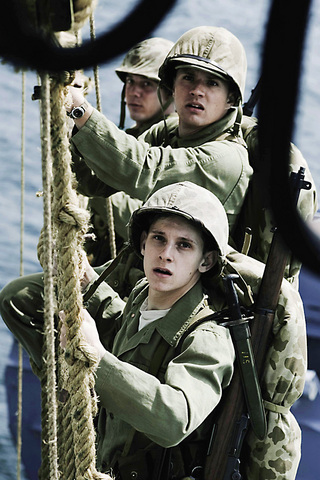
PHOTOS COURTESY OF WARNER BROS
Eastwood's cinematic deconstruction takes a considerably darker view of the historical record. The Air Force had repeatedly bombed Iwo Jima before the American landing on Feb. 19, 1945; by D-Day, barely a blade of grass survived, even as more than 20,000 Japanese soldiers remained dug in. To replicate that scorched earth, Eastwood drains much of the color from the film's already muted palette, so much so that many of the scenes on the island look as if they were shot in black and white. It seems impossible that anything living could survive long in this charred, spooky place, and it isn't long after the invasion that American bodies begin piling up amid the orange-red explosions and dull-red sprays of blood.
During these anxious moments, Eastwood characteristically keeps his sights (and ears) on the troops and the choreographed chaos of their movements; the focus remains on them, not the filmmaking. When the men hit the shore, the cameras stick close to them, moving and then, during a sudden hailstorm of bullets, running alongside the men as if similarly searching for cover. Despite the occasional bird's-eye view that underscores the staggering scale of the operation — the hundreds of boats hugging the coast, the thousands of men dotting the land — the filmmaking retains a devastating intimacy, as in a quiet shot of dead soldiers lying facedown on the beach, the water under their bodies receding as if it were blood.
The scenes on Iwo Jima are harrowing, borderline surreal, and even after Doc, Ira and Rene leave the island, they never fully escape it. During the bond drive, the pop of a camera bulb, a flash of lightning and the bang of a backfiring car engine instantly return the three to the island and its horrors, a blurring between past and present that, with seamless, ruthless efficiency, Eastwood and his longtime editor, Joel Cox, turn into a dreadful memory loop. In Bradley and Powers' book, one Iwo Jima veteran describes seeing his dead friends while sitting in class at medical school; the flashbacks, he says, were "like a movie screen wrapped around me." We see a version of that movie here, and it is terrible.
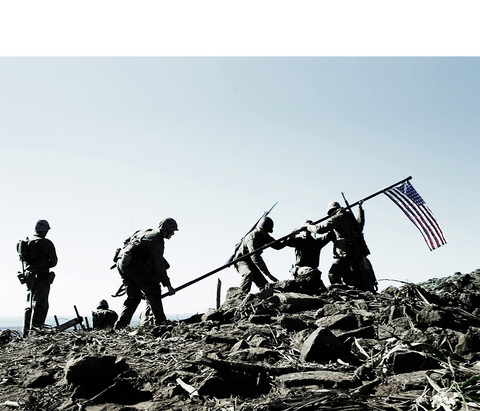
Most war movies, even those that claim to be antiwar, overtly or implicitly embrace violence as either a political or cinematic means to an end. Few filmmakers can resist the thrill of the rocket's red glare and the spectacle of death; the violence is simply too exciting. There are plenty of big bangs in Flags of Our Fathers, but because the screenplay, by William Broyles Jr. and Paul Haggis, oscillates among three separate time frames — Iwo Jima, the bond tour and, less successfully, contemporary scenes involving Doc and his son — and because the flag raisers were pulled off the field before fighting ended, the violence of their war remains at a frenzied pitch. It doesn't build, evolve, recede; it terrifies and keeps terrifying.
What do we want from war films? Entertainment, mostly, a few hours' escape to other lands and times, as well as something excitingly different, something reassuringly familiar. If Flags of Our Fathers feels so unlike most war movies and sounds so contrary to the usual political rhetoric, it is not because it affirms that war is hell, which it does with unblinking, graphic brutality. It's because Eastwood insists, with a moral certitude that is all too rare in our movies, that we extract an unspeakable cost when we ask men to kill other men. There is never any doubt in the film that the country needed to fight this war, that it was necessary; it is the horror at such necessity that defines Flags of Our Fathers, not exultation.
In this respect, the film works, among other things, as a gentle corrective to Steven Spielberg's Saving Private Ryan, with its state-of-the-art carnage and storybook neatness. (Spielberg, whose company bought the film rights to Flags of Our Fathers, is one of its producers.) Where Saving Private Ryan offers technique, Eastwood's film suggests metaphysics. Once again, he takes us into the heart of violence and into the hearts of men, seeing where they converge under a night sky as brightly lighted with explosions as any Fourth of July nocturne and in caves where some soldiers are tortured to death and others surrender to madness. He gives us men whose failings are evidence of their humanity and who are, contrary to our revolted sensitivities, no less human because they kill.
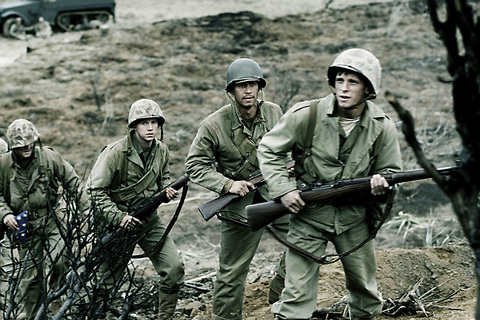
One view of Eastwood is that he has mellowed with age, or at least begun to take serious measure of the violence that has been an animating force in many of his films. In truth, the critical establishment caught up with the director, who for decades has been building a fascinating body of work that considers annihilating violence as a condition of the American character, not an aberration. Flags of Our Fathers is an imperfect addition to that body of work, though its flaws are minor and finally irrelevant in a film in which ambivalence and ambiguity are constituent of a worldview, not an aftereffect. Notably, Eastwood's next film, Letters From Iwo Jima, set to open early next year, revisits the same battle, this time from the point of view of the Japanese.

Sept.16 to Sept. 22 The “anti-communist train” with then-president Chiang Kai-shek’s (蔣介石) face plastered on the engine puffed along the “sugar railway” (糖業鐵路) in May 1955, drawing enthusiastic crowds at 103 stops covering nearly 1,200km. An estimated 1.58 million spectators were treated to propaganda films, plays and received free sugar products. By this time, the state-run Taiwan Sugar Corporation (台糖, Taisugar) had managed to connect the previously separate east-west lines established by Japanese-era sugar factories, allowing the anti-communist train to travel easily from Taichung to Pingtung’s Donggang Township (東港). Last Sunday’s feature (Taiwan in Time: The sugar express) covered the inauguration of the

The corruption cases surrounding former Taipei Mayor and Taiwan People’s Party (TPP) head Ko Wen-je (柯文哲) are just one item in the endless cycle of noise and fuss obscuring Taiwan’s deep and urgent structural and social problems. Even the case itself, as James Baron observed in an excellent piece at the Diplomat last week, is only one manifestation of the greater problem of deep-rooted corruption in land development. Last week the government announced a program to permit 25,000 foreign university students, primarily from the Philippines, Indonesia and Malaysia, to work in Taiwan after graduation for 2-4 years. That number is a

This year’s Michelin Gourmand Bib sported 16 new entries in the 126-strong Taiwan directory. The fight for the best braised pork rice and the crispiest scallion pancake painstakingly continued, but what stood out in the lineup this year? Pang Taqueria (胖塔可利亞); Taiwan’s first Michelin-recommended Mexican restaurant. Chef Charles Chen (陳治宇) is a self-confessed Americophile, earning his chef whites at a fine-dining Latin-American fusion restaurant. But what makes this Xinyi (信義) spot stand head and shoulders above Taipei’s existing Mexican offerings? The authenticity. The produce. The care. AUTHENTIC EATS In my time on the island, I have caved too many times to

In a stark demonstration of how award-winning breakthroughs can come from the most unlikely directions, researchers have won an Ig Nobel prize for discovering that mammals can breathe through their anuses. After a series of tests on mice, rats and pigs, Japanese scientists found the animals absorb oxygen delivered through the rectum, work that underpins a clinical trial to see whether the procedure can treat respiratory failure. The team is among 10 recognized in this year’s Ig Nobel awards (see below for more), the irreverent accolades given for achievements that “first make people laugh, and then make them think.” They are not


 RSS
RSS