


The Korean peninsula's leading film festival kicked off yesterday in a southern beach resort town despite growing tensions over the North Korea's recent announcement that it tested a nuclear bomb.
The mood at the 11th Pusan International Film Festival, also one of Asia's most prestigious, appeared unaffected by the diplomatic fallout from the claimed nuclear test. The film festival retains the old spelling of the South Korean city now known as Busan.
Veteran Hong Kong actor-singer Andy Lau, who is being honored as Asian filmmaker of the year, was mobbed by fans as he arrived at the Busan airport late Wednesday.

PHOTOS: AP
Workers added finishing touches to the new PIFF Pavilion, a beachfront complex built with freight containers that houses a conference room, lounges and an outdoor stage for actor appearances.
This year's program, however, includes two timely films about the North. British documentary Crossing the Line tells the story of the last American defector to North Korea.
The German documentary Comrades in Dreams follows the life of a North Korean movie projectionist, comparing it to the lives of counterparts in southern India and Midwestern America.

The Busan festival opens with South Korean director Kim Dae-seung's Traces of Love, a man who can't overcome the pain of losing his lover. Kim wowed audiences with his debut Bungee Jumping of Their Own, a touching and innovative story about a secondary school teacher's relationship with his male student whom he believes to be the reincarnation of an old lover.
Traces of Love features Yu Ji-tae from Old Boy, which won the grand prize at the Cannes Film Festival in 2004.
In all, Busan organizers will show 245 films from 63 countries, including 64 world premieres.
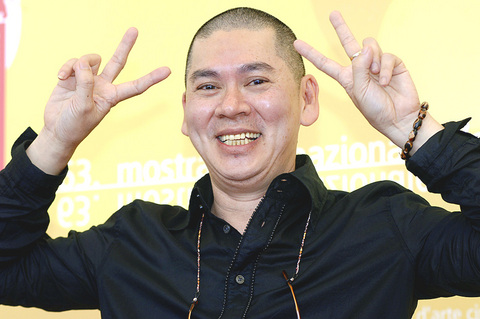
Director Tsai Ming-liang (蔡明亮) and Oscar winner Istvan Szabo from Hungary will give master classes.
Defying government sanctions, rising Chinese director Lou Ye (婁燁) will promote Summer Palace (頤和園), a love story set against the pro-democracy protests in Beijing's Tiananmen Square in 1989. Chinese film authorities banned Lou from filmmaking after he screened the film at Cannes this year without clearing government censors.
Thailand yesterday opened its second film festival this year, but some question the need for two events when the country is struggling to find a niche in the already crowded festival scene.
More than 70 films from 30 countries will be screened at the fourth World Film Festival of Bangkok, and although it may lack the celebrity draw of similar events, organizers say it has loftier aims.
“We want to give the city a serious film culture event,” said festival director Victor Silakong. “Of course, we cannot afford all the big stars but we want to promote serious cinema.”
The World Film Festival of Bangkok follows the Bangkok International Film Festival earlier this year, which boasted stars including directors Oliver Stone and Terry Gilliam and actors Willem Dafoe and Catherine Deneuve.
But Thai film industry experts are perplexed as to why the kingdom needs two festivals, especially when neither of them are close to rivaling Asia's premier film event in Busan, South Korea, let alone Venice or Cannes.
“Why do we need two festivals? I think it eats into their own programming,” said Gilbert Lim, executive vice president of Thai studio Sahamongkol Films.
“I think the resources could be developed together to make one very good film festival instead of two mediocre ones.”
A leafy boulevard in an Indian city stood in for a swish Pakistani neighborhood on Monday as Hollywood star Angelina Jolie began shooting for a film about a US journalist abducted and killed in Pakistan.
The film, A Mighty Heart, is the story of Daniel Pearl, a reporter with the Wall Street Journal who was kidnapped in the Pakistani port city of Karachi and killed in 2002 while researching a report in the aftermath of the Sept. 11 attacks.
It will be shot for a month in the western Indian industrial city of Pune as security concerns prevented filming in Pakistan.
On Monday, filming began in a two-story white bungalow in Pune's Sindh Society locality, which has a striking similarity to the district in Karachi — with its boulevards, row houses and bungalows — where Pearl was staying.
Cars painted yellow to resemble Karachi taxis were parked in front of the house and used for filming.
The Oscar-winning US actress plays the slain reporter's wife, Mariane. Her partner Brad Pitt is the movie's producer.
The celebrity couple's arrival in Pune has thrown the quiet Indian city into a frenzy as hundreds of fans throng their luxury hotel and the shooting locale for a glimpse.

Sept.16 to Sept. 22 The “anti-communist train” with then-president Chiang Kai-shek’s (蔣介石) face plastered on the engine puffed along the “sugar railway” (糖業鐵路) in May 1955, drawing enthusiastic crowds at 103 stops covering nearly 1,200km. An estimated 1.58 million spectators were treated to propaganda films, plays and received free sugar products. By this time, the state-run Taiwan Sugar Corporation (台糖, Taisugar) had managed to connect the previously separate east-west lines established by Japanese-era sugar factories, allowing the anti-communist train to travel easily from Taichung to Pingtung’s Donggang Township (東港). Last Sunday’s feature (Taiwan in Time: The sugar express) covered the inauguration of the

The corruption cases surrounding former Taipei Mayor and Taiwan People’s Party (TPP) head Ko Wen-je (柯文哲) are just one item in the endless cycle of noise and fuss obscuring Taiwan’s deep and urgent structural and social problems. Even the case itself, as James Baron observed in an excellent piece at the Diplomat last week, is only one manifestation of the greater problem of deep-rooted corruption in land development. Last week the government announced a program to permit 25,000 foreign university students, primarily from the Philippines, Indonesia and Malaysia, to work in Taiwan after graduation for 2-4 years. That number is a

This year’s Michelin Gourmand Bib sported 16 new entries in the 126-strong Taiwan directory. The fight for the best braised pork rice and the crispiest scallion pancake painstakingly continued, but what stood out in the lineup this year? Pang Taqueria (胖塔可利亞); Taiwan’s first Michelin-recommended Mexican restaurant. Chef Charles Chen (陳治宇) is a self-confessed Americophile, earning his chef whites at a fine-dining Latin-American fusion restaurant. But what makes this Xinyi (信義) spot stand head and shoulders above Taipei’s existing Mexican offerings? The authenticity. The produce. The care. AUTHENTIC EATS In my time on the island, I have caved too many times to

In a stark demonstration of how award-winning breakthroughs can come from the most unlikely directions, researchers have won an Ig Nobel prize for discovering that mammals can breathe through their anuses. After a series of tests on mice, rats and pigs, Japanese scientists found the animals absorb oxygen delivered through the rectum, work that underpins a clinical trial to see whether the procedure can treat respiratory failure. The team is among 10 recognized in this year’s Ig Nobel awards (see below for more), the irreverent accolades given for achievements that “first make people laugh, and then make them think.” They are not


 RSS
RSS