


Every year Alaskans take part in a ritual known as the Nenana Ice Classic. It is a wager, created in 1917 by a group of bored surveyors trying to guess when the ice on the Tanana River would break. Today, in a state with fewer than 700,000 people, hundreds of thousands of tickets are bought by bettors who try to predict when a tripod placed on the river will move 30m.
People will bet on anything. That is the grand theme of Roll the Bones, David G. Schwartz’s lively history of gambling through the ages. Archaeological evidence
suggests that shortly after developing opposable thumbs, early Homo sapiens used this newfound dexterity to roll craps, a game that in various permutations has outlived great empires. The earliest dice were made from the hucklebones of sheep, but by 1300BC they had acquired the smooth cube shape and dots familiar today. Dice use dots for a simple reason: they predate numbers.
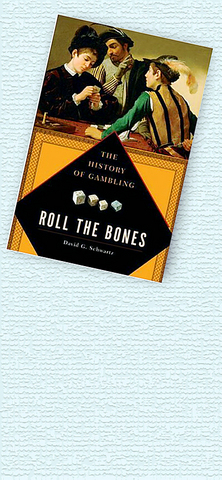
Schwartz, the director of the Center for Gaming Research at the University of Nevada, Las Vegas, takes his assignment seriously. He begins even before the beginning, with the great wagers described in ancient religious texts, where even the gods gambled furiously.
After beating the moon at the game board, Thoth, the Egyptian god of gambling, added five days to the calendar, making possible the creation of the human race. Having rooted his narrative, rather grandly, in the ancient cultures of Mesopotamia, China and India (“dice are like pieces of divine coal, which cause the hearts to burn, though remaining themselves cold,” we read in the Rig-Veda, a Hindu volume), Schwartz sets out on a quick global march that takes the reader from the gambling dens of Pompeii to the slots at Caesars Palace.
The gambling urge has expressed itself in myriad ways over the centuries. Schwartz diligently traces the evolution of cards, dice, board games, bingo, lotteries, horse racing and cockfighting, with asides on intriguing variants like cricket fighting, an ancient Chinese contest in which the insect opponents were tickled on the head with a feather until they charged each other, cheered on by excited bettors. The sport lives. In 2004 Hong Kong police broke up a cricket-fighting ring on Kowloon and seized nearly 200 crickets, some worth US$20,000.
For centuries gambling was crippled by a poor understanding of probability, whose mysteries attracted thinkers like Blaise Pascal and Galileo. Their work helped pave the way for concepts like the house advantage (the basis for all casinos) and the lottery, the first form of commercialized gambling. An early beneficiary of this pioneering work was Voltaire, who noticed a mathematical error in the rules for the French national lottery. A canny player — in this case Voltaire and a team of investors — could buy up a certain class of ticket and, relying on the laws of probability, be guaranteed an enormous profit.
Although Americans probably do not count as the world’s most ferocious gamblers, they have put their own stamp on the pursuit, notably in the game of poker. Vying games, in which players are dealt cards and then compete with one another using stakes, date back to the Renaissance, but it was in Louisiana that the 16th-century French game known as poque got a couple of new twists. Sometime in the second half of the 19th century, players in New Orleans decided to throw out cards they did not want and draw new ones.
At the same time, jackpots were introduced, requiring players to hold a pair of jacks or better before opening the betting. The draw, in particular, seems quintessentially American, the kind of innovation you might expect in a country where anyone dealt a bad hand can, in theory, discard and start over.
Schwartz carefully documents his data, even the stories that sound way too good to be true. The footnotes, however, often lead to newspaper articles or Wikipedia.org, hardly a confidence booster. No one, however, will willingly let go of the anecdote about the French naval captain who lost his shirt at Monte Carlo, then demanded his money back. When rebuffed, he threatened to turn his ship’s guns on the casino and blow it to smithereens. The casino decided to make an exception to its rules.
Like a two-week, 10-city tour, Roll the Bones moves too quickly over too much territory. The space allotted to, say, horse racing in New Zealand could have been assigned to riverboat gambling on the Mississippi, which gets short shrift, or to legendary female gamblers like Poker Alice.
There is far too little on
gambling systems and early gambling theory. Schwartz mentions the betting scandal surrounding the Breeders’ Cup horse races in 2002, in which three fraternity brothers nearly pulled off a US$3 million score, but does not bother to explain how the scheme worked. It was fascinating, one of the top horse racing stories of the year.
With gambling repackaged as family entertainment in Las Vegas, Texas hold-’em at the height of fashion and the Internet opening up new ways to bet, “Americans are never far from a chance to take a chance,” Schwartz writes. In 2004, 54 million of them visited a casino. That same year they lost more than US$78 billion on games of chance.
De Tocqueville, as always, got it exactly right. “Those who live in the midst of democratic fluctuations have always before their eyes the image of chance,” he wrote, “and they end by liking all undertakings in which chance plays a part.”

Sept.16 to Sept. 22 The “anti-communist train” with then-president Chiang Kai-shek’s (蔣介石) face plastered on the engine puffed along the “sugar railway” (糖業鐵路) in May 1955, drawing enthusiastic crowds at 103 stops covering nearly 1,200km. An estimated 1.58 million spectators were treated to propaganda films, plays and received free sugar products. By this time, the state-run Taiwan Sugar Corporation (台糖, Taisugar) had managed to connect the previously separate east-west lines established by Japanese-era sugar factories, allowing the anti-communist train to travel easily from Taichung to Pingtung’s Donggang Township (東港). Last Sunday’s feature (Taiwan in Time: The sugar express) covered the inauguration of the

The corruption cases surrounding former Taipei Mayor and Taiwan People’s Party (TPP) head Ko Wen-je (柯文哲) are just one item in the endless cycle of noise and fuss obscuring Taiwan’s deep and urgent structural and social problems. Even the case itself, as James Baron observed in an excellent piece at the Diplomat last week, is only one manifestation of the greater problem of deep-rooted corruption in land development. Last week the government announced a program to permit 25,000 foreign university students, primarily from the Philippines, Indonesia and Malaysia, to work in Taiwan after graduation for 2-4 years. That number is a
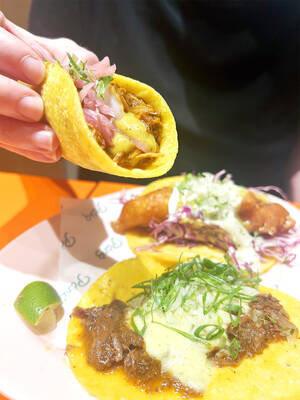
This year’s Michelin Gourmand Bib sported 16 new entries in the 126-strong Taiwan directory. The fight for the best braised pork rice and the crispiest scallion pancake painstakingly continued, but what stood out in the lineup this year? Pang Taqueria (胖塔可利亞); Taiwan’s first Michelin-recommended Mexican restaurant. Chef Charles Chen (陳治宇) is a self-confessed Americophile, earning his chef whites at a fine-dining Latin-American fusion restaurant. But what makes this Xinyi (信義) spot stand head and shoulders above Taipei’s existing Mexican offerings? The authenticity. The produce. The care. AUTHENTIC EATS In my time on the island, I have caved too many times to

In a stark demonstration of how award-winning breakthroughs can come from the most unlikely directions, researchers have won an Ig Nobel prize for discovering that mammals can breathe through their anuses. After a series of tests on mice, rats and pigs, Japanese scientists found the animals absorb oxygen delivered through the rectum, work that underpins a clinical trial to see whether the procedure can treat respiratory failure. The team is among 10 recognized in this year’s Ig Nobel awards (see below for more), the irreverent accolades given for achievements that “first make people laugh, and then make them think.” They are not


 RSS
RSS