


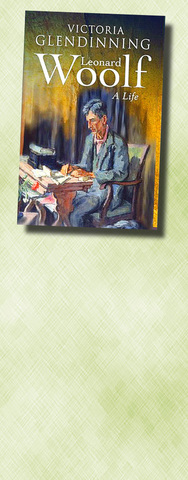
At the end of his life in 1969 aged 88, Leonard Woolf knew that he would be better known to history as the husband of Virginia than as an innovative colonial administrator in Ceylon, a staunch Fabian, an important publisher of modernist literature or the graceful writer of a classic autobiography. He was spared having to defend himself from the bizarre speculations of those who have adopted Woolf as their mascot. The Internet and academic journals blaze with accusations against him, ranging from her murder to culpable neglect. (In a letter to Victoria Glendinning last May, Phyllis Grosskurth said she regretted writing the 1980 article that started this particular hare.)
The charges against Woolf are convoluted but, Glendinning shows definitively, false. Far from feeling himself diminished by her growing reputation, he appreciated his wife's genius and did all he could to make it possible for her to express it. He cherished her and showed her as much physical affection as she was capable of receiving, though he was himself highly sexed.
When, in his old age, her reputation soared, he spent a good deal of time shooting down the craziest academic theories about her, and gently correcting correspondents, telling them, for example, that she had never read French philosopher Henri Bergson, met novelist Dorothy Richardson, corresponded with Joyce or made a serious study of Freud.
The center of the mystery is why Virginia Stephen, who shared the conventional, mild anti-Semitism of pre-Great War, upper-middle-class England, married a “penniless Jew” who looked like an Old Testament prophet. Even his lifelong hand tremor, says Glendinning, might have been an inherited trait (his father and possibly his mother had it), which mainly, but not exclusively, affects Ashkenazi Jews.
There is a good deal to be learnt about multiculturalism from examining Woolf's early life, for the Woolfs were assimilated to the extent that his father was a QC and Leonard was educated at the elite St Paul's school in London and Trinity College, Cambridge, where he was elected to the Apostles, the secret society then in its golden age, including as members GE Moore, Bertrand Russell, Lytton Strachey and John Maynard Keynes.
Though part of the English establishment, Leonard maintained a relatively uncomplicated Jewish identity (perhaps by refusing to take personally anti-Semitic remarks made by TS Eliot, Harold Nicolson and his wife). This had nothing to do with the religion of his fathers, for he was, like his fellow Apostles, a militant atheist. His grandfather, Benjamin, had already discarded Orthodoxy in favor of the Reform movement and joined a synagogue in Mayfair, central London. Glendinning's great-great-grandparents were second-generation, English-born Jews, members of the same Jewish middle class as the Woolfs, which in 1858 numbered about 35,000.
Between 1883 and 1905, another 150,000 mainly working-class, Yiddish-speaking Jews arrived in Britain and were, no doubt, the reason for Virginia's prejudice. However, there was also a Jewish upper class and Leonard's Aunt Bloom's granddaughter, “Dollie” Rothschild, married into it. Even after his marriage, and though Virginia was never entirely comfortable with his large Jewish family, Woolf continued to see them every week.
Woolf, the future colonial civil servant, and the homosexual Lytton Strachey made an odd couple, but from the day they met at Trinity in 1899, “Leonard began to define himself by discovering his differences from Lytton,” writes Glendinning. Though Leonard could not share Lytton's sexual tastes (when I interviewed him for my biography of GE Moore, Woolf told me that he was the only person in their set who had “never experienced any sort of homosexual desire,” but Glendinning does not even try to tell us what it was like to be the only straight in their Cambridge village), he was a sympathetic listener and correspondent for the sex-crazed (and probably sex- starved) Strachey.
Intoxicated by ideas and by their contact with Moore, they read, wrote and talked of art, ethics, politics and religion, of Plato, Milton, Shakespeare, Henry James and Flaubert. When they drank too much, they weren't sick in the shrubbery, but marched through Trinity Great Court reciting Swinburne too loudly.
When he went to Ceylon in 1904, he and Lytton corresponded daily, sometimes twice a day. Over the 11 years he was on the island, Woolf lost his virginity to a prostitute, prosecuted his Colonial Service job with fairness and tried his best to understand the people he was governing. In February 1909, Lytton proposed to Virginia Stephen and for an agonizing moment thought she'd accepted. With relief he wrote to Woolf that it would really be much better if he himself were to marry her, as he'd “have the immense advantage of physical desire.” It was another three-and-a-half years before the match was accomplished and the marriage will be the chief reason this book will have most of its readers.
There was, however, a great deal more to Leonard Woolf than being Virginia's consort and nurse. An entire political biography of Leonard was written by Duncan Wilson, but Glendinning gives an account of his dealings with the Webbs, the Fabian Society, the New Statesman and the Labour party that is as full and fair as the general reader will want. Ditto his career as a publisher and writer of both political tracts and reports and of fiction (though his biographer is herself a considerably better novelist than her subject). She (I think, rightly) sees that women played a hugely important part on Woolf's life and details the epistolary courtships to which he was prone, as well as his actual, long-lasting love affair with Trekkie Parsons, the artist wife of Ian Parsons, the publisher who bought Leonard's Hogarth Press for Chatto & Windus.
In a chapter called “Aftermath” Glendinning goes into the dispersal of Virginia's manuscripts and letters by the late Misses Hamill and Barker, the two old American ladies who looted them, along with so many other Bloomsbury papers, often paying in cash and disappearing back to Chicago with suitcases full of Britain's literary heritage. Though the author has hidden some of her tracks by failing to give page numbers when citing books, her deft writing and striking sympathy for her subject make this a landmark biography.

Sept.16 to Sept. 22 The “anti-communist train” with then-president Chiang Kai-shek’s (蔣介石) face plastered on the engine puffed along the “sugar railway” (糖業鐵路) in May 1955, drawing enthusiastic crowds at 103 stops covering nearly 1,200km. An estimated 1.58 million spectators were treated to propaganda films, plays and received free sugar products. By this time, the state-run Taiwan Sugar Corporation (台糖, Taisugar) had managed to connect the previously separate east-west lines established by Japanese-era sugar factories, allowing the anti-communist train to travel easily from Taichung to Pingtung’s Donggang Township (東港). Last Sunday’s feature (Taiwan in Time: The sugar express) covered the inauguration of the

The corruption cases surrounding former Taipei Mayor and Taiwan People’s Party (TPP) head Ko Wen-je (柯文哲) are just one item in the endless cycle of noise and fuss obscuring Taiwan’s deep and urgent structural and social problems. Even the case itself, as James Baron observed in an excellent piece at the Diplomat last week, is only one manifestation of the greater problem of deep-rooted corruption in land development. Last week the government announced a program to permit 25,000 foreign university students, primarily from the Philippines, Indonesia and Malaysia, to work in Taiwan after graduation for 2-4 years. That number is a
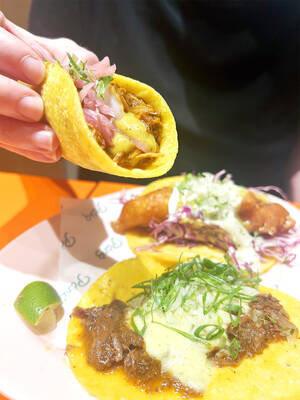
This year’s Michelin Gourmand Bib sported 16 new entries in the 126-strong Taiwan directory. The fight for the best braised pork rice and the crispiest scallion pancake painstakingly continued, but what stood out in the lineup this year? Pang Taqueria (胖塔可利亞); Taiwan’s first Michelin-recommended Mexican restaurant. Chef Charles Chen (陳治宇) is a self-confessed Americophile, earning his chef whites at a fine-dining Latin-American fusion restaurant. But what makes this Xinyi (信義) spot stand head and shoulders above Taipei’s existing Mexican offerings? The authenticity. The produce. The care. AUTHENTIC EATS In my time on the island, I have caved too many times to

In the aftermath of the 2020 general elections the Chinese Nationalist Party (KMT) was demoralized. The Democratic Progressive Party (DPP) had crushed them in a second landslide in a row, with their presidential candidate Tsai Ing-wen (蔡英文) winning more votes than any in Taiwan’s history. The KMT did pick up three legislative seats, but the DPP retained an outright majority. To take responsibility for that catastrophic loss, as is customary, party chairman Wu Den-yih (吳敦義) resigned. This would mark the end of an era of how the party operated and the beginning of a new effort at reform, first under


 RSS
RSS