


Religious hypocrisy, extremes of wealth and poverty, out-of-touch politicians, enslavement to fashion, obsession with gadgetry.
No, not today. These were targets of satirists in 18th and 19th-century London. And there were more: lawyers, doctors, soldiers, clergymen, intellectuals, even shop-keepers. All apparently merited deflating for the power they wielded.
True, the English did not invent satire. Horace and Juvenal were at it in ancient Rome; commedia dell'arte revived it in 16th-century Italy; Rabelais, Moliere and Voltaire brandished it in France. And long before Jonathan Swift, Alexander Pope and William Hogarth stirred things up in England, Chaucer, Shakespeare and Ben Jonson were masters at ridiculing human nature.
PHOTOS: NY TIMES AND AP
The message is clear: Every age gets the satire it deserves.
Today it may be more necessary than ever.
That, at least, is one conclusion offered by Satirical London, an exhibition at the Museum of London through Sept. 3, which explores "three centuries of satire, sex and scandal." The show pays little heed to literature, focusing on graphic satire, like prints and cartoons. Nonetheless, it is a healthy celebration of irreverence.
And that's where today comes in. In an atmosphere of growing religious intolerance and social conformity, sustained by fear, political correctness and electoral apathy, satire can probably aid democracy by stretching the limits of the acceptable. That this may offend is precisely its value. Satire should disturb as well as amuse.
It is not always possible. In dictatorships it can be positively foolish to mock rulers, although satire can sometimes be disguised as parody or allegory. And in many parts of the world there is no tradition of questioning authority through wit or caricature; in such countries two preferred targets, religious and political power, are usually taboo for satirists.
A reminder of this was the angry Muslim response to those infamous caricatures of the Prophet Muhammad after they were published in a Danish newspaper. If their intent was to satirize the way terrorism has exploited and distorted Islam, they were in practice viewed by many Muslims as insulting Muhammad. And when the Vatican and some Western leaders also criticized the cartoons, it was apparent that a line had been drawn.
This was possible in 18th-century London because England was already a lively, albeit still incomplete, democracy. As early as 1711, Richard Steele and Joseph Addison published The Spectator (unrelated to today's weekly of the same name), which was intended, as they put it, to "enliven morality with wit, and to temper wit with morality." In later decades, satirists also exploited this freedom to poke fun at the monarchy (poor George III received a drubbing for "losing" his American colony), aristocracy and politicians, as well as to draw attention to greed, poverty and injustices.
The most popular vehicle was graphic art, specifically prints. Around St. Paul's Cathedral in London, print shops filled their windows with the latest and most outrageous images. And passers-by, even if illiterate, even if unable to afford a print, could revel in the knowledge that the rich and powerful were not safe from ridicule. (This show recreates the window of Humphrey's popular print shop.) In this Hogarth was the master, not only because he was a skilled painter and engraver, but also because he captured the idiosyncrasies of London.
His prints inspired writers to create their own texts around, say, A Rake's Progress and A Harlot's Progress. And to this day cartoonists frequently pay homage to him by borrowing his complex compositions. Thus his Gin Lane became Cocaine Lane by Martin Rowson 250 years later.
With the creation of Punch magazine in 1841, cartoons became popular and were soon musts for popular newspapers. Even Charles Dickens, Anthony Trollope and other writers called on cartoonists to add spice to the serialization of their novels in newspapers.
"London was an extraordinary city," Ian Hislop, the editor of Private Eye, a popular satirical fortnightly, notes in a catalog essay accompanying the exhibition, "and it has an extraordinary amount of what satirists thrive on: `Vice, Folly and Humbug."' They were again the targets of London's postwar boom in satire, begun in the early 1960s by Peter Cook, Dudley Moore, Alan Bennett and Jonathan Miller in a landmark stage show called Beyond the Fringe. The floodgates opened: Cook helped found Private Eye and created a nightclub in the Soho district of London called the Establishment, the sort of place where that great American satirist Lenny Bruce could perform without protests.
Soon satire reached television through BBC shows like That Was the Week That Was, fronted by David Frost, which were so successful that Saturday night became known as Satireday night. And here, for the first time, queen and country (even dear old Shakespeare) were routinely spoofed.
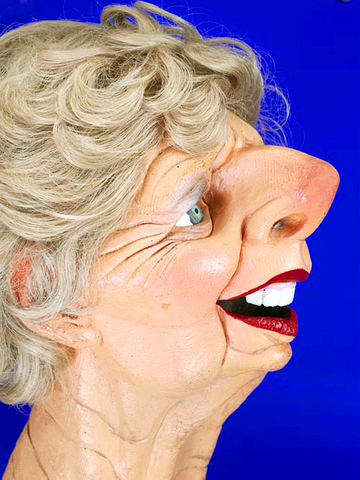
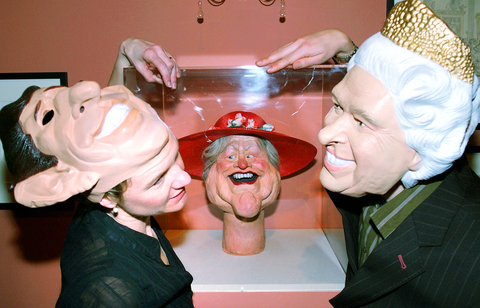
These shows were followed by the Monty Python's Flying Circus series, which, while dwelling on the absurd, led to the 1979 screen satire of religious excess, Life of Brian. The 1980s brought the Spitting Image series, in which royalty, politicians and celebrities were mercilessly lampooned using puppet heads.
Today, with reality shows ruling television, satire is kept alive in England largely by Private Eye, which not only sends up royalty and government (Prime Minister Tony Blair is depicted as a self-righteous Church of England priest) but also, and perhaps most usefully, serves as a watchdog over the country's newspapers by exposing their misreporting and ridiculing their obsession with celebrities.
Satire is hardly dead. It can also be found in France with Les Guignols de l'Info, a puppet show on television, and with Le Canard Enchaine in print.
On American television it surfaces in late-night talk shows and, most successfully, in Comedy Central's Daily Show With Jon Stewart. Movies too, from Wag the Dog to Thank You for Smoking, keep up the tradition.
Yet Satirical London reminds how much more satire can do.
In today's Western democracies, where the concentration of political, religious, economic and media power smothers debate, satire can be positively remedial by challenging stereotypes, prejudices and groupthink.
In that sense, it is not enough to satirize manipulation of power; those who permit this state of affairs -- that's us -- also deserve to be ridiculed. Satire cannot fix things, but it proffers a timely jab in the ribs.

Sept.16 to Sept. 22 The “anti-communist train” with then-president Chiang Kai-shek’s (蔣介石) face plastered on the engine puffed along the “sugar railway” (糖業鐵路) in May 1955, drawing enthusiastic crowds at 103 stops covering nearly 1,200km. An estimated 1.58 million spectators were treated to propaganda films, plays and received free sugar products. By this time, the state-run Taiwan Sugar Corporation (台糖, Taisugar) had managed to connect the previously separate east-west lines established by Japanese-era sugar factories, allowing the anti-communist train to travel easily from Taichung to Pingtung’s Donggang Township (東港). Last Sunday’s feature (Taiwan in Time: The sugar express) covered the inauguration of the

The corruption cases surrounding former Taipei Mayor and Taiwan People’s Party (TPP) head Ko Wen-je (柯文哲) are just one item in the endless cycle of noise and fuss obscuring Taiwan’s deep and urgent structural and social problems. Even the case itself, as James Baron observed in an excellent piece at the Diplomat last week, is only one manifestation of the greater problem of deep-rooted corruption in land development. Last week the government announced a program to permit 25,000 foreign university students, primarily from the Philippines, Indonesia and Malaysia, to work in Taiwan after graduation for 2-4 years. That number is a
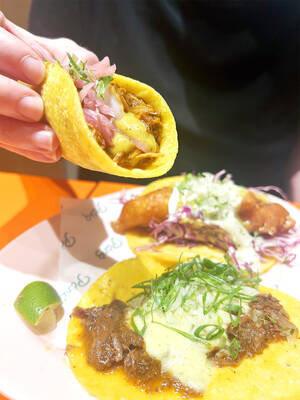
This year’s Michelin Gourmand Bib sported 16 new entries in the 126-strong Taiwan directory. The fight for the best braised pork rice and the crispiest scallion pancake painstakingly continued, but what stood out in the lineup this year? Pang Taqueria (胖塔可利亞); Taiwan’s first Michelin-recommended Mexican restaurant. Chef Charles Chen (陳治宇) is a self-confessed Americophile, earning his chef whites at a fine-dining Latin-American fusion restaurant. But what makes this Xinyi (信義) spot stand head and shoulders above Taipei’s existing Mexican offerings? The authenticity. The produce. The care. AUTHENTIC EATS In my time on the island, I have caved too many times to

In the aftermath of the 2020 general elections the Chinese Nationalist Party (KMT) was demoralized. The Democratic Progressive Party (DPP) had crushed them in a second landslide in a row, with their presidential candidate Tsai Ing-wen (蔡英文) winning more votes than any in Taiwan’s history. The KMT did pick up three legislative seats, but the DPP retained an outright majority. To take responsibility for that catastrophic loss, as is customary, party chairman Wu Den-yih (吳敦義) resigned. This would mark the end of an era of how the party operated and the beginning of a new effort at reform, first under


 RSS
RSS