


There are no albinos with red eyes and bleeding thighs stalking the galleries of the Museum of Science and Industry here. There are no dead curators sprawled naked on the floor with pentagrams drawn on their chests in blood and scrambled Fibonacci series scrawled at their sides.
But there is a "cryptex" on display, perhaps the only one ever constructed. It is a prop from the leaden movie of Dan Brown's best-selling roller-coaster ride The Da Vinci Code: Spell the right word on its dials (if you could only get at them), and the Holy Grail is yours.
That object and a few panels of wall text are the only things in Leonardo da Vinci: Man, Inventor, Genius that tap into the worldwide cultic response to Brown's novel. The association and timing, though, could not have hurt this unusual exhibition's appeal.
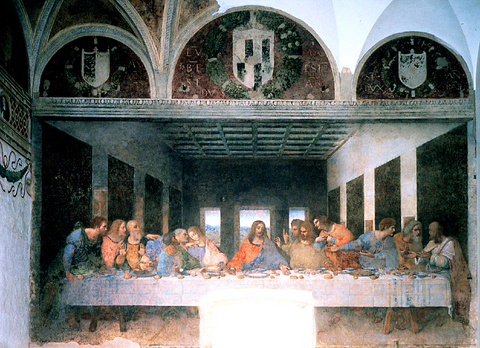
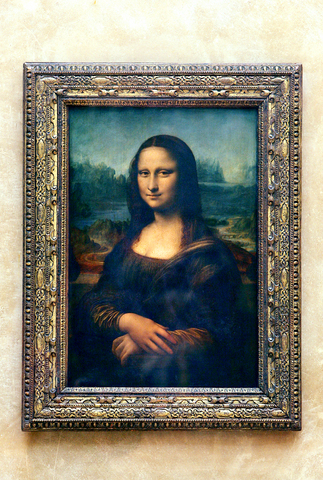
This is no act of exploitation, however: The wall texts point out that despite Brown's assertion, Leonardo did not invent anything like the cryptex. With less conclusiveness, the exhibition also debunks the book's interpretations of Leonardo's Last Supper and Mona Lisa: no church conspiracies here about keepers of the Grail sending coded messages to one another over the millenniums.
This show is almost the inverse of the world of The Da Vinci Code. A code implies something secret, available only to the initiated, a hidden world in which nothing is what it seems. Focusing on the machines and inventions sketched out in Leonardo's notebooks, the exhibition shows his almost ecstatic efforts to discern and disclose the world's workings and to master its principles, leaving nothing about them secret and hidden. This is a display of his decoding.
Pull away the veil of flesh -- as Leonardo often did in his dissections of human and animal corpses -- and you see his vision of divinity made manifest. Muscle and bone and joint are nature's versions of gears and pulleys and levers. And Leonardo never ceased combining and recombining these elemental ingredients into machines that still astonish in their simplicity and power. These are the rudimentary skeletons of his introspective Madonnas.
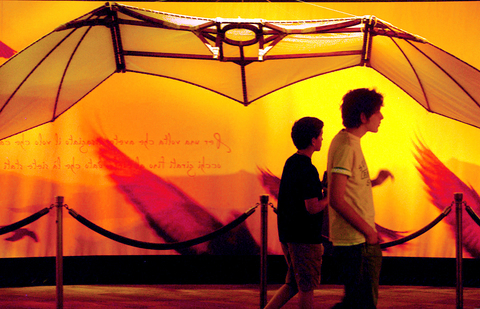
Some of his machines were built in his time, including a robotic knight that supposedly moved its arms and head according to the twists and turns of an inner mechanism. Others were imagined but never fully executed: a flying ship whose sails turn in the air like screws; enormous wings based on the anatomical structures of bats and birds that might give humans the gift of flight. Some clearly were implaus-ible: Who could easily walk on water using large floats on the bottoms of shoes and other floats pegged to the bottom of ski poles? That kind of feat would be better left to a practitioner of different sorts of miracles.
Still other machines were proposals for weaponry, including a circular tank moved by eight men who would shoot cannons while maneuvering the turtle-shelled apparatus with a series of cranks and gears.
Some of the Italian-made working models in the first section of the show -- all based on drawings from the notebooks -- are meant to be observed; others are meant to be played with. They should all have been available to touch. It would also have helped to know precisely when Leonardo was creating from scratch, when he was replicating something familiar and what he did to improve on what others had already done.
PHOTOS: AGENCIES
But watch: A mechanical hammer slams down as a handle is turned. An arched bridge is constructed for traveling armies out of rope and easily found logs. A pipe spiraling around a turning cylinder becomes an Archi-medes' screw, lifting water upward through its rotations.
You can see Leonardo's attempt to formulate a kind of mechanical vocabulary. He was not seeking abstract, universal laws, the way Newton later did. He was disclosing concrete architectural and mechan-ical elements that could be combined into ever more exotic and sophis-ticated creations.
Here is a simple machine that turns circular motion into vertical motion; over there is one that turns vertical motion into sideways motion. Many of these machines and their notebook sources can be seen in a book that could serve as a partial exhibition catalog, Leonardo: Codices and Machines by Carlo Starnazzi (Cartei and Bianchi), sold at the museum.
Another room, Leonardo's Work-shop, is more like a play shop for emulators, aspirants and school-children. The room is dominated by an 2.4m-tall model of a horse's head, meant to reproduce part of Leonardo's design for a7.3m high, 72.6-tonne bronze statue commissioned by the Duke of Milan, Ludovico Sforza.
The bronze was never cast, and the head has a pop crudity to it. But this is the place to build a 4m bridge according to Leonardo's instructions. Or to see the effect produced by a camera obscura -- a tool used by many painters of the time -- in which bright, inverted images are projected on a screen in a darkened room. Or to operate a working 2.1m-tall catapult, based on Leonardo's designs, that tosses soft red balls at a rival catapult; both were operated by teams of schoolchildren when I was there.
There is also an enormous touch screen that provides one of the smartest, most elegant interfaces I have seen for exploring complex
material. Created by the company Leonardo3, the program allows the viewer to page through some of the inventions of the Codex Atlanticus, an anthology of 40 years of Leonardo's notebooks (from 1478 to 1518).
At the Biblioteca Ambrosiana in Milan, the Codex's 1,750 drawings, bound in 12 volumes, are annotated by Leonardo's meticulous mirror-image script, but here the machines spring to life and motion with the touch of a finger. A consumer version of the software is available on CD-ROM (leonardo3.net).
The last section of the show is meant to be its climax, but what can possibly follow these inventions?
Certainly not Modern-Day Leonardos, which pays tribute to 40 contemporary inventors, artists and innovators.
However remarkable Laurie Anderson's multimedia presentations are, however brilliant the inventor Danny Hillis is, however provocative the works of the mathematician Stephen Wolfram, or useful the techniques for heart surgery created by Francis Wells (based on Leonardo's anatomical studies), Leonardo's genius casts an imposing shadow over the assembly. And the decision to include tributes to General Electric's new wind turbine and an extensive display of Boeing's design for its new 787 seems like pure pandering, placating two of the show's sponsors with reflected prestige.
In this contemporary company the spirit of Leonardo was most clear, perhaps, when a project combined concrete simplicity and wild imagin-ation, like the speculative model of a space elevator designed by the physicist Bradley Edwards, intended to move passengers and supplies along a cable extending 99,779km from the equator to an orbiting satellite. When you see Leonardo's artworks, their allure and power can lead you to imagine something grand and mysterious -- if not a code, then something dizzying, beyond simple understanding. But here the sensation is the opposite: the surface is stripped away; objects are distilled to their mechanical essences. And you are left in the presence of an extraordinary mind at work, playfully decoding the world.

Sept.16 to Sept. 22 The “anti-communist train” with then-president Chiang Kai-shek’s (蔣介石) face plastered on the engine puffed along the “sugar railway” (糖業鐵路) in May 1955, drawing enthusiastic crowds at 103 stops covering nearly 1,200km. An estimated 1.58 million spectators were treated to propaganda films, plays and received free sugar products. By this time, the state-run Taiwan Sugar Corporation (台糖, Taisugar) had managed to connect the previously separate east-west lines established by Japanese-era sugar factories, allowing the anti-communist train to travel easily from Taichung to Pingtung’s Donggang Township (東港). Last Sunday’s feature (Taiwan in Time: The sugar express) covered the inauguration of the

The corruption cases surrounding former Taipei Mayor and Taiwan People’s Party (TPP) head Ko Wen-je (柯文哲) are just one item in the endless cycle of noise and fuss obscuring Taiwan’s deep and urgent structural and social problems. Even the case itself, as James Baron observed in an excellent piece at the Diplomat last week, is only one manifestation of the greater problem of deep-rooted corruption in land development. Last week the government announced a program to permit 25,000 foreign university students, primarily from the Philippines, Indonesia and Malaysia, to work in Taiwan after graduation for 2-4 years. That number is a
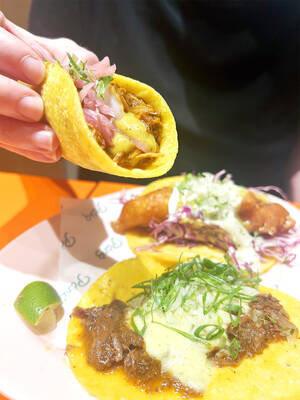
This year’s Michelin Gourmand Bib sported 16 new entries in the 126-strong Taiwan directory. The fight for the best braised pork rice and the crispiest scallion pancake painstakingly continued, but what stood out in the lineup this year? Pang Taqueria (胖塔可利亞); Taiwan’s first Michelin-recommended Mexican restaurant. Chef Charles Chen (陳治宇) is a self-confessed Americophile, earning his chef whites at a fine-dining Latin-American fusion restaurant. But what makes this Xinyi (信義) spot stand head and shoulders above Taipei’s existing Mexican offerings? The authenticity. The produce. The care. AUTHENTIC EATS In my time on the island, I have caved too many times to

In a stark demonstration of how award-winning breakthroughs can come from the most unlikely directions, researchers have won an Ig Nobel prize for discovering that mammals can breathe through their anuses. After a series of tests on mice, rats and pigs, Japanese scientists found the animals absorb oxygen delivered through the rectum, work that underpins a clinical trial to see whether the procedure can treat respiratory failure. The team is among 10 recognized in this year’s Ig Nobel awards (see below for more), the irreverent accolades given for achievements that “first make people laugh, and then make them think.” They are not


 RSS
RSS