


Taipei changes so rapidly that even the most thoroughly researched guidebook will contain serious inaccuracies in a matter of months after publication, and appear hopelessly out of date in a few years.
Compounding this problem was the fact that, until last week, there was not a single English-language guidebook devoted exclusively to Taipei. Travelers and new residents had to get by with the Taipei and Northern Taiwan sections of references by Insight Guides, National Geographic and Lonely Planet Taiwan. Of these, the latter has long been the gold standard. In roughly 200 pages that are relevant as references to the Taipei area, including maps and sections on Taiwanese history and culture, its authors did a journeyman's job of describing the area in a condensed format, with suggestions for most budgets and well-reported sections on topics such as hiking excursions and how to set up a cell phone account.
But Lonely Planet Taiwan also suffered from its share of faults. Foreigners were poorly served by questionable characterizations, such as this statement about Shanghaiese cuisine: "Many Westerners say it's disgusting, tasteless and greasy, but the liberal use of spices can make it almost palatable." Taiwanese objected to photographs they felt made their country appear backward, such as a dated picture of a family of four clinging to a boxy scooter, or unappealing as a travel destination, such as the picture of a bulletin board on the 2001 edition's cover.
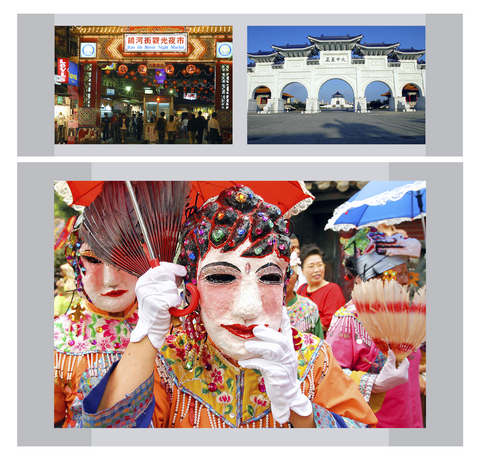
PHOTOS COURTESY OF APA PUBLICATIONS
Although Lonely Planet published a much improved edition of its Taiwan guidebook last year, there is now a better reference for those whose interest is limited to Taipei and its environs. On sale at Eslite bookstores since last week, the brand new Taipei Insight City Guide combines solid travel advice with exquisite color photography and roughly 20 maps, some of which show lanes where other guidebooks leave white space.
Highlights include:
● A Best of Taipei section, which lists top family attractions, the views, most important places of worship, best architecture, famous foods, and unique attractions like Taipei 101.

● A Places section, which provides a run-down of all the attractions and sights deemed worth seeing cross-referenced to full-color maps. A restaurant section at the end of each chapter reviews the area's best places to eat, with full address, prices, ratings and opening hours.
● A street atlas that includes 12 pages of maps with a street index.
The best thing about this book is the way its authors weave a profound understanding of the city's history and culture into descriptions of each item in the book's itinerary. Essays on topics such as people, religion and nightlife were all written by writers who have lived in Taipei for many years. Even long-term residents will learn a thing or two from the historical passages, which do not flinch from recounting the less savory aspects of the city's past.
The result is a must-read for anyone ranging from the casual tourist to long-term residents seeking a deep understanding of their home.
Unfortunately, it must be noted that the one aspect in which Taipei Insight City Guide does not surpass Lonely Planet's book is in the former's complete lack of Chinese characters and tonal markings for their romanization. With this serious defect, the new guidebook nearly removes itself from consideration by visitors looking to navigate the city on a single guidebook.
The omission of tones is particularly odd, given that the Insight guide explains how essential they are to the spoken language. And romanizations are printed throughout in parentheses next to locations referred to by their English-language names (Yongle Market, Yongle Shichang). Simply adding tonal marks to these would not have made the book any larger.
Printing Chinese characters is even more crucial, if only because the failure to do so prohibits users from resorting to the ancient point-and-grunt method of asking directions and ordering food. Not surprisingly, Taipei Insight City Guide was produced with the cooperation of the current city admini-stration, which holds the linguistic abilities of foreigners in such high esteem that it assigned numerical names to important streets, even though the streets already have romanized names.
So hang on to that old copy of Lonely Planet.

Sept.16 to Sept. 22 The “anti-communist train” with then-president Chiang Kai-shek’s (蔣介石) face plastered on the engine puffed along the “sugar railway” (糖業鐵路) in May 1955, drawing enthusiastic crowds at 103 stops covering nearly 1,200km. An estimated 1.58 million spectators were treated to propaganda films, plays and received free sugar products. By this time, the state-run Taiwan Sugar Corporation (台糖, Taisugar) had managed to connect the previously separate east-west lines established by Japanese-era sugar factories, allowing the anti-communist train to travel easily from Taichung to Pingtung’s Donggang Township (東港). Last Sunday’s feature (Taiwan in Time: The sugar express) covered the inauguration of the

The corruption cases surrounding former Taipei Mayor and Taiwan People’s Party (TPP) head Ko Wen-je (柯文哲) are just one item in the endless cycle of noise and fuss obscuring Taiwan’s deep and urgent structural and social problems. Even the case itself, as James Baron observed in an excellent piece at the Diplomat last week, is only one manifestation of the greater problem of deep-rooted corruption in land development. Last week the government announced a program to permit 25,000 foreign university students, primarily from the Philippines, Indonesia and Malaysia, to work in Taiwan after graduation for 2-4 years. That number is a
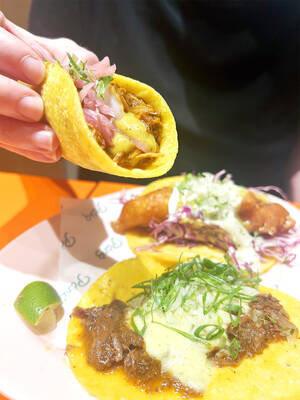
This year’s Michelin Gourmand Bib sported 16 new entries in the 126-strong Taiwan directory. The fight for the best braised pork rice and the crispiest scallion pancake painstakingly continued, but what stood out in the lineup this year? Pang Taqueria (胖塔可利亞); Taiwan’s first Michelin-recommended Mexican restaurant. Chef Charles Chen (陳治宇) is a self-confessed Americophile, earning his chef whites at a fine-dining Latin-American fusion restaurant. But what makes this Xinyi (信義) spot stand head and shoulders above Taipei’s existing Mexican offerings? The authenticity. The produce. The care. AUTHENTIC EATS In my time on the island, I have caved too many times to

In a stark demonstration of how award-winning breakthroughs can come from the most unlikely directions, researchers have won an Ig Nobel prize for discovering that mammals can breathe through their anuses. After a series of tests on mice, rats and pigs, Japanese scientists found the animals absorb oxygen delivered through the rectum, work that underpins a clinical trial to see whether the procedure can treat respiratory failure. The team is among 10 recognized in this year’s Ig Nobel awards (see below for more), the irreverent accolades given for achievements that “first make people laugh, and then make them think.” They are not


 RSS
RSS