


By now the scenario is familiar to almost any guy: The average Joe has a crush on the girl next door. For months he fixes her computer problems, drives her anywhere she wants, comforts her over the phone when she's down. Finally average Joe manages to summon up the courage to ask her out. The reply? "You're a nice guy, but ... ."
Once those first ominous words about being a "nice guy" are out, you know you're doomed. What to do?
Join the club -- the nice guy or "goodman" (好人) club that is.
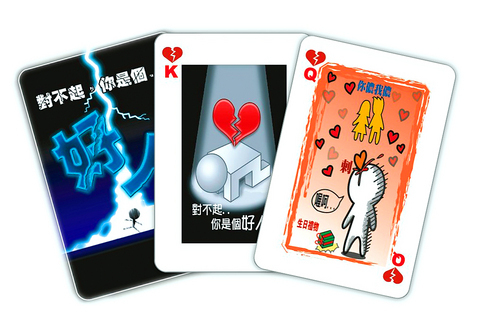
PHOTO COURTESY OF THE GOODMAN CARD ASSOCIATION
It started out as a popular joke among twenty-something males in the late 1990s, but this "goodman" scenario has recently become a full-blown Taiwanese cultural phenomenon.
It has spawned numerous phrases, like "getting the goodman card" (
There are also now many blogs, comics and even songs dedicated to the "goodman" theme. Even Wikipedia has a Chinese-language entry on this aspect of Taiwanese subculture.
Out of this subculture evolved a product that became hugely popular among university students islandwide: a deck of playing cards with humorous graffiti-like designs showing 54 rejection scenarios.
The cards were designed and marketed by a handful of college students who wanted to cash in on the phenomena. The packs went on sale at the beginning of last month, and the whole stock of 3,000 packs (NT$150 each) was sold out within a week.
The packs were taken off the "Goodman Card Association" blog site as the makers wanted to spare men from receiving such cards. Soon after, the price of a single pack hit NT$6,000 on some auction Web sites.
The conventional image of the Taiwanese "goodman" is a person who wears a thread-bare Hang-Ten T-shirt, blue and white flip-flops, and sports long hair and stubble. After years holed up in the classroom studying and taking exams, they have no idea how to interact with the fairer sex, and so are doomed to spend their adult years watching smooth-talking rivals getting the partner of their dreams. One Internet group associated with the phenomenon has even called itself the "Valentine's Day Die Die Group" (
All of this is done in the spirit of good humor, but with a number of recent studies showing a growing percentage of highly educated women remaining single for longer than members of previous generations, and increasing numbers of men arranging marriages with foreign brides, it seems to echo social trends.
"This is something that almost any guy could relate to," said Tim Chang (張庭瑋), 21, a student at National Taiwan University. He and his two roommates queued for many hours to buy the cards. "Who hasn't been a `goodman' in their lives? It probably symbolizes the dilemma that young men in our generation face, probably for the first time in Taiwan. A conservative education system has taught boys to be nice, respectful, not talk too much and to study hard. Entering college we realize that's exactly what makes us `goodmen.' Pop culture has produced the contrary image for `real men' -- namely smartly dressed, who are not nice, at least not all of the time. Now that women are more dominant in choosing a partner, this seems really unfair on nice guys."
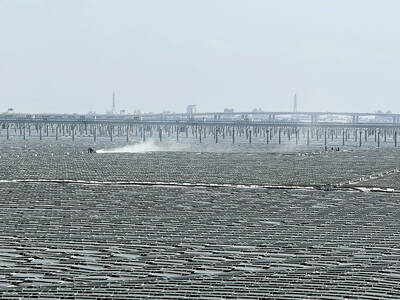
The arithmetic is straightforward and uncomfortable. By the end of 2025, Taiwan had committed itself to a 50-30-20 electricity mix — half natural gas, 30 per cent coal, 20 per cent renewables. The Ministry of Economic Affairs’s (MOEA) own monthly energy reports tell a different story. Natural gas reached 47.8 per cent of generation last year. Coal stood at 35.4 per cent, comfortably above its target ceiling. Renewables came in at 13.1 per cent, well short of the 20 per cent Taipei had pledged a decade earlier. Installed renewable capacity reached roughly half of the 12 gigawatts (GW) the government
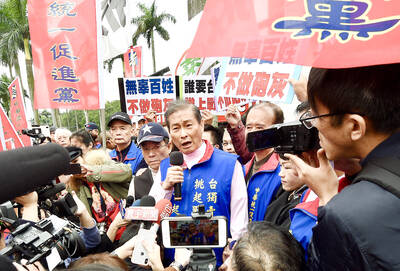
There are shadowy cabals plotting to sell out Taiwan to be annexed by China, by invasion if necessary. Fortunately, they are buffoons. In 2019, former Bamboo Union gangster and founder of the China Unification Promotion Party (CUPP), Chang An-le (張安樂, colorfully known as “White Wolf”), led a protest at the Legislative Yuan against comments made by then-premier Su Tseng-chang (蘇貞昌) that in the event of an attack by China, he would never surrender, but would protect the nation by fighting to the end, even if he only had a broom. Chang had party members bring a wooden casket that they
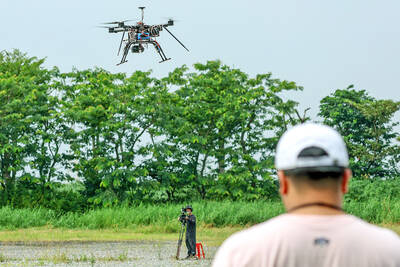
Taiwan’s drone exports are taking off, fuelled by the war in Ukraine, as Taiwanese companies seek a stake in the fast-growing global market for unmanned aerial vehicles (UAV). Low-cost drones used for reconnaissance and strikes are in high demand as governments around the world boost defense spending in the face of intensifying conflicts. A relative new player in the increasingly competitive industry, Taiwan’s pitch is to be an “Asian hub” for the production of UAVs and components free of Chinese materials, or “non-red.” That means its UAVs can be up to three times more expensive than their Chinese competitors, like the world’s biggest
It seems every few days one bumps into one of those “real man” comments in which Taiwan is urged to “face reality” or similar, and “make a deal,” with the speaker implying that soon it will be too late. “Deal” advocates always present themselves as having a superior grip on reality, and the manly ability to make the “hard choice.” Their testosterone-laden language often echoes that of Taiwan sellout advocates. Note that such commentary always specifies a process (“make a deal, work with, make progress”), never the end state of what occupation by a violent authoritarian colonialist state will entail. In


 RSS
RSS