


Christopher Wilk, curator of the Modernism show at the Victoria and Albert Museum (V&A) in London, has achieved what for any museum struggling to persuade the public to buy more tickets is the holy grail of exhibition making. He has managed to ignite a public row on a scale that he could never have predicted, even in his most optimistic dreams. Every broadsheet has been rehearsing the arguments for and against Modernism, very often with just as much heat as they had 75 years ago. The Architects' Journal cartoonist Louis Hellman portrayed Modernism this week as a Frankenstein's monster rising from the dead. Even BBC Radio 4's Today programme pitted Wilk against the improbably named self-styled classical architect Robert Adam to argue the toss about flat roofs, streamlined Frankfurt kitchens and the machine age.
The row is not so much about the show itself, which everybody seems to agree looks spectacular. The real issue is whether Modernism was a good thing. Or, as the pundit Simon Jenkins, reduced to a frothing paroxysm of polemical excess, suggests, was it a very bad thing indeed. Certainly that is the only message that emerges with much clarity from a piece Jenkins wrote last week, urging his readers in The Guardian to go and see what he says is "the most terrifying show I have ever seen." The public, it seems, need no urging.
They are flocking to look for themselves. More than 1,100 people crammed in on the day the exhibition opened, trying to discover if Modernism was simply a style, supposedly a matter of straight lines and glass walls, or whether it meant something more. Not that this caricature represents the full and often contradictory range of Modernist expression, from the sculptural curves of Erich Mendelsohn, to the elegant restraint of Mies van der Rohe, none of which seemed to be inspiring much actual terror on the day I went.
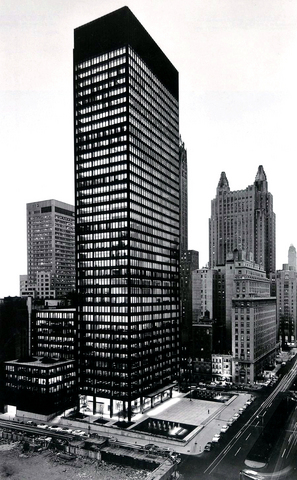
PHOTO: NY TIMES NEWS SERVICE
To judge by the fevered nature of Jenkins's arguments, you might be encouraged to conclude that he was putting his readers at serious personal risk. He appears to be characterizing Wilk as acting the mad scientist, breaking into a locked vault, thawing out the last surviving frozen vial of the long-dead plague virus of Modernism, hurling it into a reservoir and standing back cackling hysterically.
While there are many subjects on which Simon Jenkins is a perceptive and intelligent writer, aesthetics is not one of them.
This is a man who, it might be remembered, in his role as a Millennium Commissioner in Britain, once suggested that Lottery money would be wasted on the Tate, London, since it was, "a place dedicated to presenting dirty underpants as art," and that Bankside power station should instead be turned over to a museum of 19th-century machinery, rather than be contaminated by Modernism.
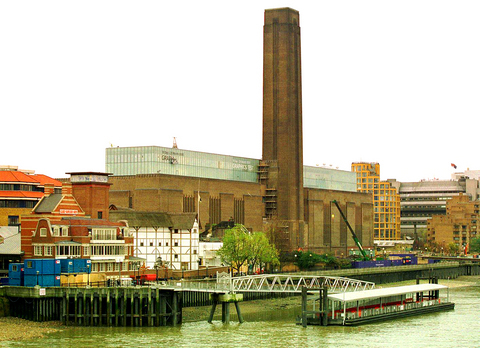
PHOTO: NY TIMES NEWS SERVICE
At one point he suggests that the housing policies of the welfare state were like the forced deportations of the totalitarians. And his grasp of some key facts is also occasionally hazy. Jenkins is wrong to say that Hitler closed the Bauhaus. The Nazis would have been content with purging its Jewish teachers. It was Mies van der Rohe, its director, who closed it rather than accept their terms.
Jenkins goes on to claim that "the creations of Mies van der Rohe ... along with the cruel brutalism of Le Corbusier, must have caused more human misery than any other in history." Including, presumably, the atom bomb.
In Britain he concludes, "Modernism was and is leaky roofs." Sadly, just as richly ornate architecture is no kind of safeguard against lunatic governments, as demonstrated so tragically by Nicolae Ceausescu's Romania, so the inability to keep the weather at bay seems to be a problem that afflicts architects of every variety, even traditionalists. Let's not forget that much of Castle Drogo, designed by Britain's most disting-uished 20th-century Classicist, Edwin Lutyens, is being renovated at huge cost by the National Trust to save it from the architect's chronic inability to keep the rain out.
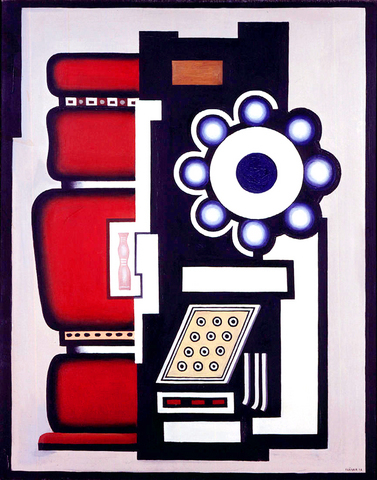
PHOTO COURTESY OF VICTORIA AND ALBERT MUSEUM
According to the critics, Britain between the wars shrugged off the sinister blandishments of the Modernists. It was only afterwards that they managed to get the ear of government and set about the disastrous destruction of the country's traditional city streets in the name of urban renewal. This is to take a surprisingly old-fashioned view of the legacy of the 1960s, which looks very different to a generation younger that Jenkins. The critics of modernism appear not to have heard of the activities of Urban Splash, one of several developers who are busily engaged in rescuing the hulks of the 1960s with the same energy that gentrifiers once applied to terraced Victorian slums. Urban Splash's latest project is an attempt to tackle the heroic but troubled streets in the sky of Park Hill, the range of concrete cliffs that tower over Sheffield, northern England.
They are turning them into desirably modish residences, and boast of recreating a time when Sheffield was a city that "had dreams about its future." Urban Splash go on to claim: "Apart from the Human League, Pulp and spoons, Park Hill is the only thing in Sheffield the rest of the world has ever heard of."
The arguments boil down to claims that Modernism was inhuman, authoritarian and technically inept. But if it was really so bad, and if it was really confined to a tiny and irrelevant coterie, why does it look so good in the show, and why was it so all-pervasive in its influence? Above all, why are its critics still so worried about it? But to answer those questions requires a rather more objective variety of criticism than is currently being brought to bear.
For -- Terence Conran, designer and entrepreneur
The people involved with Modernism believed they could make a better world. It wasn't just about producing nice objects, it was about producing them at a price that everybody could afford, not just the filthy rich, to paraphrase William Morris.
Modernism is the most exciting exhibition I have ever seen in London. It means a huge amount to me personally because I have been very influenced by Modernism, but I also think it has great political significance.
The movement was too austere for British tastes at the beginning: it reminded us a little too much of the servants' quarters, and of course we have always been cynical about new political ideas. In the early days of Habitat, I helped make the style reasonably palatable and brought it to a wider audience. Ikea has achieved today what I set out to achieve with Habitat. It's the biggest furniture retailer in the world and if you are selective you can find very good products there at amazing prices. In its way, Ikea is the Modernist dream come true.
The basic principles of Modernism are still terrifically important. I encouraged Mark Jones, the director of the V&A, to invite Gordon Brown (Britain's finance minister) to see the show. He is going through a period of enthusiasm for design at the moment and I think he would see quite clearly how Modernism can be a social solution. For instance, the Corbusian idea of the tower-block has been badly executed in this country, but I believe the majority of tower-blocks could work very well if a certain amount of money was spent and if maintenance and security were improved. People would be happy to live in them and a major housing issue would be resolved.
I would also encourage every art and design student in the country to come and see the show. It might convert them from the rather floppy decorator approach much in evidence at the moment. You can't open a design magazine without seeing chandeliers everywhere, and in my opinion we're lurching back into everything that Modernism tried to change.
The fact that they filmed the interiors of buildings such as the Villa Savoye in the exhibition so that people could feel as if they were actually walking around inside, was absolutely brilliant. It shows just how much satisfaction you can get from a Modernist space.
Against -- Robert Adam, architect
Modernism was a very important movement in its day, and it saw some fine things being produced by talented people. However, now is the time to put it into its history box and lock it up for good.
Modernism was founded on a frighteningly arrogant idea that an elite group of people could remake society into something supposedly better, regardless of what the general public actually wanted. It was labelled `true architecture' by people who believed they had found the gates to heaven. Two other theories shared a similar mentality in the 1930s: fascism and Stalinism. Paradoxically, Modernism is still around today and in fact it completely dominates the architectural profession. So much so that if you meet an architect, you expect him to be a Modernist.
Everyone struggles with the definition of Modernism. It can be seen as a style but I believe it is more than that: an historical theory, based on the idea that only the things that are different in each period are important. So in the engineering era of the 1920s and 1930s, everything had to conform to what was new in engineering, otherwise you weren't being modern. It's like saying that because we have the ability to produce blobby things with computers today, that's all we can do.
In architecture courses now, if you do traditional work they fail you or recommend you go into conservation. It's like a cult and if an architect is to be recommended or chosen through a competition, you will invariably end up with a Modernist building. Purchasing choice doesn't exist and there's a general belief that offices are by nature Modernist, because that's all you can get. Back in East Germany, people thought the same thing about the Trabant.
Housing, by contrast, is almost all traditional. These buildings are not good, but that's because architecture has abandoned them. The fact that they are bad doesn't mean that people don't want them, or that Modernism is therefore right: it just means that people are not getting a good version of what they really want. Using tower-blocks for mass housing, as we did in the 1950s and 1960s, is a big mistake. They may be suitable for luxury flats or offices, but to say we got it wrong that time, so let's try again, is utter madness.

Sept.16 to Sept. 22 The “anti-communist train” with then-president Chiang Kai-shek’s (蔣介石) face plastered on the engine puffed along the “sugar railway” (糖業鐵路) in May 1955, drawing enthusiastic crowds at 103 stops covering nearly 1,200km. An estimated 1.58 million spectators were treated to propaganda films, plays and received free sugar products. By this time, the state-run Taiwan Sugar Corporation (台糖, Taisugar) had managed to connect the previously separate east-west lines established by Japanese-era sugar factories, allowing the anti-communist train to travel easily from Taichung to Pingtung’s Donggang Township (東港). Last Sunday’s feature (Taiwan in Time: The sugar express) covered the inauguration of the

The corruption cases surrounding former Taipei Mayor and Taiwan People’s Party (TPP) head Ko Wen-je (柯文哲) are just one item in the endless cycle of noise and fuss obscuring Taiwan’s deep and urgent structural and social problems. Even the case itself, as James Baron observed in an excellent piece at the Diplomat last week, is only one manifestation of the greater problem of deep-rooted corruption in land development. Last week the government announced a program to permit 25,000 foreign university students, primarily from the Philippines, Indonesia and Malaysia, to work in Taiwan after graduation for 2-4 years. That number is a

This year’s Michelin Gourmand Bib sported 16 new entries in the 126-strong Taiwan directory. The fight for the best braised pork rice and the crispiest scallion pancake painstakingly continued, but what stood out in the lineup this year? Pang Taqueria (胖塔可利亞); Taiwan’s first Michelin-recommended Mexican restaurant. Chef Charles Chen (陳治宇) is a self-confessed Americophile, earning his chef whites at a fine-dining Latin-American fusion restaurant. But what makes this Xinyi (信義) spot stand head and shoulders above Taipei’s existing Mexican offerings? The authenticity. The produce. The care. AUTHENTIC EATS In my time on the island, I have caved too many times to

In a stark demonstration of how award-winning breakthroughs can come from the most unlikely directions, researchers have won an Ig Nobel prize for discovering that mammals can breathe through their anuses. After a series of tests on mice, rats and pigs, Japanese scientists found the animals absorb oxygen delivered through the rectum, work that underpins a clinical trial to see whether the procedure can treat respiratory failure. The team is among 10 recognized in this year’s Ig Nobel awards (see below for more), the irreverent accolades given for achievements that “first make people laugh, and then make them think.” They are not


 RSS
RSS