


East of the waterfront, up on South Jackson Street, past the International District and at the base of a steep hill in the Central area, looms a giant red Wonder Bread sign.
A lonely piece of Americana, the neon sign is perched atop a shuttered bakery. Beyond the broader neighborhood implications of the factory's imminent demolition and replacement with housing and shops is the prickly question of what happens to the sign.
The San Diego company that is developing the 0.65-hectare property said the sign would be donated to the nearby Pratt Institute of Fine Arts. But that has some neighborhood residents worried that Pratt will auction it off to wealthy collectors.

PHOTOS: NY TIMES NEWS SERVICE
Old neon industrial signs are in the midst of a renaissance, especially across the Northwest and in Los Angeles. Seattle is on the cutting edge of this scene, mostly because the city, already a national leader in historic preservation, did not take down or restore many of the original signs at bustling establishments like the Pike Place Market, founded in 1907, and the Elephant Car Wash, started up in 1951.
Still, some, like the Wonder Bread sign and the neon R for the Rainier Brewing Co, which is now in a neon museum, are no longer hovering above thriving businesses.
Pratt officials did not return telephone calls seeking comment about their plans for the sign. But the executive director, Earl Sedlik, told The Seattle Post-Intelligencer last year, when the sign question first emerged, "Our artists are eager to inherit the sign -- whether or not it ends up here, I don't know."

Bill Bradburd, an artist who moved here from San Francisco, said the Wonder Bread sign was really a symbol of a "bait and switch" on the part of city officials. Bradburd, who lives near the bakery and is a co-chairman of the Jackson Place Community Council, said development was moving at such a fast pace that city officials who had promised to protect the character of Seattle's neighborhoods were instead seizing on the dollars flowing in.
Bradburd and others on the council want the sign displayed publicly near the site of the bakery.
But is the tension over these 11 red letters, each 1.8m tall, really about the sign?
"These battles over saving something old are proxy battles," said David Brewster, the founder of Town Hall, Seattle's cultural center, who is writing a history of the city since the 1962 World's Fair here. "They are really battles against traffic, although of course gentrification weighs in."
Seattle, founded in the 1850s, is still relatively young, Brewster said. "Where you don't have a lot of history," he said, "you do want to hang onto the little you do have. And where you have a high degree of change, you fear change."
The city, still recovering from the dot-com bust, is in a young yet remarkable real estate boom. Projections for 2006 construction, said Alan Justad, a spokesman for the city's planning department, outpace last year, when the city accepted a record US$2 billion in residential and commercial building permit applications, with US$1.7 billion approved. Much of the development is concentrated downtown under a planning strategy known as "urban density," which is intended to prevent sprawl.
But development is also coming soon to neighborhoods like the Central area. Seattle, with a population of 572,000, according to city figures, and an additional three million people living elsewhere in the metropolitan area, is projecting a population increase within the city limits of at least 100,000 people by 2024.
About half of those would live downtown, Justad said, with the rest in new housing planned for some of Seattle's 38 neighborhoods, or "urban villages," in planning parlance.
"The bottom line is green; you can't hold back progress," said Terry Johnson, 62, who grew up in the Central area with Jimi Hendrix and for a time worked at the bakery. "Devel-opment, it's inevitable, and the worst thing you can do is not develop there and just leave them all to grow old poor."

Sept.16 to Sept. 22 The “anti-communist train” with then-president Chiang Kai-shek’s (蔣介石) face plastered on the engine puffed along the “sugar railway” (糖業鐵路) in May 1955, drawing enthusiastic crowds at 103 stops covering nearly 1,200km. An estimated 1.58 million spectators were treated to propaganda films, plays and received free sugar products. By this time, the state-run Taiwan Sugar Corporation (台糖, Taisugar) had managed to connect the previously separate east-west lines established by Japanese-era sugar factories, allowing the anti-communist train to travel easily from Taichung to Pingtung’s Donggang Township (東港). Last Sunday’s feature (Taiwan in Time: The sugar express) covered the inauguration of the

The corruption cases surrounding former Taipei Mayor and Taiwan People’s Party (TPP) head Ko Wen-je (柯文哲) are just one item in the endless cycle of noise and fuss obscuring Taiwan’s deep and urgent structural and social problems. Even the case itself, as James Baron observed in an excellent piece at the Diplomat last week, is only one manifestation of the greater problem of deep-rooted corruption in land development. Last week the government announced a program to permit 25,000 foreign university students, primarily from the Philippines, Indonesia and Malaysia, to work in Taiwan after graduation for 2-4 years. That number is a
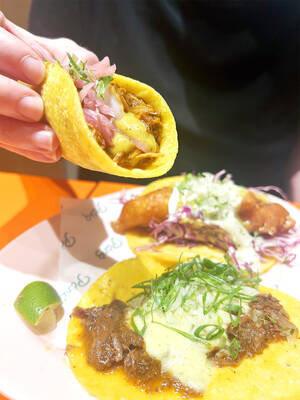
This year’s Michelin Gourmand Bib sported 16 new entries in the 126-strong Taiwan directory. The fight for the best braised pork rice and the crispiest scallion pancake painstakingly continued, but what stood out in the lineup this year? Pang Taqueria (胖塔可利亞); Taiwan’s first Michelin-recommended Mexican restaurant. Chef Charles Chen (陳治宇) is a self-confessed Americophile, earning his chef whites at a fine-dining Latin-American fusion restaurant. But what makes this Xinyi (信義) spot stand head and shoulders above Taipei’s existing Mexican offerings? The authenticity. The produce. The care. AUTHENTIC EATS In my time on the island, I have caved too many times to

Many Taiwanese have a favorable opinion of Japan, in part because Taiwan’s former colonial master is seen as having contributed a great deal to the development of local industries, transportation networks and institutions of education. Of course, the island’s people were never asked if they wanted to be ruled by Tokyo or participate in its modernization plans. From their arrival in 1895 until at least 1902, the Japanese faced widespread and violent antagonism. Things then calmed down, relatively speaking. Even so, between 1907 and 1916 there were eleven anti-Japanese revolts. A map in the National Museum of Taiwan History (國立臺灣歷史博物館)


 RSS
RSS