


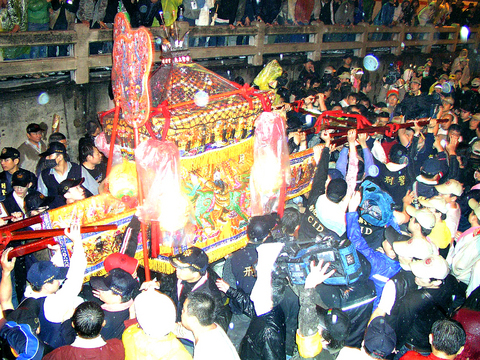
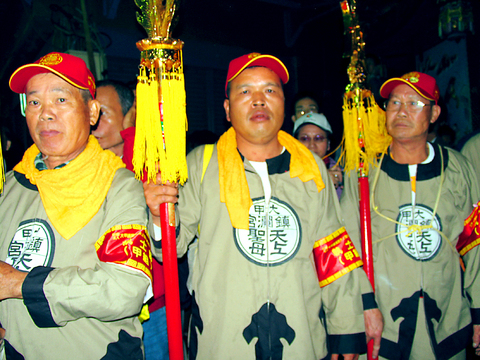
At times it was like being in a war zone as the barrage of firecrackers went on for hours, rockets exploded and chaos reigned. Fervent crowds fought to get close to the palanquin carrying the goddess Matsu and were forced back by the stewards with shouts and sometimes blows. Marchers dressed in traditional soldiers' costumes and carrying banners followed. Pilgrims trailing behind looked like refugees, with their meager possessions and bedraggled looks.
Gunpowder and incense assailed the nostrils, drums set a martial pace, gongs were struck and Chinese horns blared. It was a riot of sound and color. Then, the heavens opened and the rain poured but the march went on, out of the city and into the countryside.
The pilgrims followed and locals turned out to burn ghost money, falling to the ground so the palanquin could pass over them and Matsu would bless them with health and fortune for the year ahead.
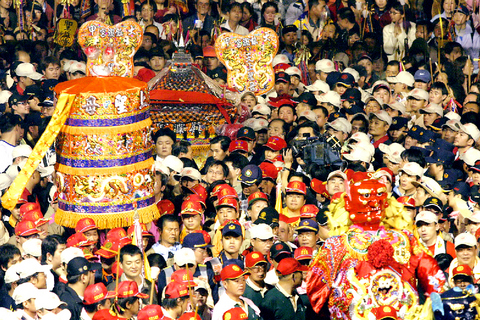
PHOTOS: JULES QUARTLY, ZHAN CHAO-YANG AND TANG SHIH-MING
Though the eight-day Tachia Matsu pilgrimage (大
After a free lunch at the Tianhou Temple (天后宮) prepared by volunteers for the pilgrims, we set off to a warehouse to procure fireworks. We loaded up the lorries and then drove to Fulung Temple (福龍宮), not far from the city center and one of the main routes on the march. Here we waited. So far, it was all peace and light and the gods seemed to be smiling. Whole families had turned out for the occasion and the sun was shining dimly.
It may have been the betel nuts, the liquor, the cigarettes and the general excitement, but when the procession arrived at the temple and the fireworks were lit, it was Matsu madness. The crowd surged to get closer to the palanquin and it became a roiling mass, deafening and blinding. This went on for hours and climaxed around 10pm when the rain started bucketing down.
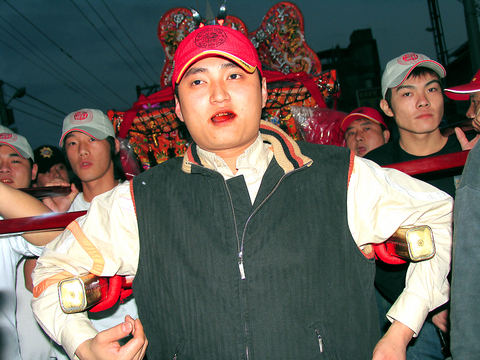
There was a continuous volley of fireworks and a small hiatus before the palanquin bearers and Matsu's retinue of followers charged with a great roar down an underpass, chased by a sea of people. There seemed to be fighting over control of the palanquin as another set of stewards took over; and there was a series of martial art displays, one of which included a 100-year-old turtle.
Then, I lost my money, the car and my patience. I was soaking, tired and hungry and couldn't take any more. Feeling pissed off seemed a reasonable reaction, especially when everyone kept saying it was all a blessing from Matsu.
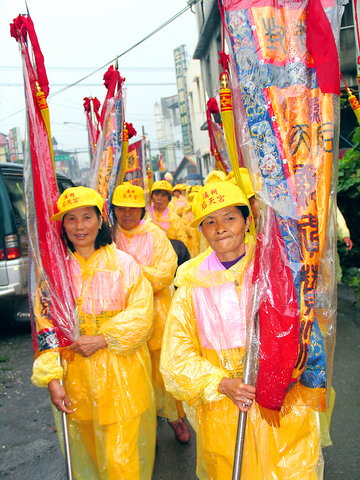
Later, however, the car was found and after drying out and refueling I tracked down the march once again as it made its way out of the city, toward Yuanlin (員林) and Beitou (北斗). It was humbling to see the long file of pilgrims in their yellow plastic raincoats and sandals still following the procession. These people were not fit or young. They were hunched against the rain, their Tachia Matsu flags strapped to their backs. It was explained to me that maybe smaller misfortunes would prevent a catastrophe or would pay for future good luck. It seemed to make sense.
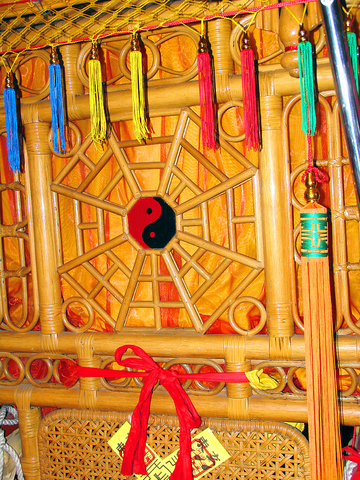
It was 3am and at the head of the procession the energy levels were still high. A new gang had taken over carrying the palanquin and there were more fireworks to signpost the route and light the way. Other palanquins joined the procession, lit up by fluorescent lights. It was a great journey, we were like salmon to the Sargasso Sea. The devout held their incense sticks, smiling serenely against the dark and content in their own world. Volunteers provided cups of hot tea along the route as if this were a marathon.
Around 11am the train of pilgrims arrived in Hsichou (溪
Around lunchtime there was another big display. First the procession with its costumed soldiers and musicians and followers wound its way through the town's narrow streets, filling them with smoke. Then they returned to the temple and everyone bowed three times before entering, accompanied by a cannonade of fireworks and wail of horns. Drunken gods clowned, policemen took their turn carrying the palanquin and the local bigwigs got their chance for an interview on national TV. Then the show was back on the road to Hsiluo (西螺).
Even the ill and the poor are encouraged to go on the Tachia Matsu pilgrimage, for the obvious reason that Matsu will bless them for it. One disabled pilgrim surnamed Chang (張

Sept.16 to Sept. 22 The “anti-communist train” with then-president Chiang Kai-shek’s (蔣介石) face plastered on the engine puffed along the “sugar railway” (糖業鐵路) in May 1955, drawing enthusiastic crowds at 103 stops covering nearly 1,200km. An estimated 1.58 million spectators were treated to propaganda films, plays and received free sugar products. By this time, the state-run Taiwan Sugar Corporation (台糖, Taisugar) had managed to connect the previously separate east-west lines established by Japanese-era sugar factories, allowing the anti-communist train to travel easily from Taichung to Pingtung’s Donggang Township (東港). Last Sunday’s feature (Taiwan in Time: The sugar express) covered the inauguration of the

The corruption cases surrounding former Taipei Mayor and Taiwan People’s Party (TPP) head Ko Wen-je (柯文哲) are just one item in the endless cycle of noise and fuss obscuring Taiwan’s deep and urgent structural and social problems. Even the case itself, as James Baron observed in an excellent piece at the Diplomat last week, is only one manifestation of the greater problem of deep-rooted corruption in land development. Last week the government announced a program to permit 25,000 foreign university students, primarily from the Philippines, Indonesia and Malaysia, to work in Taiwan after graduation for 2-4 years. That number is a
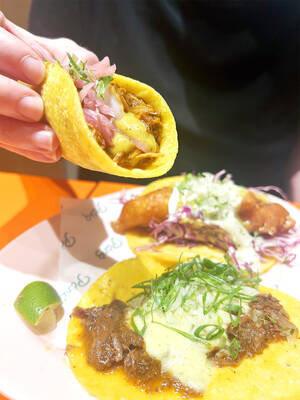
This year’s Michelin Gourmand Bib sported 16 new entries in the 126-strong Taiwan directory. The fight for the best braised pork rice and the crispiest scallion pancake painstakingly continued, but what stood out in the lineup this year? Pang Taqueria (胖塔可利亞); Taiwan’s first Michelin-recommended Mexican restaurant. Chef Charles Chen (陳治宇) is a self-confessed Americophile, earning his chef whites at a fine-dining Latin-American fusion restaurant. But what makes this Xinyi (信義) spot stand head and shoulders above Taipei’s existing Mexican offerings? The authenticity. The produce. The care. AUTHENTIC EATS In my time on the island, I have caved too many times to

In a stark demonstration of how award-winning breakthroughs can come from the most unlikely directions, researchers have won an Ig Nobel prize for discovering that mammals can breathe through their anuses. After a series of tests on mice, rats and pigs, Japanese scientists found the animals absorb oxygen delivered through the rectum, work that underpins a clinical trial to see whether the procedure can treat respiratory failure. The team is among 10 recognized in this year’s Ig Nobel awards (see below for more), the irreverent accolades given for achievements that “first make people laugh, and then make them think.” They are not


 RSS
RSS