


The huddled masses in Max Barry's hilarious new novel, Company, can be found crammed inside the Seattle corporate headquarters of Zephyr Holdings. What does Zephyr Holdings hold? Nothing. What is its office building like? "It is a building designed by committee," Barry explains. "All they have been able to agree on is that it should be rectangular, have windows, and not fall over."
On Page seven of his latest fever dream about big business (after the wild fabulist escapades of Syrup and Jennifer Government), Barry underscores his credentials as both satirist and saboteur. He presents a one-paragraph mission statement that is a marvel. He has put real words ("consolidate," "profitable," "strategic") on the page. You can see them. But they have been perfectly arranged to flummox the brain. The paragraph is a perfect specimen of corporate-speak: impressive to gaze upon, totally impossible to read.
In a book dedicated to Hewlett-Packard, which once made the silly, silly mistake of employing Barry, the secrets and lies of corporate culture are explored with sharp, absurdist precision. Joseph Heller did it better, but not by much. Barry, an Australian writer with a mad gleam and a college education in marketing, invents a rats' nest of warring departments and scheming, back-biting employees, all manipulated by a senior management staff of exceptional ruthlessness.

"If senior management was ever made up of selfless individuals who put teamwork ahead of self-interest -- and this is a big if," Barry writes, "they were long ago torn to pieces."
Into this fray comes handsome, idealistic Stephen Jones, a newcomer of such clonelike perfection that some Zephyr cynics wonder whether he has a navel. This much is certain: Jones has a mouth, and it asks too many questions. For instance, Jones wonders why his salary has been hidden within the budget for office expenses ("I'm copy paper?") just because he arrived in the midst of a hiring freeze. And he begins to wonder why Zephyr, though a hive of activity, seems to have no real customers and no real work to do.
A third of the way into Company, Barry unveils a surprise: this satirical novel also has an element of science fiction. It mustn't be spoiled here. But the place is alive with trickery and its employees' already borderline personalities are at risk. As the book says of one Zephyr worker: "If Elizabeth's brain was a person, it would have scars, tattoos, and be missing one eye. If you saw it coming, you would cross the street."
Gathering his readers around a figurative campfire, Barry explains what work used to be like. "There are stories -- legends, really -- of the `steady job,'" he writes. "Old-timers gather graduates around the flickering light of a computer monitor and tell stories of how the company used to be, back when a job was for life, not just for the business cycle." But in the book's funhouse-mirror world, flexibility is the new ideal. "Flexible jobs allow employees to share in the company's ups and downs; well, not so much the ups," Barry writes. Desperate Zephyr workers do their best to keep up with the parsimonious atmosphere. "Every day we identify new ways to lower expenses," a colleague explains to Jones. "Just yesterday, we boarded up our office windows."
Company is Barry's breakout book. It's also his most conventional. In Syrup he took on the Coca-Cola Co (nothing else he writes is quite as sidesplitting as his disclaimers of malicious intent) and made wicked fun of hot young marketing types, the ones who favor quirky names. He himself test-drove the name Maxx Barry, though nobody got the joke. Jennifer Government was also convolutedly clever, but it worked hard to achieve its anarchic spirit.
In Company the characters are more breezily conceived. This is not to say that the author's world has lost its warped mystique, just that he has made it more -- yes -- marketable.
Being John Malkovich is one of his favorite films, and its influence is felt when Company, both psychically and literally, lands in the limbo between elevator floors.
Barry has sometimes been compared to Chuck Palahniuk for his rebellious bravado, but he has much more in common with Charlie Kaufman, the screenwriter with such an easy affinity for the Orwellian surreal.
Company eventually faces the problem inherent to paranoid fantasy: once the secrets are revealed, what happens next? Barry is far better equipped to zap Zephyr than to make it a more positive, productive, life-affirming place. He perfectly understands the company's problems. ("If Senior Management captained a ship, it would take twice as long to reach its destination and have been completely rebuilt en route.") But he is less astute about Zephyr's merits, possibly because there aren't any.
The closest he comes to humanizing Zephyr is to make Jones fall reflexively for Barry's favorite type of female character, this time named Eve: a cool, selfish, elusive beauty. "She shouldn't be here," a co-worker confides to Jones. "Her ideal job would be giving lethal injections in San Quentin."
Occasionally, Company is flimsy: its central conceit, about a stolen doughnut that occasions much pouting and sniping (and is seen on the book's cover), isn't worth the attention it's given. And some of the corporate types at Zephyr are slightly generic. But Barry is a deft and focused satirist, and his sense of business ethics is right on the money. "I just want to know that we treat our employees properly," Jones insists. "That we, you know, care about them."
"Honestly?" he is told by one of the real powers at Zephyr. "We don't."

Sept.16 to Sept. 22 The “anti-communist train” with then-president Chiang Kai-shek’s (蔣介石) face plastered on the engine puffed along the “sugar railway” (糖業鐵路) in May 1955, drawing enthusiastic crowds at 103 stops covering nearly 1,200km. An estimated 1.58 million spectators were treated to propaganda films, plays and received free sugar products. By this time, the state-run Taiwan Sugar Corporation (台糖, Taisugar) had managed to connect the previously separate east-west lines established by Japanese-era sugar factories, allowing the anti-communist train to travel easily from Taichung to Pingtung’s Donggang Township (東港). Last Sunday’s feature (Taiwan in Time: The sugar express) covered the inauguration of the

The corruption cases surrounding former Taipei Mayor and Taiwan People’s Party (TPP) head Ko Wen-je (柯文哲) are just one item in the endless cycle of noise and fuss obscuring Taiwan’s deep and urgent structural and social problems. Even the case itself, as James Baron observed in an excellent piece at the Diplomat last week, is only one manifestation of the greater problem of deep-rooted corruption in land development. Last week the government announced a program to permit 25,000 foreign university students, primarily from the Philippines, Indonesia and Malaysia, to work in Taiwan after graduation for 2-4 years. That number is a
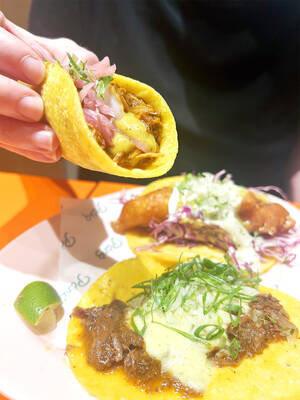
This year’s Michelin Gourmand Bib sported 16 new entries in the 126-strong Taiwan directory. The fight for the best braised pork rice and the crispiest scallion pancake painstakingly continued, but what stood out in the lineup this year? Pang Taqueria (胖塔可利亞); Taiwan’s first Michelin-recommended Mexican restaurant. Chef Charles Chen (陳治宇) is a self-confessed Americophile, earning his chef whites at a fine-dining Latin-American fusion restaurant. But what makes this Xinyi (信義) spot stand head and shoulders above Taipei’s existing Mexican offerings? The authenticity. The produce. The care. AUTHENTIC EATS In my time on the island, I have caved too many times to

In a stark demonstration of how award-winning breakthroughs can come from the most unlikely directions, researchers have won an Ig Nobel prize for discovering that mammals can breathe through their anuses. After a series of tests on mice, rats and pigs, Japanese scientists found the animals absorb oxygen delivered through the rectum, work that underpins a clinical trial to see whether the procedure can treat respiratory failure. The team is among 10 recognized in this year’s Ig Nobel awards (see below for more), the irreverent accolades given for achievements that “first make people laugh, and then make them think.” They are not


 RSS
RSS