


Recently, the Taipei Fine Arts Museum has started exhibiting part of its collection in thematic exhibitions -- a great way to learn about Taiwan's modern history as told through art. Figurative painting in Taiwan is divided into five areas and these take the viewer through the story of Taiwan's diverse painting history and features 120 works by 70 artists.
The first theme is "Naturalism-Objectivity," which mainly consists of landscape painting. This inclusion seems strange, as in Western art history classes it is taught that figurative painting is the depiction of the human form. For local painters, however, there did not seem to be separate categories as the body and the landscape were interchangeable subjects for them.
The impressionist school of pain-ting began to influence Taiwanese painters in the 1950s. It also coincided with the New Art Movement of the Japanese colonial period (1895 to 1945) when artists depicted material objects in naturalistic ways. Even though the techniques may have come from outside influences, the subject matter was unique to Taiwan and included images of farmers, village life, and the water buffalo -- which soon came to symbolize Formosan life.

PHOTO COURTESY OF TFAM
Yen Shui-long's (
Under the theme "Altered Forms-Simplification," more lyrical and fanciful paintings appear. Wu Hao's (
As nativist literature began to influence the local visual arts during the 1970s, painters began to use Western painting techniques such as photorealism to portray Taiwan's grassroots culture. "Native Consciousness-Photorealism" is a grouping of paintings that depict Taiwan's unique local flavor.

PHOTO COURTESY OF TFAM
As neo-expressionist painting swept Europe and North America in the early 1980s, the passionate forms of expressive brushwork had a major influence on Taiwanese painters. However, these artists had strong ideas about Taiwanese identity and were concerned with the contemporary political and social issues, as martial law was beginning to lose its grip. Under the theme "Historical Subjects-Neo-Expressionism" many of the works by these critical painters refer to the local history of coloni-zation and the struggle in the search for a native identity.
Yang Mao-lin's (
The last theme of the exhibition is "Virtual Realities-New Figurative Forms" and highlights the pluralist nature of the local art scene in the 1990s. As more artists studied or traveled abroad, they brought back diverse cultural influences. Wu Yung-chieh's (

PHOTO COURTESY OF TFAM
Last week, Viola Zhou published a marvelous deep dive into the culture clash between Taiwanese boss mentality and American labor practices at the Taiwan Semiconductor (TSMC) plant in Arizona in Rest of World. “The American engineers complained of rigid, counterproductive hierarchies at the company,” while the Taiwanese said American workers aren’t dedicated. The article is a delight, but what it is depicting is the clash between a work culture that offers employee autonomy and at least nods at work-life balance, and one that runs on hierarchical discipline enforced by chickenshit. And it runs on chickenshit because chickenshit is a cultural
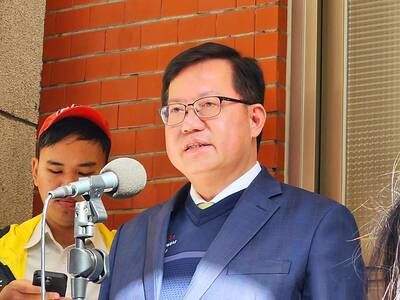
By far the most jarring of the new appointments for the incoming administration is that of Tseng Wen-tsan (鄭文燦) to head the Straits Exchange Foundation (SEF). That is a huge demotion for one of the most powerful figures in the Democratic Progressive Party (DPP). Tseng has one of the most impressive resumes in the party. He was very active during the Wild Lily Movement and his generation is now the one taking power. He has served in many of the requisite government, party and elected positions to build out a solid political profile. Elected as mayor of Taoyuan as part of the
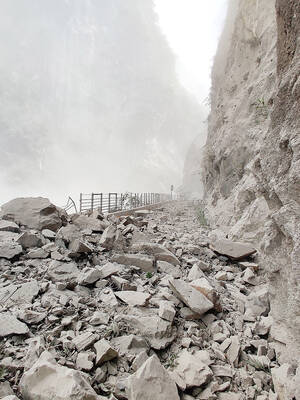
Moritz Mieg, 22, lay face down in the rubble, the ground shaking violently beneath him. Boulders crashed down around him, some stones hitting his back. “I just hoped that it would be one big hit and over, because I did not want to be hit nearly to death and then have to slowly die,” the student from Germany tells Taipei Times. MORNING WALK Early on April 3, Mieg set out on a scenic hike through Taroko Gorge in Hualien County (花蓮). It was a fine day for it. Little did he know that the complex intersection of tectonic plates Taiwan sits

When picturing Tainan, what typically comes to mind is charming alleyways, Japanese architecture and world-class cuisine. But look beyond the fray, through stained glass windows and sliding bookcases, and there exists a thriving speakeasy subculture, where innovative mixologists ply their trade, serving exquisite concoctions and unique flavor profiles to rival any city in Taiwan. Speakeasies hail from the prohibition era of 1920s America. When alcohol was outlawed, people took their business to hidden establishments; requiring patrons to use hushed tones — speak easy — to conceal their illegal activities. Nowadays legal, speakeasy bars are simply hidden bars, often found behind bookcases


 RSS
RSS