


In November, a performance of a sensationally popular acrobatic version of Swan Lake in Shanghai was abruptly canceled. Refunds were issued to more than 3,000 ticket holders. And the show's two lead performers were summoned here to the nation's capital.
"We flew to Beijing and arrived on Saturday," said Wu Zhengdan, the female lead. "We knew we were going to perform for someone special. We just didn't know who it was."
That Sunday evening, Wu and her partner, Wei Baohua, performed at a banquet in the Great Hall of the People, one of China's landmark government buildings, for dignitaries who included US President George W. Bush and China's President Hu Jintao (
PHOTOS: NY TIMES
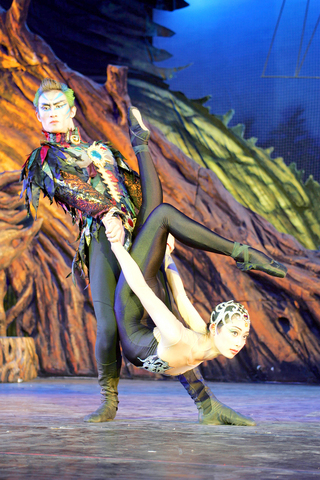
Demonstrating the unconventional blend of classical ballet and traditional Chinese acrobatics they perfected for the new Swan Lake, the delicate Wu, 24, did a pirouette, aloft on the shoulder and outstretched arm of the muscular Wei, 34, who is also her husband. She also rose up, stunningly, on pointe on Wei's head. There followed a gymnastic pas de deux.
Such bravura moves have delighted crowds in China over the past year, helping turn this radical reworking of Swan Lake by the Guangdong Military Acrobatic Troupe into a box office hit and transforming the couple into stars.
Now, the acrobatic Swan Lake featuring Wu and Wei is preparing for a world tour that will include Russia, Japan, Germany, and the US, where the couple already won high praise last October when they took part in the "Festival of China" at the Kennedy Center in Washington.
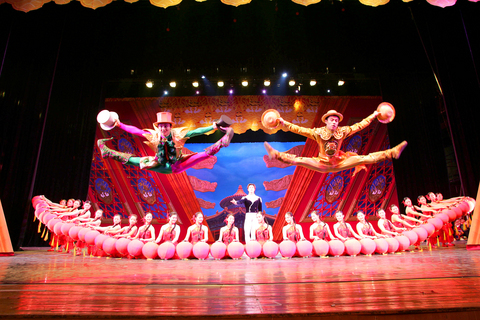
What audiences will see is not your usual Swan Lake. Although this 19th-century Russian ballet has been a fixture on the Chinese stage for decades, the current version contains several decidedly Chinese twists.
It opens with Prince Siegfried dreaming of a beautiful girl who has been transformed into a swan by an evil eagle, a vision that propels him into a quest that takes him from Europe through Africa, the Middle East, and South Asia before landing him in Beijing -- a journey that provides the acrobatic troupe with ample opportunity for displays of local color. There, in the Forbidden City, he meets the young Chinese swan-woman he will make his bride.
This West-meets-East take on Swan Lake is emblematic of the broad shift under way in China as state-sponsored cultural institutions move toward more market-oriented offerings.
Film producers, dancers, musicians -- even military performing groups -- that long depended on the government for financial support are now aggressively pursuing commercial opportunities. They are seeking private sponsors and hoping to profit by luring bigger audiences at home or exporting cultural extravaganzas to the rest of the world.
Filmmakers, often backed by state-owned production houses, are now trying to make Hollywood blockbusters. Even the monks of Shaolin Temple, famed for their martial arts skills, have gone commercial, forming their own for-profit company to produce kung fu movies and promote the Shaolin brand. The choreographer behind the new Swan Lake, Zhao Ming, says that China's state-run performing arts system is packed with hidden talent waiting to be discovered. "There are a lot of people with great technique here, but because they're in the military troupe, they have less chance to let people know," said Zhao, who also choreographs the Beijing Military Troupe.
Both Wu and Wei are products of a similarly rigid system, the socialist-era sports school programs that are still geared toward producing Olympic champions.

Sept.16 to Sept. 22 The “anti-communist train” with then-president Chiang Kai-shek’s (蔣介石) face plastered on the engine puffed along the “sugar railway” (糖業鐵路) in May 1955, drawing enthusiastic crowds at 103 stops covering nearly 1,200km. An estimated 1.58 million spectators were treated to propaganda films, plays and received free sugar products. By this time, the state-run Taiwan Sugar Corporation (台糖, Taisugar) had managed to connect the previously separate east-west lines established by Japanese-era sugar factories, allowing the anti-communist train to travel easily from Taichung to Pingtung’s Donggang Township (東港). Last Sunday’s feature (Taiwan in Time: The sugar express) covered the inauguration of the

The corruption cases surrounding former Taipei Mayor and Taiwan People’s Party (TPP) head Ko Wen-je (柯文哲) are just one item in the endless cycle of noise and fuss obscuring Taiwan’s deep and urgent structural and social problems. Even the case itself, as James Baron observed in an excellent piece at the Diplomat last week, is only one manifestation of the greater problem of deep-rooted corruption in land development. Last week the government announced a program to permit 25,000 foreign university students, primarily from the Philippines, Indonesia and Malaysia, to work in Taiwan after graduation for 2-4 years. That number is a

This year’s Michelin Gourmand Bib sported 16 new entries in the 126-strong Taiwan directory. The fight for the best braised pork rice and the crispiest scallion pancake painstakingly continued, but what stood out in the lineup this year? Pang Taqueria (胖塔可利亞); Taiwan’s first Michelin-recommended Mexican restaurant. Chef Charles Chen (陳治宇) is a self-confessed Americophile, earning his chef whites at a fine-dining Latin-American fusion restaurant. But what makes this Xinyi (信義) spot stand head and shoulders above Taipei’s existing Mexican offerings? The authenticity. The produce. The care. AUTHENTIC EATS In my time on the island, I have caved too many times to

In a stark demonstration of how award-winning breakthroughs can come from the most unlikely directions, researchers have won an Ig Nobel prize for discovering that mammals can breathe through their anuses. After a series of tests on mice, rats and pigs, Japanese scientists found the animals absorb oxygen delivered through the rectum, work that underpins a clinical trial to see whether the procedure can treat respiratory failure. The team is among 10 recognized in this year’s Ig Nobel awards (see below for more), the irreverent accolades given for achievements that “first make people laugh, and then make them think.” They are not


 RSS
RSS