


Now in its third year, the Weather in My Brain Sound-Visual Art Festival (腦天氣影音藝術季) has evolved quickly from a basement-type event into a three-week, two-city festival that takes free-spirited adventurers into a challenging world of experimental electronic sounds and avant-garde visual art.
Promoted by inspired artists on the cutting edge of the digital arts from Japan, Europe and Taiwan, the arts festival presents digital artforms in two main categories: live sound-and-visual performances, and a music video film festival.
Aiming to offer an inclusive look at visual-audio art works, ranging from contemporary gallery pieces to commercial art and raw street art, the MV film festival has 10 themes by different programmers. Experimental films by a new generation of Chinese artists are grouped into the Reinventing Experimental Chinese Sound-Visuals, while Weather in My Brain Special Section will showcase 11 pieces selected from entries by young local artists.
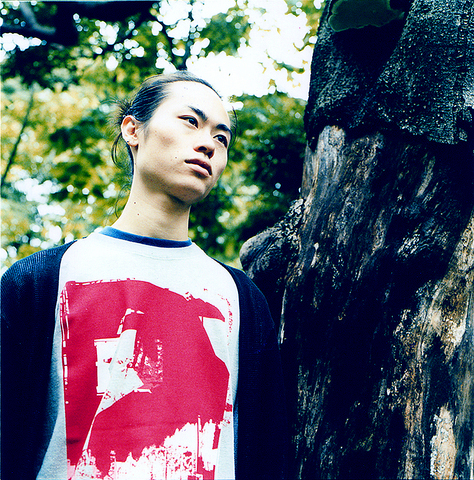
PHOTO COURTESY OF WIMB
On a more commercial note, Creative Taiwanese Music Videos introduces rarely seen MVs packed with the energy of local independent acts. In collabor-ation with eight independent labels from around the world, Progressive Label Music Videos showcases MV productions from Ninja Tune in the UK and W+K Tokyo Lab in Japan.
For those with more classicaly-trained minds, Critical Day and Upper Level will take festival-goers deep into multi-dimensional sound and digital spaces. Yuki Kawamura is one of the artists in focus this year, and nine of his short pieces will be shown at the festival.
Films begin showing Monday at a dozen venues across Taipei. Live sound and visual art performances will start Wednesday, to Jan. 20, at the newly opened Eslite Flagship Bookstore in the Xinyi district.
Organizer and curator Huang Yi-chin (黃一晉) believes the fine arts shouldn't be confined to gallery spaces.
The three-day performances will feature Japanese artists Tatsuya Yoshida + Ruins, Ryoichi Kurokawa, VJ Hiroi, Marc Behrens from Germany, Alpha District from UK and a troupe of local artists including Monbaza, Cold Turkey Express, Varo, Punk Can and EJ, Clair and Logico (朗機工).
Having toured with Brit bands such as Death Cab for Cuties, Cave In and The Darkness, Alpha District will conclude the live performance series with local post-rock bass player Huang Hong-jun (黃宏駿) against a digital mural created by Mindlobster.
The festival will continue in Taichung starting on Jan. 21 with a large outdoor performance.
International artists Ryoichi Kurokawa. Alpha Districk, Marc Behrens, and local talents Nylas, Logico and others will all head south for the grand gathering.
The MV Film Festival in Taichung will also take place at various locations including JDS, Renaissance
Performance notes:
What: Weather in My Brain Sound-Visual Art Festival (
Where: Two main venues: 6F, Eslite Hall at Eslite Flagship Bookstore in Xinyi District (
When: Jan. 16 through Jan. 27 in Taipei; Jan. 21 through Feb. 5 in Taichung.
Tickets: For live performances, tickets cost NT$450 for one show; NT$650 for a three-day pass, available through NTCH ticketing outlets or at performance venues.
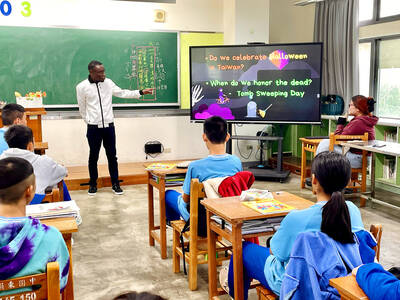
For many people, Bilingual Nation 2030 begins and ends in the classroom. Since the policy was launched in 2018, the debate has centered on students, teachers and the pressure placed on schools. Yet the policy was never solely about English education. The government’s official plan also calls for bilingualization in Taiwan’s government services, laws and regulations, and living environment. The goal is to make Taiwan more inclusive and accessible to international enterprises and talent and better prepared for global economic and trade conditions. After eight years, that grand vision is due for a pulse check. RULES THAT CAN BE READ For Harper Chen (陳虹宇), an adviser
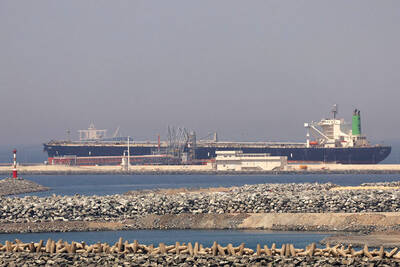
The breakwater stretches out to sea from the sprawling Kaohsiung port in southern Taiwan. Normally, it’s crowded with massive tankers ferrying liquefied natural gas from Qatar to be stored in the bulbous white tanks that dot the shoreline. These are not normal times, though, and not a single shipment from Qatar has docked at the Yongan terminal since early March after the Strait of Hormuz was shuttered. The suspension has provided a realistic preview of a potential Chinese blockade, a move that would throttle an economy anchored by the world’s most advanced and power-hungry semiconductor industry. It is a stark reminder of
The last couple of weeks spectators in Taiwan and abroad have been treated to a remarkable display of infighting in the Chinese Nationalist Party (KMT) over the supplementary defense budget. The party has split into two camps, one supporting an NT$800 billion special defense budget and one supporting an NT$380 billion budget with additional funding contingent on receiving letters of acceptance (LOA) from the US. Recent media reports have said that the Taiwan People’s Party (TPP) is leaning toward the latter position. President William Lai (賴清德) has proposed NT$1.25 trillion for purchases of US arms and for development of domestic weapons
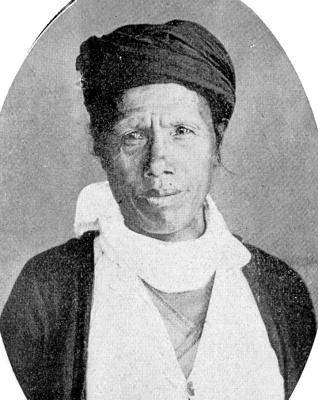
May 11 to May 17 Traversing the southern slopes of the Yushan Range in 1931, Japanese naturalist Tadao Kano knew he was approaching the last swath of Taiwan still beyond colonial control. The “vast, unknown territory,” protected by the “fierce” Bunun headman Dahu Ali, was “filled with an utterly endless jungle that choked the mountains and valleys,” Kano wrote. He noted how the group had “refused to submit to the measures of our authorities and entrenched themselves deep in these mountains … living a free existence spent chasing deer in the morning and seeking serow in the evening,” even describing them as


 RSS
RSS