


I drove into New Haven on a recent morning with a burning question on my mind. How did my daughter do against the chimpanzees?
A month before, I had found a letter in the cubby of my daughter Charlotte at her preschool. It was from a graduate student at Yale asking for volunteers for a psychological study. The student, Derek Lyons, wanted to observe how three- and four-year-olds learn. I was curious, so I got in touch. Lyons explained how his study might shed light on human evolution.
His study would build on a paper published in the July issue of the journal Animal Cognition by Victoria Horner and Andrew Whiten, two psychologists at the University of St. Andrews in Scotland. Horner and Whiten described the way they showed young chimps how to retrieve food from a box.

The box was painted black and had a door on one side and a bolt running across the top. The food was hidden in a tube behind the door. When they showed the chimpanzees how to retrieve the food, the researchers added some unnecessary steps. Before they opened the door, they pulled back the bolt and tapped the top of the box with a stick. Only after they had pushed the bolt back in place did they finally open the door and fish out the food.
Because the chimps could not see inside, they could not tell that the extra steps were unnecessary. As a result, when the chimps were given the box, two-thirds faithfully imitated the scientists to retrieve the food.
The team then used a box with transparent walls and found a strikingly different result. Those chimps could see that the scientists were wasting their time sliding the bolt and tapping the top. None followed suit. They all went straight for the door.
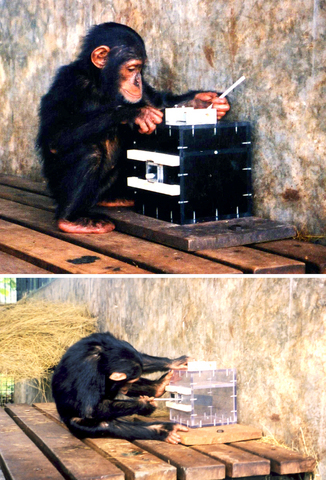
The researchers turned to humans. They showed the transparent box to 16 children from a Scottish nursery school. After putting a sticker in the box, they showed the children how to retrieve it. They included the un-necessary bolt pulling and box tapping.
The scientists placed the sticker back in the box and left the room, telling the children that they could do whatever they thought necessary to retrieve it.
The children could see just as easily as the chimps that it was pointless to slide open the bolt or tap on top of the box. Yet 80 percent did so anyway.
"It seemed so spectacular to me," Lyons said. "It suggested something remarkable was going on."
It was possible, however, that the results might come from a simple desire in the children just to play along. To see how deep this urge to overimitate went, Lyons came up with new experiments with the transparent box. He worked with a summer intern, Andrew Young, a senior at Carnegie Mellon, to build other puzzles using Tupperware, wire baskets and bits of wood. And Lyons planned out a much larger study, with 100 children.
I was intrigued. I signed up Charlotte, and she participated in the study twice, first at the school and later at Lyons' lab.
Charlotte didn't feel like talking about either experience beyond saying they were fun. As usual, she was more interested in talking about atoms and princesses.
Lyons was more eager to talk. He invited me to go over Charlotte's performance at the Yale Cognition and Development Lab, led by Lyons' adviser, Frank Keil.
Driving into New Haven for our meeting, I felt as if Charlotte had just taken some kind of interspecies SAT. It was silly, but I hoped that Charlotte would show the chimps that she could see cause and effect as well as they could. Score one for Homo sapiens.
At first, she did. Lyons loaded a movie on his computer in which Charlotte eagerly listened to him talk about the transparent plastic box.
He set it in front of her and asked her to retrieve the plastic turtle that he had just put inside. Rather than politely opening the front door, Charlotte grabbed the entire front side, ripped it open at its Velcro tabs and snatched the turtle.
"I've got it!" she shouted.
A chimp couldn't have done better, I thought.
But at their second meeting, things changed. This time, Lyons had an undergraduate, Jennifer Barnes, show Charlotte how to open the box. Before she opened the front door, Barnes slid the bolt back across the top of the box and tapped on it needlessly. Charlotte imitated every irrelevant step. The box ripping had disappeared. I could almost hear the chimps hooting.
Barnes showed Charlotte four other puzzles, and time after time she overimitated. When the movies were over, I wasn't sure what to say.
"So how did she do?" I asked awkwardly.
"She's pretty age-typical," Lyons said. Having watched 100 children, he agrees with Horner and Whiten that children really do overimitate. He has found that it is very hard to get children not to.
If they rush through opening a puzzle, they don't skip the extra steps. They just do them all faster. What makes the results even more intriguing is that the children understand the laws of physics well enough to solve the puzzles on their own. Charlotte's box ripping is proof of that.
Lyons sees his results as evidence that humans are hard-wired to learn by imitation, even when that is clearly not the best way to learn. If he is right, this represents a big evolutionary change from our ape ancestors. Other primates are bad at imitation. When they watch another primate doing something, they seem to focus on what its goals are and ignore its actions.
As human ancestors began to make complicated tools, figuring out goals might not have been good enough anymore. Hominids needed a way to register automatically what other hominids did, even if they didn't understand the intentions behind them. They needed to imitate.
Not long ago, many psychologists thought that imitation was a simple, primitive action compared with figuring out the intentions of others. But that is changing.
"Maybe imitation is a lot more sophisticated than people thought," Lyons said.
We don't appreciate just how automatically we rely on imitation, because usually it serves us so well.
"It is so adaptive that it almost never sticks out this way," he added. "You have to create very artificial circumstances to see it."
In a few years, I plan to explain this experience to Charlotte. I want her to know what I now know. That it's OK to lose to the chimps. In fact, it may be what makes us uniquely human.

Sept.16 to Sept. 22 The “anti-communist train” with then-president Chiang Kai-shek’s (蔣介石) face plastered on the engine puffed along the “sugar railway” (糖業鐵路) in May 1955, drawing enthusiastic crowds at 103 stops covering nearly 1,200km. An estimated 1.58 million spectators were treated to propaganda films, plays and received free sugar products. By this time, the state-run Taiwan Sugar Corporation (台糖, Taisugar) had managed to connect the previously separate east-west lines established by Japanese-era sugar factories, allowing the anti-communist train to travel easily from Taichung to Pingtung’s Donggang Township (東港). Last Sunday’s feature (Taiwan in Time: The sugar express) covered the inauguration of the

The corruption cases surrounding former Taipei Mayor and Taiwan People’s Party (TPP) head Ko Wen-je (柯文哲) are just one item in the endless cycle of noise and fuss obscuring Taiwan’s deep and urgent structural and social problems. Even the case itself, as James Baron observed in an excellent piece at the Diplomat last week, is only one manifestation of the greater problem of deep-rooted corruption in land development. Last week the government announced a program to permit 25,000 foreign university students, primarily from the Philippines, Indonesia and Malaysia, to work in Taiwan after graduation for 2-4 years. That number is a
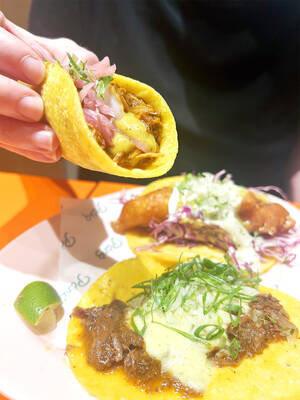
This year’s Michelin Gourmand Bib sported 16 new entries in the 126-strong Taiwan directory. The fight for the best braised pork rice and the crispiest scallion pancake painstakingly continued, but what stood out in the lineup this year? Pang Taqueria (胖塔可利亞); Taiwan’s first Michelin-recommended Mexican restaurant. Chef Charles Chen (陳治宇) is a self-confessed Americophile, earning his chef whites at a fine-dining Latin-American fusion restaurant. But what makes this Xinyi (信義) spot stand head and shoulders above Taipei’s existing Mexican offerings? The authenticity. The produce. The care. AUTHENTIC EATS In my time on the island, I have caved too many times to

In a stark demonstration of how award-winning breakthroughs can come from the most unlikely directions, researchers have won an Ig Nobel prize for discovering that mammals can breathe through their anuses. After a series of tests on mice, rats and pigs, Japanese scientists found the animals absorb oxygen delivered through the rectum, work that underpins a clinical trial to see whether the procedure can treat respiratory failure. The team is among 10 recognized in this year’s Ig Nobel awards (see below for more), the irreverent accolades given for achievements that “first make people laugh, and then make them think.” They are not


 RSS
RSS