


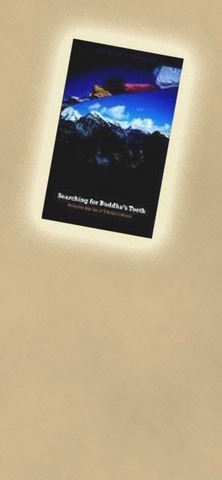
"Writings on Tibet could fill a modest library," writes the author of this short but excellent book. "Not much is, however, written on the Tibetan exile by the Tibetans themselves." (And this despite the fact that some 3,000 new Tibetans are estimated to arrive in India every year).
Tsering N Khortsa was for several years a writer on the Taipei Times. Under the name Tsering Namgyal he penned features, articles on business and book reviews. These days he's working as a freelance writer and translator, dividing his time between Taiwan and India. He's also all-but completed a novel. Searching for Buddha's Tooth, however, is his first published book.
It makes fascinating reading. It's essentially a collection of essays on life, as an educated Tibetan born in India sees it, but the author's eye is particularly acute. He's very conscious, for instance, of the paradoxes that cluster round exiled Tibetan life -- that there were only five contestants in the Miss Tibet beauty contest last year (the Dalai Lama's government in exile had campaigned against the event), and that two Tibetan emigrants at Delhi airport had no idea which country they had visas for, thinking it was perhaps "Space."
In reality it was Spain.
A quiet sense of the absurd informs this subtle book. It begins with the arrival of purported relics of the Buddha in Taiwan -- twice -- in 1999. The first one was apparently fraudulent, the second accredited. But even in these bizarre circumstances Tsering writes that if people gained some spiritual solace from viewing the first relic it would also have served a purpose. This is typical of his benign, easy-going, essentially charitable approach.
There's tougher stuff too, however. Modern literature on India -- V.S.Naipaul, Rohinton Mistry, Nirad Chaudhuri -- gets a knowledgeable survey during a treatment of the maverick Tibetan poet Tenzin Tsundue, the man who in 2002 climbed scaffolding up to the window of then Chinese premier Zhu Rongji's (朱鎔基) hotel room in Mumbai to call for freedom for his homeland. (Tsundue also secretly entered Tibet from Ladakh when a student, was arrested, and was lucky to eventually be repatriated to India).
Tensin Tsundue's parents had worked as a construction laborers, and having to take menial jobs was a common experience for exiled Tibetans and their offspring.
Tsering Namgyal, however, was luckier. Born in India where his father had fled from Tibet, he first came to Taiwan on a government scholarship in 1989. Since then he hasn't looked back, and nowadays contributes articles to The Asian Wall Street Journal, the Harvard Asia Pacific
Review and the Taipei Review. Even so, the first book he ever read about the Himalayan land of his forefathers was Tintin in Tibet, as he relates with charac-teristic modesty and quiet humor.
When he first set foot in Taiwan, he recounts, the whole place seemed awash with BMWs and Mercedes, and the consumption of cognac was high. It was a world of "gung-ho capitalism" where, being Tibetan, he was treated at school as "akin to an endangered species on the brink of extinction." It was only later that he understood that 1989 was the peak of Taiwan's economic boom, and things could only become less intense thereafter.
There's plenty more about Taiwan in this book. Two points are particularly interesting -- the parallels between the Tibetans and the Taiwanese, and the change that took place in Taiwan's official attitude to the Dalai Lama.
The author claims the Chinese Nationalist Party (KMT) and the Tibetans were alike in striving to re-create their lost lands. Both, too, saw returning to claim their just inheri-tance as their ultimate goal. Unfortunately, because the KMT consi-dered all of China, including Tibet and Mongolia, as part of its rightful domain, good relations with the Dalai Lama's government-in-exile at Dharamsala proved problematic. Yet both shared a common enemy in China, and both also shared a common predicament, the threat of eventual international isolation.
Things improved under President Lee Teng-hui (
During the Dalai Lama's second visit here, in the spring of 2001, Tsering Namgyal, who worked on Taipei Times at the time, was lucky enough to enjoy a 10-minute audience with His Holiness during which the great man suggested that, as he knew some Mandarin, he might like to go to Tibet and "observe the developments ... and try to help the Tibetans there."
It seemingly didn't happen, but instead the author has written this sane and balanced book on aspects of the life of exiled Tibetans, in India and elsewhere.
Another eye-opening topic covered is the Tibetan presence on the Internet. There are some 45 Internet cafes in Dharamsala (the greatest concentration in India, Tsering claims) and he lists many Tibet-related sites. In the first feature film by a Tibetan emigree, We're No Monks, the main character spends most of his time on-line.
Searching for Buddha's Tooth deserves to reach far more readers than simply those living in Taiwan and India. Indeed, it should be essential reading for the large numbers of Tibet-lovers worldwide. It's sane, balanced and well-informed. There are no strident re-workings of China's crimes and no demands for Tibetan independence. Instead Tsering observes the scene close-up, but with a cool head -- the loss of Tibet to China is called "this sad reality" -- and a detached amusement.
His is a tone of moderation and an educated, international perspective. Let's hope that this temperate book has already found a place in the literature of the Tibetan diaspora.

Sept.16 to Sept. 22 The “anti-communist train” with then-president Chiang Kai-shek’s (蔣介石) face plastered on the engine puffed along the “sugar railway” (糖業鐵路) in May 1955, drawing enthusiastic crowds at 103 stops covering nearly 1,200km. An estimated 1.58 million spectators were treated to propaganda films, plays and received free sugar products. By this time, the state-run Taiwan Sugar Corporation (台糖, Taisugar) had managed to connect the previously separate east-west lines established by Japanese-era sugar factories, allowing the anti-communist train to travel easily from Taichung to Pingtung’s Donggang Township (東港). Last Sunday’s feature (Taiwan in Time: The sugar express) covered the inauguration of the

The corruption cases surrounding former Taipei Mayor and Taiwan People’s Party (TPP) head Ko Wen-je (柯文哲) are just one item in the endless cycle of noise and fuss obscuring Taiwan’s deep and urgent structural and social problems. Even the case itself, as James Baron observed in an excellent piece at the Diplomat last week, is only one manifestation of the greater problem of deep-rooted corruption in land development. Last week the government announced a program to permit 25,000 foreign university students, primarily from the Philippines, Indonesia and Malaysia, to work in Taiwan after graduation for 2-4 years. That number is a
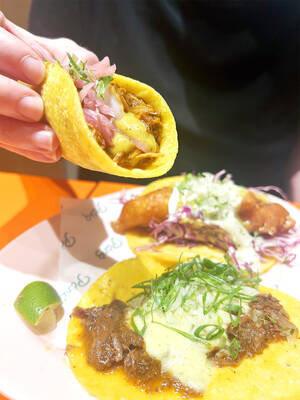
This year’s Michelin Gourmand Bib sported 16 new entries in the 126-strong Taiwan directory. The fight for the best braised pork rice and the crispiest scallion pancake painstakingly continued, but what stood out in the lineup this year? Pang Taqueria (胖塔可利亞); Taiwan’s first Michelin-recommended Mexican restaurant. Chef Charles Chen (陳治宇) is a self-confessed Americophile, earning his chef whites at a fine-dining Latin-American fusion restaurant. But what makes this Xinyi (信義) spot stand head and shoulders above Taipei’s existing Mexican offerings? The authenticity. The produce. The care. AUTHENTIC EATS In my time on the island, I have caved too many times to

In a stark demonstration of how award-winning breakthroughs can come from the most unlikely directions, researchers have won an Ig Nobel prize for discovering that mammals can breathe through their anuses. After a series of tests on mice, rats and pigs, Japanese scientists found the animals absorb oxygen delivered through the rectum, work that underpins a clinical trial to see whether the procedure can treat respiratory failure. The team is among 10 recognized in this year’s Ig Nobel awards (see below for more), the irreverent accolades given for achievements that “first make people laugh, and then make them think.” They are not


 RSS
RSS