


The Taipei Golden Horse Film Festival ensures that the star-studded Golden Horse Awards doesn't entirely hog the spotlight of film lovers by providing a lineup over 200
feature and short films. It also brings over world-class film making professionals, such as director Suzuki Seijun and the Dardenne brothers.
Behind such an accomplishment stands a long-haired, petite woman named Christine Tsui-Hua Huang (黃翠華).
Fifteen years ago, she was appointed program director for the Taipei Golden Horse Film Festival and for three years built up the film gala when the local film festival industry was still in its infancy.
Returning now, with a wealth of experience under her belt, Huang has grander aspirations. Having majored in English literature at university, she holds a rather poetic view of cinema as an art form.
"To me, film, or art in general, is the medium through which I can gain an understanding of myself and the world," Huang said.
She believes a film festival is a communicative medium. Primarily a visual art form, cinema makes a direct impact on the audience and delivers powerful messages, while offering individualistic perspectives about the world.
"As an island country, Taiwan needs to expand its understanding of the world. It is important for us to be introspective as well as understanding other cultures and peoples."
This goal is realized in the "Global Vision" section of the festival, in which over 35 independent films from Asia, Europe, Africa and South and North America present different stories from around the globe.
Another key concern for festival curators is diversity, Huang said. A healthy environment for cinema is one which embraces all possibilities, in terms of content and form.
"Taiwan's movie market is too small and is dominated by the mainstream," she said. "As a festival supported by the government, we must use tax payers' money well, that is, to supplement the lack of alternatives in the market."
This is why the bulk of screenings go to independent films, while the new section, "The Digital (R)evolution," preserves the festival's experimental spirit.
Democratization is also a concept Huang bears in mind when she sets the festival's agenda. Each individual's right to see the films he or she likes is ensured through Huang's insistence on diversity.
"I hope the festival can satisfy audience members of all tastes and preferences. It should also be a showcase for filmmakers with different aesthetic interests and expressions." Huang said.
Although coming across as an idealist, Huang is pragmatic. As a producer for her ex-husband Hung Hung's (鴻鴻) three movies Love of Three Oranges (三橘之戀), Human Comedy (人間喜劇) and A Garden in the Sky (空中花園), she gained not only valuable experience of local independent film making but also an insider's view of the industry's weaknesses.
"In Taiwan we are not short of good ideas and young talent. Production and stardom are the two major weak points of the local industry."
To address these problems the festival includes two special programs this year: A collection of works by European producer Paolo Branco, who specializes in fund-raising and international co-operation for independent cinema. The other program introduces the films of Japanese actor Asano Tadanobu, who is respected as an independent and mainstream actor.
"When I curate the programs, I think of how the festival can be of help to the industry. By bringing in foreign experience and examples, local film professionals and industry experts may benefit from the model of success set by others."
When asked how the cinematic environment had changed over the years, Huang said that a decade ago the Golden Horse had no competitors to vie for resources.
But now, the dominant position of the Golden Horse Film Festival has been eroded. Small- to medium-size film festivals have mushroomed and cater to audiences of different interests. The era of democracy for film festivals has begun, while new problems gradually emerge along the way.
"Now we face a new set of problems, such as the unbalanced distribution of resources, or festivals with similar orientations that overlap and therefore compete for limited resources," Huang said, setting out some of the issues for the next stage of growth in local film festivals.

Last week, Viola Zhou published a marvelous deep dive into the culture clash between Taiwanese boss mentality and American labor practices at the Taiwan Semiconductor (TSMC) plant in Arizona in Rest of World. “The American engineers complained of rigid, counterproductive hierarchies at the company,” while the Taiwanese said American workers aren’t dedicated. The article is a delight, but what it is depicting is the clash between a work culture that offers employee autonomy and at least nods at work-life balance, and one that runs on hierarchical discipline enforced by chickenshit. And it runs on chickenshit because chickenshit is a cultural
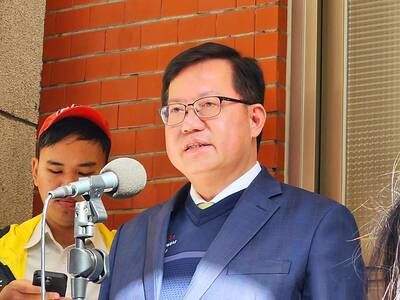
By far the most jarring of the new appointments for the incoming administration is that of Tseng Wen-tsan (鄭文燦) to head the Straits Exchange Foundation (SEF). That is a huge demotion for one of the most powerful figures in the Democratic Progressive Party (DPP). Tseng has one of the most impressive resumes in the party. He was very active during the Wild Lily Movement and his generation is now the one taking power. He has served in many of the requisite government, party and elected positions to build out a solid political profile. Elected as mayor of Taoyuan as part of the
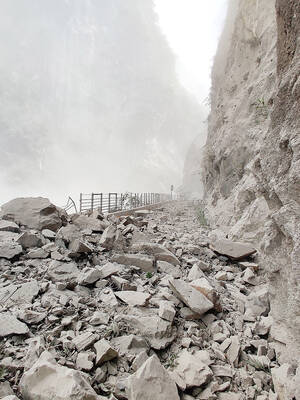
Moritz Mieg, 22, lay face down in the rubble, the ground shaking violently beneath him. Boulders crashed down around him, some stones hitting his back. “I just hoped that it would be one big hit and over, because I did not want to be hit nearly to death and then have to slowly die,” the student from Germany tells Taipei Times. MORNING WALK Early on April 3, Mieg set out on a scenic hike through Taroko Gorge in Hualien County (花蓮). It was a fine day for it. Little did he know that the complex intersection of tectonic plates Taiwan sits

When picturing Tainan, what typically comes to mind is charming alleyways, Japanese architecture and world-class cuisine. But look beyond the fray, through stained glass windows and sliding bookcases, and there exists a thriving speakeasy subculture, where innovative mixologists ply their trade, serving exquisite concoctions and unique flavor profiles to rival any city in Taiwan. Speakeasies hail from the prohibition era of 1920s America. When alcohol was outlawed, people took their business to hidden establishments; requiring patrons to use hushed tones — speak easy — to conceal their illegal activities. Nowadays legal, speakeasy bars are simply hidden bars, often found behind bookcases


 RSS
RSS