


"We are losing.
"Four years and two wars after the attacks of Sept. 11, 2001, America is heading for a repeat of the events of that day, or perhaps something worse. Against our most dangerous foe, our strategic position is weakening."
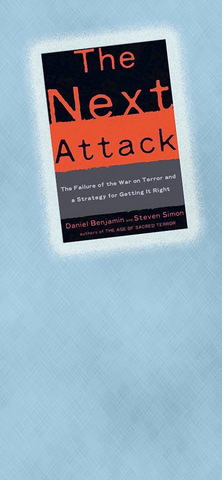
So begins Daniel Benjamin and Steven Simon's sobering new book, The Next Attack. The authors, two of US ex-president Bill Clinton's counterterrorism aides, draw a persuasive and utterly frightening picture of the current state of America's war on terror.
They see more and more Muslims, many of whom had no earlier ties to radical organizations, enlisting in the struggle against the West, and they also point out the proliferation of freelance terrorists, self-starters without any formal ties to al-Qaeda or other organized groups. They see local and regional grievances (in places like Saudi Arabia, Chechnya and Southeast Asia) merging into "a pervasive hatred of the US, its allies, and the inter-national order they uphold." And they see in the Muslim world traditional social and religious inhibitions against violence and even against the use of weapons of mass destruction weakening as a growing number of radical clerics assume positions of influence.
Like the CIA officer Michael Scheuer, the author (under the pseudonym "Anonymous") of the 2004 book Imperial Hubris, Benjamin and Simon regard the US invasion of Iraq as a kind of Christmas present to Osama bin Laden: an unnecessary and ill-judged war of choice that has not only become a recruitment tool for jihadis but that has also affirmed the story line that al-Qaeda leaders have been telling the Muslim world that America is waging war against Islam and seeking to occupy oil-rich Muslim countries.
The US invasion of Iraq toppled one of the Mideast's secular dictatorships, the authors write, and produced a country in chaos, a country that could well become what Afghanistan was during the years of Soviet occupation: a magnet for jihadis and would-be jihadis from around the world; a "country-sized training ground" (with an almost limitless supply of arms). The authors add that "the sad irony" of the war is that Iraq now stands as an argument against democratization for many in the Middle East: "the current chaos there confirms the fears of both the rulers and the ruled in the authoritarian states of the region that sudden political change is bound to let slip the dogs of civil war."
In their last book, The Age of Sacred Terror (2002), Benjamin and Simon looked at how bureaucratic infighting and a lack of urgency on the part of government officials contributed to the failure to prevent Sept. 11. This volume, a sequel of sorts, similarly draws upon the authors' experience in counter-terrorism and their inside know-ledge of the national security apparatus, and it offers a grim cautionary lesson: "not only are we not attending to a growing threat, we are stoking the fire."
Though the authors' message is harrowing, they write in carefully reasoned, highly convincing terms. Much of their narrative ratifies judgments made in recent books by other intelligence experts and journalists.
Like Seymour Hersh (Chain of Command) and James Bamford (A Pretext for War), Simon and Benjamin note the Bush administration's penchant, in the walk-up to the war, for cherry-picking intelligence to bolster its own preconceptions and for setting up alternative intelligence-gathering operations that would produce evidence supporting ideas that higher-ups like former deputy defense secretary Paul Wolfowitz and Defense Secretary Donald Rumsfeld already believed to be true.
Like George Packer (The Assassins' Gate) and Larry Diamond (Squandered Victory), they suggest that the shocking lack of planning for a postwar Iraq stemmed in large measure from the administration's assumptions about an easy US triumph and its reluctance to listen to experts in the military and the State Department. And like Richard Clarke (Against All Enemies), they criticize the Bush White House for focusing on the number of al-Qaeda leaders captured or killed, instead of addressing the ideological underpinnings of radical Islam, which continually attracts new converts.
In laying out these arguments, Benjamin and Simon deftly flesh out now-familiar observations with new details and some revealing interviews with officials who worked with the administration or observed the decision-making process firsthand.
Writing that "the move to war" came "faster than has been reported," the authors quote one State Department diplomat who said that a small, secret meeting was held on the Martin Luther King Day weekend of Jan. 2002 to plan the invasion; this official said, "the original idea was to go to war by Tax Day (April 15) 2002."
The authors also quote Colin Powell's former chief of staff Lawrence Wilkerson -- who recently made headlines with a speech in which he charged that America's foreign policy had been usurped by a small, secretive cabal within the administration -- saying that the essential decision-making and planning for the Iraq war "was not taking place in the statutory process" of the National Security Council, "but in the parallel process run" by Vice President Dick Cheney, who had assembled his own national security staff of 14.
Much of the planning for the occupation, Benjamin and Simon write, was also done "out of channels," with officials "issuing directives without ever having their plans scrubbed in the kind of tedious, iterative process that the government typically uses to make sure it is ready for any contingency." They note, for instance, that the Principals Committee (President Bush's foreign policy Cabinet) did not even meet "to discuss the disbanding of the Iraqi army, which is now seen as one of the critical mistakes that has fed the insurgency."
One of the most disturbing charges that the authors level at the Bush administration is that it has failed to "look beyond al-Qaeda" and "recognize the multiplying forms that the jihadist threat is taking."
It is also a failure to comprehend fully the fallout in the Muslim world of the prison abuses at Abu Ghraib and the detentions at Guantanamo Bay.
In sum, Benjamin and Simon warn, these failures mean "we are clearing the way for the next attack -- and those that will come after."

Sept.16 to Sept. 22 The “anti-communist train” with then-president Chiang Kai-shek’s (蔣介石) face plastered on the engine puffed along the “sugar railway” (糖業鐵路) in May 1955, drawing enthusiastic crowds at 103 stops covering nearly 1,200km. An estimated 1.58 million spectators were treated to propaganda films, plays and received free sugar products. By this time, the state-run Taiwan Sugar Corporation (台糖, Taisugar) had managed to connect the previously separate east-west lines established by Japanese-era sugar factories, allowing the anti-communist train to travel easily from Taichung to Pingtung’s Donggang Township (東港). Last Sunday’s feature (Taiwan in Time: The sugar express) covered the inauguration of the

The corruption cases surrounding former Taipei Mayor and Taiwan People’s Party (TPP) head Ko Wen-je (柯文哲) are just one item in the endless cycle of noise and fuss obscuring Taiwan’s deep and urgent structural and social problems. Even the case itself, as James Baron observed in an excellent piece at the Diplomat last week, is only one manifestation of the greater problem of deep-rooted corruption in land development. Last week the government announced a program to permit 25,000 foreign university students, primarily from the Philippines, Indonesia and Malaysia, to work in Taiwan after graduation for 2-4 years. That number is a

This year’s Michelin Gourmand Bib sported 16 new entries in the 126-strong Taiwan directory. The fight for the best braised pork rice and the crispiest scallion pancake painstakingly continued, but what stood out in the lineup this year? Pang Taqueria (胖塔可利亞); Taiwan’s first Michelin-recommended Mexican restaurant. Chef Charles Chen (陳治宇) is a self-confessed Americophile, earning his chef whites at a fine-dining Latin-American fusion restaurant. But what makes this Xinyi (信義) spot stand head and shoulders above Taipei’s existing Mexican offerings? The authenticity. The produce. The care. AUTHENTIC EATS In my time on the island, I have caved too many times to

In a stark demonstration of how award-winning breakthroughs can come from the most unlikely directions, researchers have won an Ig Nobel prize for discovering that mammals can breathe through their anuses. After a series of tests on mice, rats and pigs, Japanese scientists found the animals absorb oxygen delivered through the rectum, work that underpins a clinical trial to see whether the procedure can treat respiratory failure. The team is among 10 recognized in this year’s Ig Nobel awards (see below for more), the irreverent accolades given for achievements that “first make people laugh, and then make them think.” They are not


 RSS
RSS