


Fu Mei-hui(傅美妃)used to run a drug store with her husband in Sanchung City(三重市), Taipei County. After her husband decided to fold up the business five years ago, she turned to the Peng Wan-Ru Foundation (PWR Foundation, 彭婉如文教基金會), an organization partly funded by the government which helps woman find employment mainly as baby-sitters and housekeepers by offering training courses, for help.
Baby-sitting has traditionally been a means by which married women can earn a modest wage. Working parents usually leave their children at the baby-sitter's home, sometimes over night, and pick up their offspring after work.
Fu, now in her early fifties, has raised three children of her own and thus felt confident about her ability to take care of other people's babies.

The PWR's intensive training program cost Fu NT$6,000 and consisted of lectures by doctors, head nurses and other medical experts and a stint in a children's hospital so her competence and childcare skills could be evaluated. The program lasted approximately three months and included a total of 100-hours of training.
The PWR Foundation started the program in 1998 and has trained more than 4,000 women nation-wide in child-raising skills.
Fu received thorough training and a certificate proving her abilities before she began working as a professional caregiver. However, Fu's hard work did not reap immediate benefit. Sanchung is populated by predominately lower-income families that generally cannot afford to hire baby-sitters.
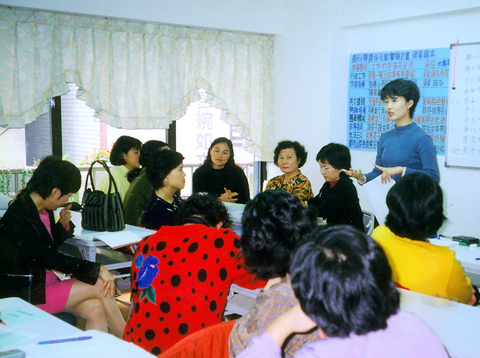
PHOTO COURTESY OF CHANG YA-HUI
After a few months, Fu decided to take a housekeeping course in an attempt to take advantage of a niche in the labor market that has been booming in Taipei and other cities in Taiwan.
The hard work paid off. Fu was employed immediately after the course and now works five days a week for four hours each day for a family in Taipei. Fu also provides baby-sitting services for the family and earns an average monthly wage of between NT$20,000 and NT$25,000.
Fu's case is not an exception. Hsue Ming-chu(薛明珠) is a high school graduate in her late thirties. She comes from a poor family in Taipei and married an ironsmith. She has two young children, aged seven and five, and works six days a week as a housekeeper, dividing her time between 12 families in the greater Taipei area.

PHOTO COURTESY OF CHANG YA-HUI
Hsue is satisfied with her job, which she has been doing for the last three years and which earns her some NT$40,000 per month, more than many university graduates earn.
She said she'd like to work as much as possible while she is physically able to save enough money for her children's education.
Doing what you know best
Liu Pei-ling
forties, was a book-keeper for many years and is raising two children of her own, aged 17 and 11.
She decided to stay at home to care for her children after the birth of her second child. Liu returned to the job market two years ago as a baby-sitter.
Liu regularly cared for two, sometimes three, infants which earned her approximately NT$30,000 per month.
But since last year business has been slow and Liu currently cares for only one child, which has drastically reduced her income.
Both Liu and Fu complained about the negative media coverage of baby-sitters prompted by the mistreatment of children by unqualified caregivers.
"It seems to me that the media is biased against the profession. There are many well-trained and responsible baby-sitters who deserve proper news coverage as well. A few bad apples should not tarnish the image of babysitters as a group. Responsible parents should employ qualified baby-sitters to look after their children," said Liu.
The monthly fee for a qualified baby-sitter with a training certificate or official license is NT$15,000 or more per child. A babysitter without proper training may be paid NT$3,000 to NT$5,000 less.
There are some 46 agencies, including private companies and partially government-funded organizations, competing to provide baby-sitting services in Taiwan.
However, as the birthrate continues to decline there are less and less babies to baby-sit, forcing more and more middle-aged females to hunt for jobs in other fields such as housekeeping.
"It was rather difficult at the beginning for me to swallow my pride and do cleaning jobs like a housemaid. It took me many months to overcome the bad feelings. I finally came to realize that no matter how comfortable my life has been, I just have to face the cold and hard reality that my family may fall apart without this seemingly meager income. This regular job keeps me going in my daily life and gives me a sense of responsibility," said Fu.
Hsue took her first job in an electronics factory in her neighborhood after she gave birth to two children. Lacking skills and work experience, she was asked to take a nine-hours-per-day job for five days a week and was promised a monthly salary of NT$15,800, the minimum wage in Taiwan. The factory closed suddenly and the owner failed to pay Hsue her last two months wages.
The incident drove her to look farther afield for work.
Lotus Lin
A distinctive feature of Taiwanese society is that mothers often confine themselves to taking jobs near their place of residence even if this entails accepting poorly paid employment. Had Hsue not been cheated she may have held on to the low-paid factory job for the rest of her life.
Family concerns and the pressure they place on married women to find local employment result in work patterns that provide little benefit for women seeking employment to boost their family's income.
"A low-paid job for middle-aged women simply does not help much," Lin said.
Little choice
Furthermore, the working hours for the types of jobs that women returning to work often take are inflexible.
These women often shy away from full-time or night-time work so that they can care for their children and do household chores.
Fu's switch to house-keeping services enables her to work and to feel a purpose in life which contrasts with Liu's experience.
As many middle-aged Taiwanese women lack professional skills, and are often not computer literate, their scope for employment is limited.
Baby-sitting and housekeeping at present seem to be the two most important sources of employment for middle-aged female job seekers,
particularly as there is little competition from men.
It is no wonder that with partial assistance from the government, organizations that safeguard women's welfare such as the PWR Foundation, the Taiwan Fund for Children and Families, The Garden of Hope Foundation and the Humanistic Education Foundation are channeling their efforts into helping women find employment as babysitters or as housekeepers.
Lin said the situation is improving as jobs in the insurance business and sales, which generally pay more, are gradually opening up to women.
Office work also suits women who are returning to work and are unable to undertake physically demanding work because of health problems.
Senior lecturer Chang Ya-hui(張雅惠), general manager of Momosun Home Care(桃媽媽家事管理), agrees with Lotus Lin's analysis in most cases. However, Chang said that many married women somehow fail to disassociate family life from vocational duties, and this becomes a major stumbling block to finding a rewarding career.
Chang suggested that women seeking employment must first overcome this mental barrier in order to open up more career opportunities. She said: "It's time to leave your housewife mentality behind and live up to the challenges in the job market if you are serious about taking a descent job to support your family."

Sept.16 to Sept. 22 The “anti-communist train” with then-president Chiang Kai-shek’s (蔣介石) face plastered on the engine puffed along the “sugar railway” (糖業鐵路) in May 1955, drawing enthusiastic crowds at 103 stops covering nearly 1,200km. An estimated 1.58 million spectators were treated to propaganda films, plays and received free sugar products. By this time, the state-run Taiwan Sugar Corporation (台糖, Taisugar) had managed to connect the previously separate east-west lines established by Japanese-era sugar factories, allowing the anti-communist train to travel easily from Taichung to Pingtung’s Donggang Township (東港). Last Sunday’s feature (Taiwan in Time: The sugar express) covered the inauguration of the

The corruption cases surrounding former Taipei Mayor and Taiwan People’s Party (TPP) head Ko Wen-je (柯文哲) are just one item in the endless cycle of noise and fuss obscuring Taiwan’s deep and urgent structural and social problems. Even the case itself, as James Baron observed in an excellent piece at the Diplomat last week, is only one manifestation of the greater problem of deep-rooted corruption in land development. Last week the government announced a program to permit 25,000 foreign university students, primarily from the Philippines, Indonesia and Malaysia, to work in Taiwan after graduation for 2-4 years. That number is a

This year’s Michelin Gourmand Bib sported 16 new entries in the 126-strong Taiwan directory. The fight for the best braised pork rice and the crispiest scallion pancake painstakingly continued, but what stood out in the lineup this year? Pang Taqueria (胖塔可利亞); Taiwan’s first Michelin-recommended Mexican restaurant. Chef Charles Chen (陳治宇) is a self-confessed Americophile, earning his chef whites at a fine-dining Latin-American fusion restaurant. But what makes this Xinyi (信義) spot stand head and shoulders above Taipei’s existing Mexican offerings? The authenticity. The produce. The care. AUTHENTIC EATS In my time on the island, I have caved too many times to

In a stark demonstration of how award-winning breakthroughs can come from the most unlikely directions, researchers have won an Ig Nobel prize for discovering that mammals can breathe through their anuses. After a series of tests on mice, rats and pigs, Japanese scientists found the animals absorb oxygen delivered through the rectum, work that underpins a clinical trial to see whether the procedure can treat respiratory failure. The team is among 10 recognized in this year’s Ig Nobel awards (see below for more), the irreverent accolades given for achievements that “first make people laugh, and then make them think.” They are not


 RSS
RSS