


Nana Mouskouri, the world's best-selling female recording artist, is to hold two concerts at the Sun Yat-sen Memorial Hall in Taipei, beginning tomorrow. Nana, as she is affectionately called by her fans around the world, will take to the stage a final time in Taiwan on her Farewell World Tour 2005/2006. The Taipei Times spoke by phone to the chanteuse mid-morning last week in Singapore.
TT: How has your Asian trip been so far?
NM: Well, tomorrow we are going to have the first concert [in Singapore] and we'll be here for another three or four days. I was busy having interviews with local newspapers and television stations. The reception here has been just

wonderful and I am getting myself ready for the concert.
TT: I heard that when you were here in Taipei in March 2001 many of your fans were so moved by your performance they cried.
NM: Yes, I have very good memories of the concerts in Taipei four years ago. As time goes by I am no longer as young as I used to be, but I never lose my enthusiasm for music. Music is my energy and through it I am able to communicate with people.

PHOTOS COURTESY OF NEW ASPECT FOUNDATION
TT: Why did you choose now to bid farewell to the musical world?
NM: Well, my idea is that since I've been singing for so many years and can still sing well, it would be nice for me to go around and say, "Thank you very much," to my fans for their support. Another thing is that the world is changing very fast and you never know what is going to happen next. So, I decided to leave the stage with my dignity and with a good
impression. I think it's time.
TT: I expect the two scheduled concerts in Taipei are going to be very emotional. I bet there will be tears.
NM: For all the reasons that everybody knows, my life will pass away someday and somehow. In life, nothing lasts forever. I do not want to be in a situation when I can no longer sing and force myself to disappear all of a sudden. That would leave people wondering what happened to me. In other words, this is an elegant way to say goodbye.
TT: I find the song I'll Remember You very touching and it would work perfectly for the occasion.
NM: You know, this was originally a Bob Dylan song and I've used it occasionally in the past, but we changed the lyrics a little bit to suit the situation. It's the same thing with Frank Sinatra's My Way. It's originally a French song, which I've known for years. I never recorded the song before because I did not believe it was the right moment to do it. The song should be sung to mean, at one point, you are at the end of something. But I recorded it this time along with the song I'll Remember You especially for this tour. So, this is the story behind it. I chose the songs to mean something.
TT: Can you tell us about your expected
repertoire for Taipei?
NM: I am preparing some new songs and a new program for this trip. The concert is going to be different but naturally I'll do some of the [audience's] favorites as well. The new program will tell the story of the high points of my life. At the beginning there will be video clips to show the important stages of my career. In this way, the audience will have a clear idea about what kind of person I was and who I am today.
TT: And how many different languages will you be singing in?
NM: I'll sing in Greek of course. You know I am a Greek and above all I love Greek songs. Besides, I'll sing in English, French and
Spanish as well. And I am trying to sort out a surprise for you (laughing). I hope I will make it.
TT: Yes, I heard you are preparing a Taiwanese song for us.
NM: Well, when I go to some place I think it's a nice way to say, "Thank you," by singing a local song to the audiences there. I was advised to sing a Taiwanese folk song and I hope it's a good one.
TT: Is the song called White Peony (
NM: Yes, it is. I do not plan to do a popular song there. So, is it a folk song?
TT: Yes, and it's a very popular one. By the way, I found a rather interesting coincidence. The song White Peony was first released in 1936 and it's the year you were born.
NM: Really? The idea is to have a favorite folk song that everybody sings, even at school. Well, I am now very excited, emotionally. What I'll do is to ask the audience to help me with the lyrics, which is hard, and to have them singing along with me. The other day, when I was in New Zealand, I sang a Maori song and the audience sang along with me. At the end they sang a farewell song to me. I was completely overwhelmed by it.
TT: It's a shame that you can afford only a little time to stay here. Otherwise, you'd be able to see more of Taiwan.
NM: Well, I could come here on my holidays next time. I can do some benefit concerts for the needy children in Taiwan. I am interested in helping children with problems all over the world through projects such as providing them with homes or assisting them to receive proper education.
TT: On your tour of Asia, what would interest you the most -- in addition to promoting children's causes?
NM: The development of each country. I believe it's very important for people in Asian countries to look after their own culture, instead of getting too influenced by the Western world. The Western world is growing old and it needs fresh ideas from Asia to change itself. I always love the fact that people in Asia believe in hard-work and care very much for their own future. Asia is not spoiled, like the Western world is now.
TT: Is it true that you are going to devote most of your time to work with UNICEF after your retirement?
NM: Yes, humanitarian causes in particular, through UNICEF. I have done a lot of work in Africa and South America for those causes.
TT: Finally, what parts of your career are you especially proud of? Do you have any regrets after four decades as a well-loved artist?
NM: I am very proud of having a career as a singer. I am always very honest with my singing. I feel proud of the fact that I followed my own road. I did not want to be a star, just a good singer. But for some reason many people have supported me. As to the regrets, I have not tried to hurt anybody. If I had to do it all again, from the very beginning, I'd do it the same. So, I could say I do not have regrets in my life. I try to give love to people and, in the right way, I receive love from them in return. For my entire life, I have been singing songs about love, tolerance, peace, hope and dreams. You may say dreams are part of hope, but dreams are very important. They give people optimism. Even if you do not hold solutions to their problems, dreams can lead people to see those problems in healthier and optimistic ways.
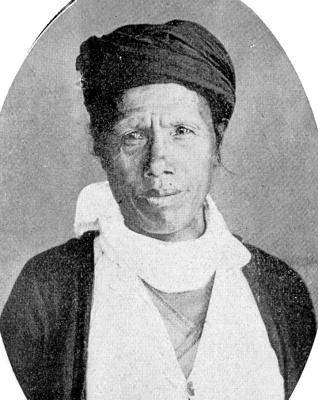
May 11 to May 17 Traversing the southern slopes of the Yushan Range in 1931, Japanese naturalist Tadao Kano knew he was approaching the last swath of Taiwan still beyond colonial control. The “vast, unknown territory,” protected by the “fierce” Bunun headman Dahu Ali, was “filled with an utterly endless jungle that choked the mountains and valleys,” Kano wrote. He noted how the group had “refused to submit to the measures of our authorities and entrenched themselves deep in these mountains … living a free existence spent chasing deer in the morning and seeking serow in the evening,” even describing them as

As a different column was being written, the big news dropped that Chinese Nationalist Party (KMT) caucus whip Fu Kun-chi (傅?萁) announced that negotiations within his caucus, with legislative speaker Han Kuo-yu (韓國瑜) of the KMT, party Chair Cheng Li-wun (鄭麗文), Taichung Mayor Lu Shiow-yen (盧秀燕) and Taiwan People’s Party (TPP) Chair Huang Kuo-chang (黃國昌) had produced a compromise special military budget proposal. On Thursday morning, prior to meeting with Cheng over a lunch of beef noodles, Lu reiterated her support for a budget of NT$800 or NT$900 billion — but refused to comment after the meeting. Right after Fu’s

Yesterday, the Democratic Progressive Party (DPP) nominated legislator Puma Shen (沈伯洋) as their Taipei mayoral candidate, the Chinese Nationalist Party (KMT) put their stamp of approval on Wei Ping-cheng (魏平政) as their candidate for Changhua County commissioner and former legislator Tsai Pi-ru (蔡壁如) of the Taiwan People’s Party (TPP) has begun the process to also run in Changhua, though she has not yet been formally nominated. All three news items are bizarre. The DPP has struggled with settling on a Taipei nominee. The only candidate who declared interest was Enoch Wu (吳怡農), but the party seemed determined to nominate anyone
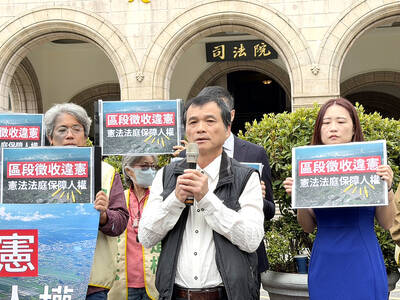
What government project has expropriated the most land in Taiwan? According to local media reports, it is the Taoyuan Aerotropolis, eating 2,500 hectares of land in its first phase, with more to come. Forty thousand people are expected to be displaced by the project. Naturally that enormous land grab is generating powerful pushback. Last week Chen Chien-ho (陳健和), a local resident of Jhuwei Borough (竹圍) in Taoyuan City’s Dayuan District (大園) filed a petition for constitutional review of the project after losing his case at the Taipei Administrative Court. The Administrative Court found in favor of nine other local landowners, but


 RSS
RSS