


The legendary diva Nana Mouskouri is coming to town to bid farewell to Taiwan audiences four years after she last visited Taipei. Mouskouri, the top-selling female recording
artist of all time, and a popular artist in Taiwan, will perform at the Sun Yet-sen Memorial Hall on Wednesday and Thursday.
On her Farewell World Tour 2005/2006, Mouskouri has just completed the Australian leg. She will perform in Singapore tomorrow and Hong Kong on Monday before landing in Taiwan. Afterwards, she will touch down in Seoul and other South Korean cities for four days from Oct. 8 to Oct. 13.

PHOTO COURTESY OF NEW ASPECT FOUNDATION
Mouskouri once said: "Music for me was like many rainbows, filled with many, many colors."
Adding a dash more color to her Taiwan concerts, Mouskouri will sing a popular Taiwanese folk song called White Peony (
The song, which tells of a young girl's heart and compares it to a white peony in the garden longing for the gentle touch of love from the wind in spring, was first released in 1936 by two young local composers and was an instant success islandwide. The song's melody is still widely recognized.
A local media report indicates that many of Mouskouri's local fans fondly remember her 2001 performances in Taipei that won her many encores.
The Greek songstress captivated large crowds at her two previous performances at the Sun Yet-sen Memorial Hall when more than 4,500 people attended.
Many members of the audience were moved to tears at Mouskouri's compassionate display of friendliness and love.
Mouskouri was born in October 1936 in Canee, Crete. Her father worked as a film projectionist. Mouskouri's debut single The White Rose of Athens was released in 1961, selling over 1 million copies. After moving to Paris in 1963 she became a superstar in France with her 1967 album Le Jour Ou La Colombe.
Born with only one vocal chord and not the average two, the rare condition gives her voice a unique color and texture, which marks Mouskouri's singing out from other performers.
Throughout her four-decade-long musical career, Mouskouri has sold around 200 million records worldwide and has been awarded about 350 gold, platinum and diamond records. Since 1958, she has recorded more than 1,350 songs in 65 countries, singing in English, French, German, Greek, Italian and Spanish.
Mouskouri's ability to sing and speak in these major languages made her an ideal spokesperson for UNICEF. She was appointed as a Goodwill Ambassador in 1993 stepping into the shoes of the previous holder of the post, actress Audrey Hepburn. She was then elected as a member of the European Parliament in June 1994, but resigned in 1997 refusing to back warfare anywhere in the world.
Mouskouri became so deeply involved in her work with the UN on relieving hardship throughout the world she decided to give up her musical career for good in order to devote more of her time to philanthropic works.
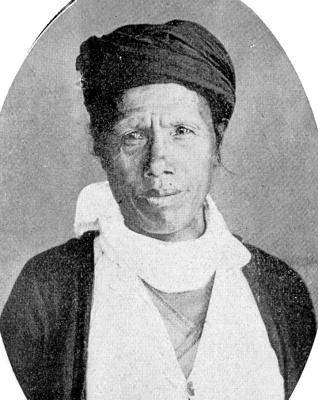
May 11 to May 17 Traversing the southern slopes of the Yushan Range in 1931, Japanese naturalist Tadao Kano knew he was approaching the last swath of Taiwan still beyond colonial control. The “vast, unknown territory,” protected by the “fierce” Bunun headman Dahu Ali, was “filled with an utterly endless jungle that choked the mountains and valleys,” Kano wrote. He noted how the group had “refused to submit to the measures of our authorities and entrenched themselves deep in these mountains … living a free existence spent chasing deer in the morning and seeking serow in the evening,” even describing them as

As a different column was being written, the big news dropped that Chinese Nationalist Party (KMT) caucus whip Fu Kun-chi (傅?萁) announced that negotiations within his caucus, with legislative speaker Han Kuo-yu (韓國瑜) of the KMT, party Chair Cheng Li-wun (鄭麗文), Taichung Mayor Lu Shiow-yen (盧秀燕) and Taiwan People’s Party (TPP) Chair Huang Kuo-chang (黃國昌) had produced a compromise special military budget proposal. On Thursday morning, prior to meeting with Cheng over a lunch of beef noodles, Lu reiterated her support for a budget of NT$800 or NT$900 billion — but refused to comment after the meeting. Right after Fu’s

Yesterday, the Democratic Progressive Party (DPP) nominated legislator Puma Shen (沈伯洋) as their Taipei mayoral candidate, the Chinese Nationalist Party (KMT) put their stamp of approval on Wei Ping-cheng (魏平政) as their candidate for Changhua County commissioner and former legislator Tsai Pi-ru (蔡壁如) of the Taiwan People’s Party (TPP) has begun the process to also run in Changhua, though she has not yet been formally nominated. All three news items are bizarre. The DPP has struggled with settling on a Taipei nominee. The only candidate who declared interest was Enoch Wu (吳怡農), but the party seemed determined to nominate anyone
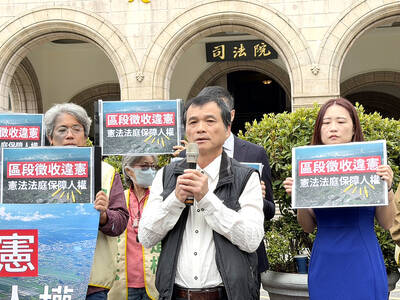
What government project has expropriated the most land in Taiwan? According to local media reports, it is the Taoyuan Aerotropolis, eating 2,500 hectares of land in its first phase, with more to come. Forty thousand people are expected to be displaced by the project. Naturally that enormous land grab is generating powerful pushback. Last week Chen Chien-ho (陳健和), a local resident of Jhuwei Borough (竹圍) in Taoyuan City’s Dayuan District (大園) filed a petition for constitutional review of the project after losing his case at the Taipei Administrative Court. The Administrative Court found in favor of nine other local landowners, but


 RSS
RSS