


Like the British, the Dutch, the Spanish and the French before them, Japanese colonists were prolific builders in their Asian empire prior to its collapse 60 years ago.
For the Japanese, however, architectural splendor came a distant second to the goal of serving the needs of empire and the war effort and although many imposing buildings were built, few had genuine architectural merit.
"Most of what the Japanese put up was shoddy and there is really only a tiny handful left," said Peter Bartholemew, a historian and expert on architecture in Korea, a colony of Japan from 1910 to 1945.
In the rapid industrialization of Northeast and Southeast Asia in the past few decades, many Japanese buildings in places such as Hong Kong and Taiwan have been swept away by the wrecker's ball to make room for modern development.
Other buildings, like the most imposing colonial structure in South Korea that served as the Japanese occupation headquarters, were destroyed in a display of nationalist fervor.
"Frankly, the demolition of these buildings was no great loss to the world's architectural heritage," said Bartholomew, a director of the century-old Seoul branch of Britain's Royal Asiatic Society.
Japanese colonial buildings sprinkled across the Asian mainland from northern China to Singapore and on the islands of Taiwan and Hong Kong broadly fit into three categories: industrial plant to supply the war machine and the expanding empire; colonial administrative buildings to house the growing corp of colonial administrators; and private housing for officials.
Some graceful structures were erected and a few survive including temples and shrines in Taiwan, colonized by Japan from 1895 to 1945.
An effort to preserve them began after Lee Teng-hui (
The headquarters of the Japanese colonial governor has been used as Taiwan's Presidential Office Building since 1949 and a cluster of other Japanese colonial offices also survive including the Executive Yuan and the old National Taiwan University Building.
In South Korea, the Bank of Korea, Seoul City hall and the Seoul railway station are among more prominent examples of Japanese colonial architecture, which essentially aped the bulky neo-classical stone structures popular in Europe in the early 20th century.
"All of these buildings are European style and many of the architects were in fact Europeans working for the Japanese," said Bartholomew.
One of those European architects was Georg de Lalande, a German who designed the most famous Japanese structure ever built in Korea.
That was the copper-domed granite monolith that served as the Japanese governor general's office. Finished in 1926, more than a decade after Lalande's death, the building blocked the front of Kyongbok Palace, the ancient residence of Korea's kings, and portions of the palace were demolished to make way for the Japanese structure.
"This was to remind the Koreans who were the real masters in their country," said Andrei Lankov, a history professor at Kookmin University in Seoul, in a recent commentary.

Sept.16 to Sept. 22 The “anti-communist train” with then-president Chiang Kai-shek’s (蔣介石) face plastered on the engine puffed along the “sugar railway” (糖業鐵路) in May 1955, drawing enthusiastic crowds at 103 stops covering nearly 1,200km. An estimated 1.58 million spectators were treated to propaganda films, plays and received free sugar products. By this time, the state-run Taiwan Sugar Corporation (台糖, Taisugar) had managed to connect the previously separate east-west lines established by Japanese-era sugar factories, allowing the anti-communist train to travel easily from Taichung to Pingtung’s Donggang Township (東港). Last Sunday’s feature (Taiwan in Time: The sugar express) covered the inauguration of the

The corruption cases surrounding former Taipei Mayor and Taiwan People’s Party (TPP) head Ko Wen-je (柯文哲) are just one item in the endless cycle of noise and fuss obscuring Taiwan’s deep and urgent structural and social problems. Even the case itself, as James Baron observed in an excellent piece at the Diplomat last week, is only one manifestation of the greater problem of deep-rooted corruption in land development. Last week the government announced a program to permit 25,000 foreign university students, primarily from the Philippines, Indonesia and Malaysia, to work in Taiwan after graduation for 2-4 years. That number is a
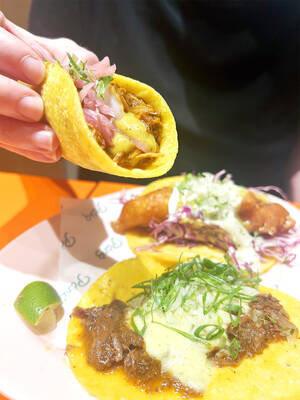
This year’s Michelin Gourmand Bib sported 16 new entries in the 126-strong Taiwan directory. The fight for the best braised pork rice and the crispiest scallion pancake painstakingly continued, but what stood out in the lineup this year? Pang Taqueria (胖塔可利亞); Taiwan’s first Michelin-recommended Mexican restaurant. Chef Charles Chen (陳治宇) is a self-confessed Americophile, earning his chef whites at a fine-dining Latin-American fusion restaurant. But what makes this Xinyi (信義) spot stand head and shoulders above Taipei’s existing Mexican offerings? The authenticity. The produce. The care. AUTHENTIC EATS In my time on the island, I have caved too many times to

In a stark demonstration of how award-winning breakthroughs can come from the most unlikely directions, researchers have won an Ig Nobel prize for discovering that mammals can breathe through their anuses. After a series of tests on mice, rats and pigs, Japanese scientists found the animals absorb oxygen delivered through the rectum, work that underpins a clinical trial to see whether the procedure can treat respiratory failure. The team is among 10 recognized in this year’s Ig Nobel awards (see below for more), the irreverent accolades given for achievements that “first make people laugh, and then make them think.” They are not


 RSS
RSS