


One moment you're in a room that owes something to Space Odyssey in terms of style. The next you've moved along a glass tube inside a yellow, orange, blue and red skyscraper to a room with a Japanese interior.
Nineteen of the world's top architects and designers this week unveiled the fruit of their labors and input into Puerta America, a unique luxury hotel in Madrid that comprises either a floor designed by each one of them or else a bar, the restaurant, the parking lot or the swimming pool.
Jean Nouvel, Ron Arad, Norman Foster, Zaha Hadid, Arata Isozaki and company normally go up against each other in bidding for top design jobs around the world.

This time they're all in it together in a joint effort.
A Spanish hotel chain had the idea of bringing them together to an avant-garde designer's answer to the Tower of Babel -- which you can stay in.
"Freedom" was the design motto, after the poem by Paul Eluard, whose verses can be seen in calligraphic style in a full palette of colors and in several languages on the facade, that being the work of French architect Jean Nouvel.

"It is a utopian hotel, a Statue of Liberty, an open book," explained Spanish architect Felipe Saez de Gordoa, who contributed the outer structure.
The end result is a 14-storey, 34,000m2 affair, handily placed for the airport and the business district of the capital -- but also close to the motorway and in a forest of residential tower blocks.
Yet one can be forgiven for forgetting about such environs and the usual rather impersonal ambiance of many a hotel around the globe when you step inside this five-star monument which could easily be mistaken for a museum.
"It's like Star Wars!" exclaimed one visitor on reaching the futurist Kathryn Findley floor, where curved steel that changes colour tone as one walks past is the order of the day to go with one's clothes and movements.
There are carpets galore, beds suspended opposite bay windows, leather seating -- and everything is white once you're in the bedroom, which you access by immaculate doors.
British designer Ron Arad explains his concept thus.
"You don't go to a hotel to be at home -- otherwise you might as well stay at home," he insists.
To add to the out-of-the-ordinary experience he has therefore come up with such touches as round beds. To get to the bathroom you slink around a central curving module in an open-plan arrangement.
Iraqi designer Zaha Hadid prefers one-piece furniture in a single undulating area -- and on her floor the bedrooms can be black or white. The bath is chiselled from out of the wall as if carved out over time by the waters of a stream.
And no need to hang a "do not disturb" sign outside your door. That's all done at the touch of a button from inside the room, the message to be left alone or a request for breakfast to be brought up appearing on the outer door.
Britain's David Chipperfield contribu-ted minimalist glazed clay black flooring lightened up with an azure ceiling.
Venezuela's Eva Castro and Germany's Holger Kehne (Plasmastudio) preferred bold sweeps more akin to industrial rock with triangular fragments of unoxydised steel in a concave and convex riot of infinite reflections.
Japanese veteran Arata Isozaki preferred to remain true to the serene values of the traditional interior of his homeland.
On his floor, curtains, walls and bed are all black, black, black -- as is the "Marilyn chair," named after Marilyn Monroe and supposedly tracing a similar line to her voluptuous features.
Isozaki applied aesthetic principles based on the author Juchiniro Tanizaki, who suggested in his work Eulogy of Shadow the idea of "darkening walls, plunging into the shadows that which is too visible, stripping out from the interior all superfluous decor."
Jean Nouvel also took some inspiration from Japan -- but the panels in his room are of glass, depicting a range of transparent erotic photographs by Nobuyoshu Araki and Frenchman Alain Fleisher in a libertine flourish.

Last week, Viola Zhou published a marvelous deep dive into the culture clash between Taiwanese boss mentality and American labor practices at the Taiwan Semiconductor (TSMC) plant in Arizona in Rest of World. “The American engineers complained of rigid, counterproductive hierarchies at the company,” while the Taiwanese said American workers aren’t dedicated. The article is a delight, but what it is depicting is the clash between a work culture that offers employee autonomy and at least nods at work-life balance, and one that runs on hierarchical discipline enforced by chickenshit. And it runs on chickenshit because chickenshit is a cultural
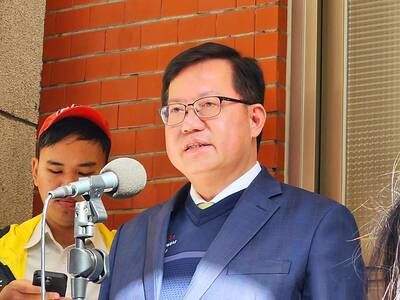
By far the most jarring of the new appointments for the incoming administration is that of Tseng Wen-tsan (鄭文燦) to head the Straits Exchange Foundation (SEF). That is a huge demotion for one of the most powerful figures in the Democratic Progressive Party (DPP). Tseng has one of the most impressive resumes in the party. He was very active during the Wild Lily Movement and his generation is now the one taking power. He has served in many of the requisite government, party and elected positions to build out a solid political profile. Elected as mayor of Taoyuan as part of the
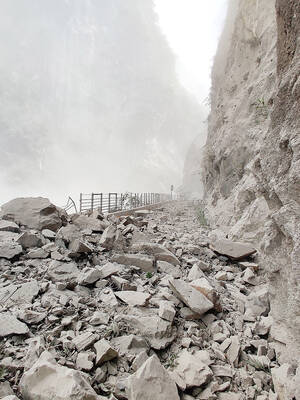
Moritz Mieg, 22, lay face down in the rubble, the ground shaking violently beneath him. Boulders crashed down around him, some stones hitting his back. “I just hoped that it would be one big hit and over, because I did not want to be hit nearly to death and then have to slowly die,” the student from Germany tells Taipei Times. MORNING WALK Early on April 3, Mieg set out on a scenic hike through Taroko Gorge in Hualien County (花蓮). It was a fine day for it. Little did he know that the complex intersection of tectonic plates Taiwan sits

When picturing Tainan, what typically comes to mind is charming alleyways, Japanese architecture and world-class cuisine. But look beyond the fray, through stained glass windows and sliding bookcases, and there exists a thriving speakeasy subculture, where innovative mixologists ply their trade, serving exquisite concoctions and unique flavor profiles to rival any city in Taiwan. Speakeasies hail from the prohibition era of 1920s America. When alcohol was outlawed, people took their business to hidden establishments; requiring patrons to use hushed tones — speak easy — to conceal their illegal activities. Nowadays legal, speakeasy bars are simply hidden bars, often found behind bookcases


 RSS
RSS