


When Wu Bai (伍佰) and China Blue released Two Face Man (雙面人) in February it was obvious from the get-go that the grand-old-man of Taiwan's alternative music scene was taking the opportunity to veer away from his rock guitar oriented roots.
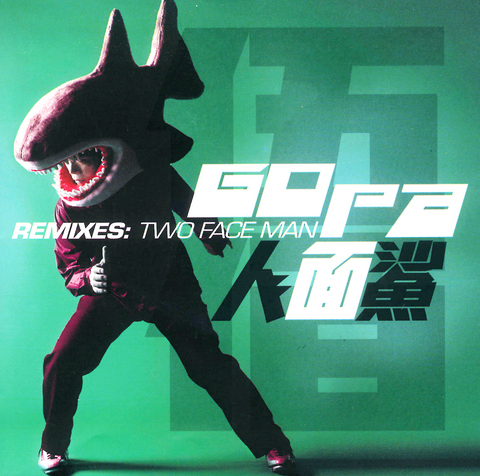
Packed with loops, edits and a host of dance music effects the album was an original and exciting piece of work. With the crux of the dance sound already firmly in place, Wu Bai has chosen to take the final steps towards a full-on dance album on his latest release, the aptly titled Remixes: Two Face Man (Go Pa 人面鯊).
Helping to give a new voice to Wu Bai and China Blue are the UK's Adam Freeland, Way Out West and Barry Gilbey, Belgian progressive house producer Housetrap, the US's Superchumbo, Taiwan's Victor Cheng, German hard trance act the Warp Brothers, Dutch DJ Ronald van Gelderen, Japan's Ram Rider and Singaporean DJ Virusindigo.

The most creative remixes include the Warp Brothers fiery rework of Two Face Man (雙面人), Freeland's pulsating and hard-edged version of Li Hai (厲害) and Virusindigo's 1970s-disco remix of Typhoon Heat (風颱心情).
While Wu Bai should be applauded for choosing to remix his second Taiwanese language album to date in order to give the local dance crowd something to shout, or rather dance about, isn't without its faults. Barry Gilbey's muted and lifeless remix of Seaplane (海底飛凌機) is a disappointment as is Cheng's wholly uninspired version of Li Hai.
Formed by ex-members of the award winning contemporary Hakka combo Labor Exchange (
It blends jazz, rock, folk and even a myriad of classical Chinese/Hakka sounds to create what is possibly one of the most interesting and certainly one of the most creative albums to come out of TCM's studios in a longtime.
Although there is a mild contemporary feel to the much of the material, the heart of the album is firmly rooted in the past and the tunes are all based loosely on traditional Hakka folk songs. The trumpet-like suona and duel stringed violin-like erhu play a major role in all the album's numbers and the operatic-like vocals of lead singer, Chen Guan-yu (陳冠宇) and the powerful drumming of Chung Cheng-da (鍾成達) add an even greater sense of tradition to the musical affair.
Listeners looking for the mild-rock sound of Labor Exchange probably wont find much solace in Hohak Carnival, but those with an ear for an intelligent merger of tradition and modernity will be pretty much hooked from the start. Of the 10 tunes none will disappoint.
The album gets off to a pleasing beginning with the tune Playing and Singing (彈唱), which is a slow acoustic rework of a traditional Hoklo song. The classical and Hakka nature of the music picks up after the opener and the band's traditional instrumentation comes into play on tunes like the jerky post-rock Seven Day Song (七朝歌), the Nanguan infused instrumental Big Reunion (大團圓) and the retro The Flowering of the Peach Blossoms (桃花開).
In addition to the more standard crossover material the Hohak Band also takes the time to dabble in rap. OK, Destitute Man (窮苦人) is not a tune that will appeal to the hoards of Taiwanese kids who like to dress and act as if they are from the ghetto, but Chen and company do a pretty good job of creating an enjoyable and far from laughable Hakka rap tune.
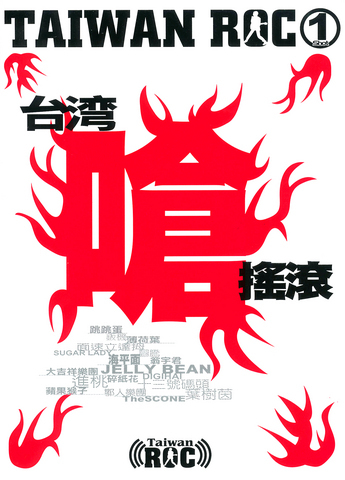
Recorded at CTS (華視) studios last December, the Taiwan ROC (台灣嗆搖滾) DVD is at times interesting and at others, a painful visual insight into the sounds and appearances of 18 of the nation's up and coming underground bands.
Given that very few of the acts have released records and live appearances by several of the bands are, thankfully pretty few and far between, it comes as no surprise that the quality of some of the music is lacking in both direction and zeal.
Stage presence and musical ability is also questionable, with several of the acts resembling limp lettuce and others jumping around the stage like there's no tomorrow. And while there's certainly nothing wrong with performing Pete Townsend-like scissor kicks and playing the guitar as low-slung as Johnny Ramone, neither should be attempted by band members who haven't mastered their instruments.
Acts like Suichihua (碎紙花), a combo that tries to mix the guitar snarl of the Clash with the more ska oriented sound of the Mighty Mighty Bosstones falls flat on the track Trouble (麻煩), and should concentrate on getting the rhythm right before settling for an stage image.
Equally inane is Jumping Egg (跳跳蛋), whose jerky Brit-pop-like Love is False (愛都是假的) and it's slow and annoying Rush (衝) warrant little in the way of praise and are instantly forgettable.
It's not all bad news though and some of the better acts to appear on the DVD include the rock combo Sugar Lady, downbeat act Icat
(
The star of the show, however, is Peppermint (薄荷葉). The three-piece act might employ an over-played anti-pop-like stage presence, with the drummer's back to the camera and the bassist and guitarist/singer adopting rigid posses, but it works well and matches the band's brilliantly morose sound.
Taiwan's foul-mouthed bad boy rocker Chang Chen-yue (
Like many of his previous tunes the title track, which deals with getting wasted and staying up all night, is packed with obscenities. Not that the gnarly buzzsaw guitar driven number needs them, musically it's edgy enough, but then we're talking about a guy who seems to think that swearing in English, Taiwanese or Mandarin is cool.
Of course, it's not and what it all boils down to in the music business is the need to record, produce and cut a clean version of the same tune for radio play. Regardless of the version you choose to listen to both are non-adventurous, yet well-produced rock tunes.
The EPs second tune and the one that has gotten most attention is Model (
His record company's legal department seems to have stepped in, however, and put a stop to what could have proven to be a series of costly legal battles. Instead of naming and shaming Chang simply waxes satirical about the pointlessness of worshipping celebrity models on what is a so-so power-pop tune.
The highlight of the new EP is the final track, Let Me Beat U Up! (

Sept.16 to Sept. 22 The “anti-communist train” with then-president Chiang Kai-shek’s (蔣介石) face plastered on the engine puffed along the “sugar railway” (糖業鐵路) in May 1955, drawing enthusiastic crowds at 103 stops covering nearly 1,200km. An estimated 1.58 million spectators were treated to propaganda films, plays and received free sugar products. By this time, the state-run Taiwan Sugar Corporation (台糖, Taisugar) had managed to connect the previously separate east-west lines established by Japanese-era sugar factories, allowing the anti-communist train to travel easily from Taichung to Pingtung’s Donggang Township (東港). Last Sunday’s feature (Taiwan in Time: The sugar express) covered the inauguration of the

The corruption cases surrounding former Taipei Mayor and Taiwan People’s Party (TPP) head Ko Wen-je (柯文哲) are just one item in the endless cycle of noise and fuss obscuring Taiwan’s deep and urgent structural and social problems. Even the case itself, as James Baron observed in an excellent piece at the Diplomat last week, is only one manifestation of the greater problem of deep-rooted corruption in land development. Last week the government announced a program to permit 25,000 foreign university students, primarily from the Philippines, Indonesia and Malaysia, to work in Taiwan after graduation for 2-4 years. That number is a

This year’s Michelin Gourmand Bib sported 16 new entries in the 126-strong Taiwan directory. The fight for the best braised pork rice and the crispiest scallion pancake painstakingly continued, but what stood out in the lineup this year? Pang Taqueria (胖塔可利亞); Taiwan’s first Michelin-recommended Mexican restaurant. Chef Charles Chen (陳治宇) is a self-confessed Americophile, earning his chef whites at a fine-dining Latin-American fusion restaurant. But what makes this Xinyi (信義) spot stand head and shoulders above Taipei’s existing Mexican offerings? The authenticity. The produce. The care. AUTHENTIC EATS In my time on the island, I have caved too many times to

In a stark demonstration of how award-winning breakthroughs can come from the most unlikely directions, researchers have won an Ig Nobel prize for discovering that mammals can breathe through their anuses. After a series of tests on mice, rats and pigs, Japanese scientists found the animals absorb oxygen delivered through the rectum, work that underpins a clinical trial to see whether the procedure can treat respiratory failure. The team is among 10 recognized in this year’s Ig Nobel awards (see below for more), the irreverent accolades given for achievements that “first make people laugh, and then make them think.” They are not


 RSS
RSS