


Tainism is the religious tradition that says all living organisms have souls and, to avoid incurring negative karmic retribution, practitioners must not harm any life form, including plants and insects.
Lee Sung-yang (
"Insects have minds and they use them. They can think, feel, forget and remember," said Lee during an interview at his home last week.

He continued by saying, if individuals accept his theory that insects have minds, then as a result people would treat the natural environment with more respect.
"It's easier to show consideration to something if you view it as an equal."
Insect behavior first became of interest to him during middle school while reading Jean-Henri Fabre's Souvenirs Enthomologiques. Fabre's conclusion was that insects act on biological instinct, and Lee reluctantly accepted this view until his own research suggested otherwise.
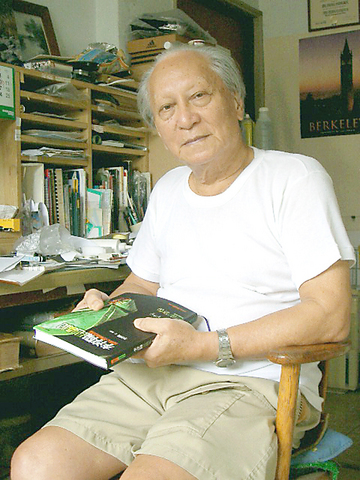
PHOTOS: DIANA FREUNDL, TAIPEI TIMES
Lee enrolled at the Tokyo University of Agriculture in Japan where he studied plant pathology. After graduating with a doctorate, he returned to Taiwan and accepted a position as an entomologist researching control of insects on rice and soybean plants at the Agricultural Research Institute.
"My becoming an entomologist was a kind of fate. I didn't want to study ugly worms and bugs, but I wanted to be a researcher and this was the job I was hired to do. I am a man of curiosity, and gradually I found some aspects of my job appealing. Step by step my interest in insects developed," Lee explained.
His curiosity evolved into a decade-long obsession when in 1967, he began shooting Hidden Events a documentary intended to illustrate feeding, mating, parenting and self-defense habits of insects. Inspired by the1953 Disney documentary, The Living Desert, Lee wanted to uncover the marvels of the insect world the way that Disney had exposed the desert. He had previous film experience working on a commercial movie made for a chemical company, yet nothing prepared him for the epic project that would demand all his spare time and drain his savings account.
"Shooting insects is a kind of torture. They don't listen to you. I would be ready to shoot, and the moment I pressed down the shutter, poof, it flies a way," he said.
In order to capture 230 insects on film, Lee required a custom-made camera lens and a small set, which he fashioned himself. In 1977 he had two hours of footage that would gain him international recognition.
He first sent the material to the British Broadcasting Corporation (BBC), which responded by sending a team to Taiwan to produce a program based on the making of his documentary. He then produced a second edit of his film and sent it off again, this time to the US. Much to his surprise, Hidden Events took first prize in the Photographic Society of America International Film Festival.
Two documentaries and years of research later, Lee was ready to put some of what he had learned in writing. Raised during the Japanese occupation of Taiwan, Lee speaks Japanese, Taiwanese and English with ease but struggles with Mandarin, therefore he choose to write his manuscript in English. After a deal fell through with a US company, he had the draft translated into Chinese and published in Taiwan in 1981. A second book in Chinese was released this year; however, he has yet to produce an English text.
When asked to give an example of how he came to his theory on insect intelligence, Lee described the behavior of one female wasp. He watched the wasp complete its task of covering a nest with mud and begin covering another nest at a new location. From time to time Lee witnessed the wasp become what he described as absent-minded and forget that it had completed the first nest. The wasp would fly toward the first nest, until just before landing when it would remember the job was completed. It would then change direction and move toward the second nest to continue its work.
"If an insect can forget and then remember what it had forgotten, then something more than simple biological instinct is taking place," he said.
He has never sent his theory to a scientific journal to be evaluated, although he has received praise from entomologists at home and abroad.
Canadian entomologist Christopher Starr encountered Lee's first book while in Taiwan as a visiting lecturer. Impressed by the research, Starr encouraged him to send his findings to the scientific community for publication. Lee explained he is no longer interested in defending his theory for scientists, but not for lack of experience -- he has published many articles in the Journal of Economic Entomology.
"I want to do something good to enrich everyone, not only scientists," he said. He is currently working on an updated English edition to his first book.
When asked if his theory dictated vegetarianism or organic farming, he replied, "It's all theory and practice. Everyday I eat meat and fish so how can I say `Don't kill insects?' It would be hypocritical."
His opinion on using pesticides as a source of insect control is that it has become a necessary evil for many farmers to make a living, but he hopes growing interest in organic farming will eventually fade out the use of poisonous chemicals.
"Every living creature has a right to live. We don't need to change the way we live, just the way we think. We think we are the masters of this planet, but we share this world with others, so we should stop behaving like we rule it," he said.
A little more respect and compassion for our little neighbors won't solve all the problems of the world, he added, but it would help.

Sept.16 to Sept. 22 The “anti-communist train” with then-president Chiang Kai-shek’s (蔣介石) face plastered on the engine puffed along the “sugar railway” (糖業鐵路) in May 1955, drawing enthusiastic crowds at 103 stops covering nearly 1,200km. An estimated 1.58 million spectators were treated to propaganda films, plays and received free sugar products. By this time, the state-run Taiwan Sugar Corporation (台糖, Taisugar) had managed to connect the previously separate east-west lines established by Japanese-era sugar factories, allowing the anti-communist train to travel easily from Taichung to Pingtung’s Donggang Township (東港). Last Sunday’s feature (Taiwan in Time: The sugar express) covered the inauguration of the

The corruption cases surrounding former Taipei Mayor and Taiwan People’s Party (TPP) head Ko Wen-je (柯文哲) are just one item in the endless cycle of noise and fuss obscuring Taiwan’s deep and urgent structural and social problems. Even the case itself, as James Baron observed in an excellent piece at the Diplomat last week, is only one manifestation of the greater problem of deep-rooted corruption in land development. Last week the government announced a program to permit 25,000 foreign university students, primarily from the Philippines, Indonesia and Malaysia, to work in Taiwan after graduation for 2-4 years. That number is a

This year’s Michelin Gourmand Bib sported 16 new entries in the 126-strong Taiwan directory. The fight for the best braised pork rice and the crispiest scallion pancake painstakingly continued, but what stood out in the lineup this year? Pang Taqueria (胖塔可利亞); Taiwan’s first Michelin-recommended Mexican restaurant. Chef Charles Chen (陳治宇) is a self-confessed Americophile, earning his chef whites at a fine-dining Latin-American fusion restaurant. But what makes this Xinyi (信義) spot stand head and shoulders above Taipei’s existing Mexican offerings? The authenticity. The produce. The care. AUTHENTIC EATS In my time on the island, I have caved too many times to

In a stark demonstration of how award-winning breakthroughs can come from the most unlikely directions, researchers have won an Ig Nobel prize for discovering that mammals can breathe through their anuses. After a series of tests on mice, rats and pigs, Japanese scientists found the animals absorb oxygen delivered through the rectum, work that underpins a clinical trial to see whether the procedure can treat respiratory failure. The team is among 10 recognized in this year’s Ig Nobel awards (see below for more), the irreverent accolades given for achievements that “first make people laugh, and then make them think.” They are not


 RSS
RSS