


Paul Clark's efficient and intelligent survey titled Reinventing China looks at the films and careers of China's group of film directors who came to fame in the late 1980s and 1990s.
The fame was sometimes relative, but the most celebrated of them -- Zhang Yimou (
Clark, who is a Professor of Chinese at the University of Auckland, claims he got the idea for this new book while standing waist-deep at the quieter end of Hawaii's Waikiki Beach alongside Zhang and Chen -- enviable access to your celebrated subject-matter, you might think. But Clark is something of an authority on this subject and is the author of the much more extensive survey Chinese Cinema: Culture and Politics Since 1949.

That book was published by Cambridge University Press in 1987 and it's a fair guess that Clark offered this new book, in many ways an up-dating of the older one, to the same publisher.
That it has ended up appearing under the imprint of the far smaller Chinese University Press in Hong Kong should not necessarily be seen as saying something about its relative quality. Publishers' criteria for taking on books change by the day and the Hong Kong outfit has done a good job in terms of presentation and paper quality.
Not only Zhang and Chen but all the eight other filmmakers featured in this book enrolled in the Beijing Film Academy in the same year, 1978, and graduated four years later. The academy was, at the time, China's only film school. The book, then, is in the way of being what Clark calls a "collective biography" of a generation. Mao Zedong had died in September 1976, and his widow and her associates had been arrested the following month. China was thus clearly set for change, and the halt to that change that was to come in Tiananmen Square on June 4, 1989, was still some way off. That a new kind of film was to emerge was virtually inevitable.
What was new about the films produced by this generation was that, for the first time in 40 years, they were not the products of a hard-line ideology. On the other hand, Clark makes the point that the students of this era had not had an unenviable upbringing. Their childhoods had taken place in the 1950s and early 1960s, what Clark calls "generally happy times," largely optimistic though inevitably politically-charged. These were the heady days of revolution, comparable to those early on in the revolutions in France and Russia, when all things seemed possible and the future a promised land.
All that disappeared in 1966 with the onset of the Cultural Revolution, followed in 1968 by the initiation of the scheme that was to influence a whole generation, the sending down to the countryside of 17 million of the nation's often relatively privileged urban youth.
Most of the filmmakers featured in this book were in their early teens in 1968. Not all their families were of equal revolutionary standing, however. Zhang's father had been an officer in Chiang Kai-shek's (蔣介石) Nationalist army prior to 1949 and earned a living doing odd jobs.
His status was further reduced by the fact that his eldest brother had fled to Taiwan in 1948. Zhang's mother was a professional dermatologist, but both parents were sent to the mountainous interior in the late 1960s -- a result of perceived anti-revolutionary crimes, and Zhang himself was labeled the "son of a dog" by Red Guards.
Chen's case was slightly different. His parents had both been involved in the film industry, but this didn't necessarily afford any protection. Chen, for example, had to attend mass criticism meetings denouncing his father and other leading members of the Beijing Film Studio. Clark sees this experience as lying behind the intense father-son relationships in many of the son's subsequent films.
The other filmmakers are less well-known, though enthusiasts will be familiar with several of them, especially Tian Zhuangzhuang, director of Horse Thief (1986) and The Blue Kite (1992), Wu Ziniu, director of Evening Bell (1988) and The Nanjing Massacre (1995), and Zhang Jianya, director of Ice River (1986) and Crash Landing (1999).
Taiwan appears here and there, notably in relation to two of Zhang's films. One of these, Codename Cougar (1989), featured the hi-jacking of a flight between Taipei and Seoul with the plane having to land in China and secret negotiations taking place between Taipei and Beijing. And the better-known Raise the Red Lantern of 1992 was a co-production with Taiwan -- its executive producer was the Taiwanese film director Hou Hsiao-hsien (
Reinventing China is a useful and meticulous book that has three major virtues. First, it offers an over-view of a crucial era of Chinese filmmaking, linking the social background, the filming activities and the personal biographies of the directors.
Second, it contains intelligent critiques of the films discussed, essentially all the important films of the time plus many others.
Lastly, it has the great advantage of personal contact with the 10 directors. All of them talked at length to Clark, not only about their adolescent experiences as re-located city youth, but also about the films they made as adults, what they intended to portray and occasionally how far they think they achieved their aims.
This is therefore both a handbook to consult before seeing the films of that era, and a work to read entire to put the individual films in their historical context. It may not represent a strikingly original approach, but it is cogent, intelligent and very well informed, and as such is definitely recommended.

Sept.16 to Sept. 22 The “anti-communist train” with then-president Chiang Kai-shek’s (蔣介石) face plastered on the engine puffed along the “sugar railway” (糖業鐵路) in May 1955, drawing enthusiastic crowds at 103 stops covering nearly 1,200km. An estimated 1.58 million spectators were treated to propaganda films, plays and received free sugar products. By this time, the state-run Taiwan Sugar Corporation (台糖, Taisugar) had managed to connect the previously separate east-west lines established by Japanese-era sugar factories, allowing the anti-communist train to travel easily from Taichung to Pingtung’s Donggang Township (東港). Last Sunday’s feature (Taiwan in Time: The sugar express) covered the inauguration of the

The corruption cases surrounding former Taipei Mayor and Taiwan People’s Party (TPP) head Ko Wen-je (柯文哲) are just one item in the endless cycle of noise and fuss obscuring Taiwan’s deep and urgent structural and social problems. Even the case itself, as James Baron observed in an excellent piece at the Diplomat last week, is only one manifestation of the greater problem of deep-rooted corruption in land development. Last week the government announced a program to permit 25,000 foreign university students, primarily from the Philippines, Indonesia and Malaysia, to work in Taiwan after graduation for 2-4 years. That number is a
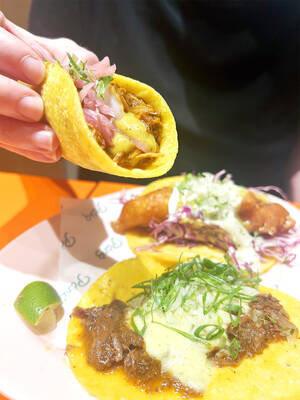
This year’s Michelin Gourmand Bib sported 16 new entries in the 126-strong Taiwan directory. The fight for the best braised pork rice and the crispiest scallion pancake painstakingly continued, but what stood out in the lineup this year? Pang Taqueria (胖塔可利亞); Taiwan’s first Michelin-recommended Mexican restaurant. Chef Charles Chen (陳治宇) is a self-confessed Americophile, earning his chef whites at a fine-dining Latin-American fusion restaurant. But what makes this Xinyi (信義) spot stand head and shoulders above Taipei’s existing Mexican offerings? The authenticity. The produce. The care. AUTHENTIC EATS In my time on the island, I have caved too many times to

In a stark demonstration of how award-winning breakthroughs can come from the most unlikely directions, researchers have won an Ig Nobel prize for discovering that mammals can breathe through their anuses. After a series of tests on mice, rats and pigs, Japanese scientists found the animals absorb oxygen delivered through the rectum, work that underpins a clinical trial to see whether the procedure can treat respiratory failure. The team is among 10 recognized in this year’s Ig Nobel awards (see below for more), the irreverent accolades given for achievements that “first make people laugh, and then make them think.” They are not


 RSS
RSS