


Wrong About Japan has already attracted quite a bit of attention, including being serialized on BBC World Service radio within weeks of publication. This is not surprising. Australian novelist Peter Carey, now living in New York, has twice won the UK's Man Booker Prize and is a major, if quirky, figure on the literary scene. Getting himself invited to Japan to meet fellow artists can't have been difficult, but what he offers here is not a magisterial overview of contemporary artistic Tokyo but a whimsical account of a trip he took to a country he thinks he understands in the company of his 12-year-old son.
Carey senior's mind is full of the past: films like The Seven Samurai, Japanese swords and the novels of Yukio Mishima. His son Charley, on the other hand, thinks only in terms of manga (comic books) and anime (animated films). All the famous artists they meet in Tokyo think like Charley, while Carey senior bumbles on trying to make sense of what he sees in terms of an older Japanese culture he tries to convince himself he understands.
This is a nice theoretical structure for a short book like this, and Carey is wise enough to understand that there isn't a great deal of mileage in it. In a sense, it's an opportunity to publish interview material with some celebrated names in light-weight form -- he says he always was a terrible interviewer. Funny old Carey posing his earnest critical interpretations and Japanese directors responding with "Mmmmmm" or a plain "No" while Charley looks on in embarrassment is the basic situation in most of the interview situations.
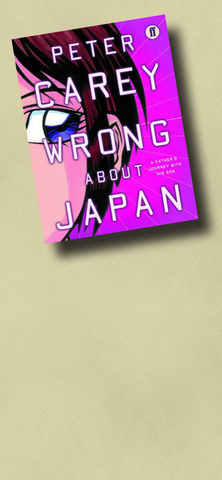
Before they arrive, Charley has extracted a promise from his father that they won't have to visit any of "the real Japan." This phrase refers to an earlier trip made by Carey senior with someone his own age when they sought out kabuki, ryokan and temple bells amidst what looked to them like the international-style uniformity of the indus-
trialized Japanese world. Charley wants none of this but instead the more instant pleasures of the modern Japanese youth culture.
His father mostly complies, though they do go to a kabuki performance -- five hours of hell, Charley judges -- and stay in a traditional ryokan, most interesting to both of them for its extraordinary hot and cold-water toilet. Charley is actually far more dogged than his father in sticking to Japanese food, though they both end up with relief in Mister Donut long before the book ends.
At the heart of Wrong About Japan is a comic juxtaposition of Carey senior's desire to see Japanese manga and anime as representing such things as the isolation of the modern individual in a post-industrial society or a contemporary manifestation of classical samurai traditions, and the totally different views of their actual Japanese creators and, needless to say, Charley.
The idea of the fundamental inscrutability to Westerners of things Japanese is as old as Western books about Japan themselves. Films, too, have often taken the same line, as Lost in Translation recently demonstrated. Carey's approach is therefore nothing new. Nevertheless his presentation of himself as the less intelligent one in many of his encounters is an effective ironic device that sustains the book's interest. It's only Carey senior who turns out to be almost continuously "wrong about Japan."
Together they meet Yoshiyuki Tomino, director of Mobile Suit Gundam, one of Charley's favorite dramas, and Hiroyuki Kitakubo, creator of Blood, The Last Vampire. The latter is described as looking like "an underprivileged kid who had grown up drawing manga by the light of an open refrigerator door." There is a nice picture at the end of the book of him and Charley connecting clenched fists, nonetheless.
The most absorbing chapter is an account by an informant identified only as "Mr Yazaki" of the US firebombing of his home town in 1944. American forces all but destroyed many Japanese cities by conventional bombing in the months running up to the dropping of the atomic bombs on Hiroshima and Nagasaki, and Carey, who laudably wants something anti-war in the book, introduces the topic by reference to a classic anime movie, Isao Takahata's Grave of the Fireflies.
Charley's ally is a Japanese boy of his own age, Takashi, who he has contacted beforehand on the Internet. Takashi's teenage elegance -- hair that stands up in triangular sections, a high-necked blue jacket with gold buttons, knee-high boots -- both overawes Carey senior and allows him to make the boy a slightly sad figure. At the last moment, for instance, he proves too shy to accompany the Careys to meet some of his greatest idols.
At a deeper level, however, Carey is making fun of himself. He crafts his own character into that of a befuddled, baffled and old-fashioned father figure, mumbling on about novels and films of the 1940s and 1950s when the artists he meets, and his son, too, are only interested in the newest cultural creations.
The potentially profound idea that artists have more in common with the young than with their contemporaries is offered only by implication. Peter Carey is presumably aware of it but hides the knowledge to allow the comic aspects of the situation to take effect.
The book ends with the two Careys meeting the great Hayao Miyazaki, director of Princess Mononoke and Spirited Away. As they part company, Miyazaki says that he believes humanity's imagination is its most precious possession and that it can create either virtue or weapons capable of destroying all life. At last Peter Carey and somebody famous and Japanese appear to have found an opinion they can share.

Yesterday, the Democratic Progressive Party (DPP) nominated legislator Puma Shen (沈伯洋) as their Taipei mayoral candidate, the Chinese Nationalist Party (KMT) put their stamp of approval on Wei Ping-cheng (魏平政) as their candidate for Changhua County commissioner and former legislator Tsai Pi-ru (蔡壁如) of the Taiwan People’s Party (TPP) has begun the process to also run in Changhua, though she has not yet been formally nominated. All three news items are bizarre. The DPP has struggled with settling on a Taipei nominee. The only candidate who declared interest was Enoch Wu (吳怡農), but the party seemed determined to nominate anyone
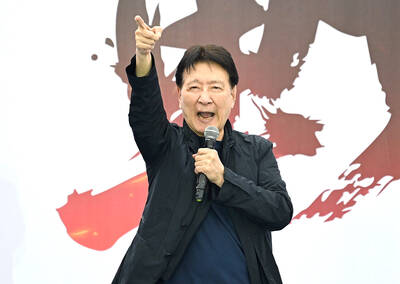
In a sudden move last week, opposition lawmakers of the Chinese Nationalist Party (KMT) and Taiwan People’s Party (TPP) passed a NT$780 billion special defense budget as a preemptive measure to stop either Chinese leader Xi Jinping (習近平) or US President Donald Trump from blocking US arms sales to Taiwan at their summit in Beijing, said KMT heavyweight Jaw Shaw-kong (趙少康), speaking to the Taipei Foreign Correspondents Club on Wednesday night in Taipei. The 76-year-old Jaw, a political talk show host who ran as the KMT’s vice presidential candidate in 2024, says that he personally brokered the deal to resolve
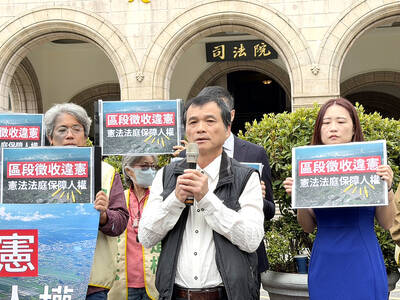
What government project has expropriated the most land in Taiwan? According to local media reports, it is the Taoyuan Aerotropolis, eating 2,500 hectares of land in its first phase, with more to come. Forty thousand people are expected to be displaced by the project. Naturally that enormous land grab is generating powerful pushback. Last week Chen Chien-ho (陳健和), a local resident of Jhuwei Borough (竹圍) in Taoyuan City’s Dayuan District (大園) filed a petition for constitutional review of the project after losing his case at the Taipei Administrative Court. The Administrative Court found in favor of nine other local landowners, but
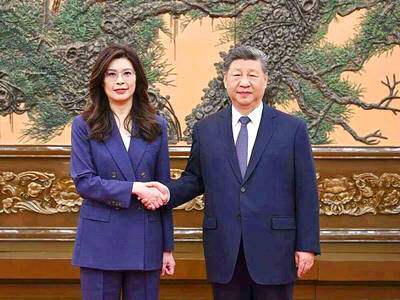
The Chinese Nationalist Party (KMT), alongside their smaller allies the Taiwan People’s Party (TPP), are often accused of acting on behalf of the Chinese Communist Party (CCP). Some go so far as to call them “traitors.” It is not hard to see why. They regularly pass legislation to stymie the normal functioning of the ruling Democratic Progressive Party’s (DPP) administration, and they have yet to pass this year’s annual budget. They slashed key elements of the government’s proposed NT$1.25 trillion (US$40 billion) special military budget, and in the smaller NT$780 billion package they did pass, it is riddled with provisions that


 RSS
RSS