


To a palaeoanthropologist, the past is an open book, but one that fails to tell the whole story. The covers are missing. The first chapters may never be found. There are hardly any pages, and most are so smeared and crumpled, so foxed and faded, that the text could mean almost anything. The cast of characters is confusing and narrative thread anybody's guess. Its authorship is the subject of political debate in the US, the beginning is the stuff of fantasies, and even the latest chapters are entirely provisional. Is it a detective story, a cliffhanger, or a romance? Can there be a happy ending?
There is a story-so-far, but that potted version of events is forever being revised, and nobody knows that better than Chris Stringer, one of the authors of a book published last week called The Complete World of Human Evolution.
Complete? Stringer spent eight years on the text. In the course of it, he had to contemplate plot lines that incorporate unexpected characters, teasing bits of evidence and relics of ambiguous adventures from the sere soils of Africa and the limestone caves of Europe. Then, late last year, he had to sit down in one night and compose an entirely new chapter to incorporate the discovery of Homo floresiensis, also known as the Hobbit.
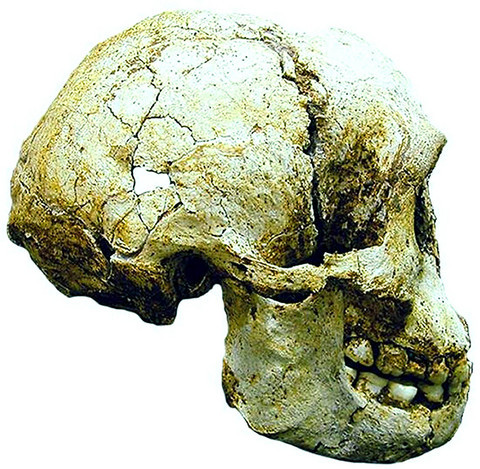
Homo floresiensis was the mysterious survivor unearthed from a cave on the island of Flores in Indonesia. It was a pygmy descendant, perhaps of Homo erectus, perhaps even connected to an earlier human species, but with this special feature: The bones were only 18,000 years old. So Homo sapiens, Homo erectus, Homo neanderthalis and Homo floresiensis must have all shared the planet at the same time, tantalizingly recently, within the last 100,000 years perhaps. Now only Homo sapiens survives.
What stories could those bones tell? And who could have dreamed, before their discovery, that some tree-climbing, pygmy-elephant-hunting human candidate could have survived on a tropical island while Homo sapiens moved into the Fertile Crescent, preparing to invent agriculture, civilization and global
terrorism?

Stringer, 57, is head of human origins at the Natural History Museum in London. One of palaeoanthropology's big players, he has spent his career in pursuit of Homo neanderthalis and is also one of the great proselytisers of the "out-of-Africa theory," the one that says the human story begins on just one continent. Homo floresiensis, however, astonished him.
"Until that turned up, we had no idea that ancient humans had ever reached as far as Flores. We certainly had no idea that there was a completely new kind of human -- or is it even human? That is still being argued about -- living there, and the fact that it was still around there when modern people passed through the region. Each of those is astonishing and that shows how little we knew about human evolution in that part of the world. We are building up pieces of a huge, complex jigsaw, and we still have a lot of spaces to fill in," he said.
"Nature is constantly experimenting. I think a lot of people thought that humans were somehow different, that we had this all embracing culture and this unifying adaptation, that meant that human evolution progressed in a somewhat different way, because of our technology and the way we probably vainly think we are partly controlling the world now. So people project backwards and think humans are somehow special. The evidence shows us that our evolution was as complex and as undirected, I suppose, as that of any other species we have studied."

PHOTO: EPANBELOW, MOUNT EBULO VOLCANO TOWERS ABOVE FLORES, INDON
Here is the orthodoxy, pieced together over a century or more by Darwin's disciples: Primate creatures with a capacity for walking upright emerged perhaps 20 million years ago. From these emerged the ancestors of all gorillas, all chimpanzees and all humans. There is no line of evolution; think, instead, of foliage, and the surviving humans and two species of chimpanzees are just nearby buds at the ends of twigs close together on the tree of life.
Nobody knows with any real confidence where to put the other 20 or so extinct candidates -- half of them found in the last 10 years -- that can be classed as humans or proto-humans. Nobody knows much about what they were like or how they coped.
Brain size expanded, perhaps because of increasing social interplay. Stone tools emerged. Fire was employed. Weapons and cooperative hunting became evident long before Homo sapiens.
Modern humans probably popped up within the last 200,000 years, but the things that make modern humans so distinctive in the fossil record -- symbolic art, pottery and jewelry -- bloomed only about 50,000 years ago. Nobody in the world of palaeoanthropology considers modern humanity to be the flower of creation, either. A temporary bloom, maybe.
It's humbling, Stringer said.
"We shouldn't see ourselves as the summit of the perfection of whatever evolution is trying to achieve," he said.
"We seem to be very successful at the moment in terms of our numbers, but, looking at it on a geological timescale, how successful will we look in 50,000 years, which is a very short time, geologically speaking?"
Genetic evidence suggests humans may have come close to extinction a number of times in the past. Modern humans shared the Middle East with Homo neanderthalis 120,000 years ago and, as Cro-Magnons, became the sole tenants of Europe 30,000 years ago, a terrain held successfully by the Neanderthals for more than 100,000 years. Did they compete? Did they co-exist? Did they trade or cohabit?
Stringer's devotion to the Neanderthals began with a primary school project and continued with a body of groundbreaking research that ultimately earned him a fellowship of the Royal Society.
"OK, why aren't they here now, and why are we here?" And did we have a role in their extinction?" he asked.
And how different were the Neanderthals anyway? Sixty years ago a US scientist said that if a Neanderthal, shaved and dressed, got on the New York subway, nobody would bat an eyelid. That, says Stringer, tells you more about New York than about the Neanderthals.
Stringer prefers an observation by the geneticist Steve Jones, of University College London, who said that if you were on the Tube and a Cro-Magnon got on, you might move seats. If a Neanderthal got on, you might change carriages.
"Neanderthals were certainly human and evolved as us in their own way, but they were different. They had several hundred thousand years of evolving their own anatomy and behavior. But when these people met in Europe. would they have seen each other as people? Or as someone different?" he said.
"I still tend to the view that the primary message would have been different. They would have had a different body language, a completely different way of communication; they would have had different behaviors."
He thinks the Neanderthals perished at a moment of maximum stress in the stop-go, hot-cold pattern of climate during the last ice age.
Though they left their mark in the Pyrenees, they never got to Britain at all. But then the human occupation of Britain is itself a bit of a riddle. Boxgrove man, whoever he was -- Homo ergaster? Homo heidelbergensis? -- got to Boxgrove near Chichester, hunted, chipped flints and butchered a rhino. They may not have killed the rhino -- a very dangerous adventure -- but even if they were just scavenging, it must have taken some degree of cooperation and organization to have driven off the lions, or wolves, and secured the carcass for themselves. And then Boxgrove man and his tribe departed, leaving one human shin as evidence that they walked in and walked out.
There was evidence, most of it indirect, of little pulses of human occupation, and then a gap of 100,000 years when no humans appeared to have visited Britain at all. At times, the country must have looked like the plains of Africa -- hyenas, rhinos, lions, red deer and so on -- and, at others, like the tundra, but although the animals came and went, humans did not. Modern humans finally moved in and stayed only 12,000 years ago.
Stringer and his co-author Peter Andrews -- a former head of human origins at the Natural History Museum and an expert on the early part of the human story -- tried to tell the story of human evolution not just through time, but through its context: How you set about excavating a site, what a piece of tooth or jaw can tell you about ancient human behavior. In that, the title means what it says: Complete.
How much more is there to tell? The past will also reveal more. The future, paradoxically, might not. Modern humans, after such a short time on Earth and so many adventures, could have nowhere to go.
"With our behavior and global warming and so on, we could be writing ourselves a suicide note. But if humans do get through that crisis and carry on, evolution is continuing. And under the skin, in our genes, it is certainly continuing, and will continue," Stringer says.
"So in the long term, of course, we will evolve and change.That's the nature of evolution. Nothing stays the same in the long term. We may look the same, but under the surface the genes are evolving and changing. That will go on."
CHRIS STRINGER'S LIFE AT A GLANCE
Education: East Ham Grammar school; anthropology at University College London; PhD at Bristol University in 1974.
Career: Joined Natural History Museum in London in 1973; author of 200 scientific papers and co-author of three books; director of the Leverhulme-funded Ancient Occupation of Britain project.
Off-duty: Has a daughter and two sons; listens to Shostakovich, Vaughan Williams and Joy Division; enjoys astronomy and supporting West Ham.
They say: ``Stringer is the very antithesis of the drawling, lackadaisical, elegant, upper-class Englishman for whom appearing to work too hard is `bad form.' To Stringer, bad form is doing sloppy science or being too lazy or mentally hidebound to get at the truth.''
Erik Trinkaus and Pat Shipman, The Neanderthals (1993)
He says:
``That's what science is about. You ask questions all the way along and you find out that the answers are wrong, and that's good because you can ask another question.''
The Complete World of Human Evolution by Chris Stringer and Peter Andrews is published by Thames and Hudson

Sept.16 to Sept. 22 The “anti-communist train” with then-president Chiang Kai-shek’s (蔣介石) face plastered on the engine puffed along the “sugar railway” (糖業鐵路) in May 1955, drawing enthusiastic crowds at 103 stops covering nearly 1,200km. An estimated 1.58 million spectators were treated to propaganda films, plays and received free sugar products. By this time, the state-run Taiwan Sugar Corporation (台糖, Taisugar) had managed to connect the previously separate east-west lines established by Japanese-era sugar factories, allowing the anti-communist train to travel easily from Taichung to Pingtung’s Donggang Township (東港). Last Sunday’s feature (Taiwan in Time: The sugar express) covered the inauguration of the

The corruption cases surrounding former Taipei Mayor and Taiwan People’s Party (TPP) head Ko Wen-je (柯文哲) are just one item in the endless cycle of noise and fuss obscuring Taiwan’s deep and urgent structural and social problems. Even the case itself, as James Baron observed in an excellent piece at the Diplomat last week, is only one manifestation of the greater problem of deep-rooted corruption in land development. Last week the government announced a program to permit 25,000 foreign university students, primarily from the Philippines, Indonesia and Malaysia, to work in Taiwan after graduation for 2-4 years. That number is a

This year’s Michelin Gourmand Bib sported 16 new entries in the 126-strong Taiwan directory. The fight for the best braised pork rice and the crispiest scallion pancake painstakingly continued, but what stood out in the lineup this year? Pang Taqueria (胖塔可利亞); Taiwan’s first Michelin-recommended Mexican restaurant. Chef Charles Chen (陳治宇) is a self-confessed Americophile, earning his chef whites at a fine-dining Latin-American fusion restaurant. But what makes this Xinyi (信義) spot stand head and shoulders above Taipei’s existing Mexican offerings? The authenticity. The produce. The care. AUTHENTIC EATS In my time on the island, I have caved too many times to

In a stark demonstration of how award-winning breakthroughs can come from the most unlikely directions, researchers have won an Ig Nobel prize for discovering that mammals can breathe through their anuses. After a series of tests on mice, rats and pigs, Japanese scientists found the animals absorb oxygen delivered through the rectum, work that underpins a clinical trial to see whether the procedure can treat respiratory failure. The team is among 10 recognized in this year’s Ig Nobel awards (see below for more), the irreverent accolades given for achievements that “first make people laugh, and then make them think.” They are not


 RSS
RSS