


Here is a question fit for Yoda: Now that the director George Lucas has finished the last of his six Star Wars movies, what will become of his company, the entertainment empire Lucasfilm?
To hear Lucas tell it, Lucasfilm will be less ambitious, not more. There will be no more live-action blockbuster movies, he said, and that means fewer peaks and troughs: In the past, the company's profits would soar during years when a Star Wars film was released, only to fall off a cliff between movies.
From now on, he said, Lucasfilm will be a "widget-driven" enterprise, churning out books, video games and television shows, with a more predictable rate of return of 10 percent to 20 percent a year. Eventually, he said, the hit-driven cult of personality surrounding both him and Star Wars will give way to "a sane reality."
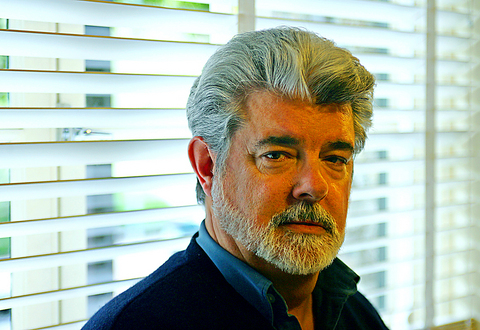
PHOTO: AP
"I have no intention of running a film company," said Lucas. "That is the last thing in the world I'd do."
"I'm trying to get back to that place that the company functions without me and Star Wars," the multibillionaire added.
Those who know him wonder how much control he is ready to give up. Lucas, 61, started the company in 1971 in Marin County, north of San Francisco, as a production vehicle for his movies, but he has since compiled a dizzying array of entertainment businesses that would make any Hollywood studio chief jealous. They include video games (LucasArts), special effects (Industrial Light and Magic), sound editing (Skywalker Sound) and Star Wars product licensing (Lucas Licensing)

PHOTO: REUTERS
As the sole owner of Lucasfilm, a company that analysts estimate has nearly US$1 billion in annual revenue and virtually no debt, Lucas has no one to answer to -- and he can manage the transition from Star Wars as he sees fit.
"Over the next several months, he said, he plans to concentrate on revving up future projects, including two recently announced Star Wars television series.
"Above all, George wants options," said Jim Morris, a 17-year Lucasfilm veteran who oversaw its special effects and sound divisions before he joined Pixar Animation Studios as a producer. "And those options include, of course, taking the company public one day."
This summer, Lucasfilm's roughly 1,500 employees will move into the Letterman Digital Arts Center, the company's newly built headquarters in San Francisco. Lucas spared no expense in designing the US$350 million campus, where employees will be together in one facility for the first time, far from the mystique of Skywalker Ranch and Lucas. The new place may aid the evolution to a less Lucas-dependent environment.
Micheline Chau, the president and chief operating officer, said Lucas began thinking about overhauling the company in 2002, just after the release of Attack of the Clones, the fifth Star Wars film made.
In a sense, Lucasfilm has always served two masters: Lucas and everyone else. While major decisions are not made without consulting the director, Chau and others have much leeway.
"We are not a democracy," she said. "Still, we've never been, `What would George think?' We've never run our businesses like that. We have to stand on our own two feet."
But as much authority as is afforded to Chau, Lucas remains the arbiter of all things Star Wars. And that is unlikely to change.
"You know we're unusual in the sense that we're bounded by this visionary legend who has created things that have stretched the boundaries of this world's culture," said Howard Roffman, president of Lucas Licensing.
It is precisely that sentiment, though, that may limit Lucasfilm. Critics warn that the company is so tied up in the Star Wars mythology that it will be difficult for Lucas to distance himself.
In fact, Chau said the company had hired a handful of writers and directors to work with Lucas and she hoped they could do projects on their own once they gained the director's trust.
"What is important for management," Chau said, "is that we put people in front of George who can interact with him, work well with him and who are not afraid of George."
But Lucas has made it clear that he is not interested in training a ready army of filmmakers.
"It's not like we have to come up with a movie every year," he said, concerned about what has become a hit-driven business. "I don't want to be Pixar."
His ambition for Lucasfilm, he said, is far more ordinary.
"I'm not depending on these people or a new group of people to take the company into a megahit reality," he said. "I'm trying to build a company where we don't make miracles but we do a good job."

Sept.16 to Sept. 22 The “anti-communist train” with then-president Chiang Kai-shek’s (蔣介石) face plastered on the engine puffed along the “sugar railway” (糖業鐵路) in May 1955, drawing enthusiastic crowds at 103 stops covering nearly 1,200km. An estimated 1.58 million spectators were treated to propaganda films, plays and received free sugar products. By this time, the state-run Taiwan Sugar Corporation (台糖, Taisugar) had managed to connect the previously separate east-west lines established by Japanese-era sugar factories, allowing the anti-communist train to travel easily from Taichung to Pingtung’s Donggang Township (東港). Last Sunday’s feature (Taiwan in Time: The sugar express) covered the inauguration of the

The corruption cases surrounding former Taipei Mayor and Taiwan People’s Party (TPP) head Ko Wen-je (柯文哲) are just one item in the endless cycle of noise and fuss obscuring Taiwan’s deep and urgent structural and social problems. Even the case itself, as James Baron observed in an excellent piece at the Diplomat last week, is only one manifestation of the greater problem of deep-rooted corruption in land development. Last week the government announced a program to permit 25,000 foreign university students, primarily from the Philippines, Indonesia and Malaysia, to work in Taiwan after graduation for 2-4 years. That number is a

This year’s Michelin Gourmand Bib sported 16 new entries in the 126-strong Taiwan directory. The fight for the best braised pork rice and the crispiest scallion pancake painstakingly continued, but what stood out in the lineup this year? Pang Taqueria (胖塔可利亞); Taiwan’s first Michelin-recommended Mexican restaurant. Chef Charles Chen (陳治宇) is a self-confessed Americophile, earning his chef whites at a fine-dining Latin-American fusion restaurant. But what makes this Xinyi (信義) spot stand head and shoulders above Taipei’s existing Mexican offerings? The authenticity. The produce. The care. AUTHENTIC EATS In my time on the island, I have caved too many times to

In a stark demonstration of how award-winning breakthroughs can come from the most unlikely directions, researchers have won an Ig Nobel prize for discovering that mammals can breathe through their anuses. After a series of tests on mice, rats and pigs, Japanese scientists found the animals absorb oxygen delivered through the rectum, work that underpins a clinical trial to see whether the procedure can treat respiratory failure. The team is among 10 recognized in this year’s Ig Nobel awards (see below for more), the irreverent accolades given for achievements that “first make people laugh, and then make them think.” They are not


 RSS
RSS