


It isn't every day that a university professor goes to a factory in China and enrolls as one of the workforce in order to study the conditions there and the experiences of its workers. But this is what Pun Ngai has done in this remarkable book.
Made in China is in one way a bombshell, but it is also two very different books. On the one hand it's a vivid and persuasive first-hand account of life in China's factories in the late 20th century -- places where a huge range of the commodities you see in shops from Taipei to Cincinnati are made.
The personal histories of workers, many of them female and under 20, are quoted verbatim, and their nightly screams and dreams (the author's phrase) recorded. But on the other it's also an academic work replete with expressions such as "the power, discourses, and processes of sexualizing bodies in the workplace" and "individuals torn by the tensions between capitalist forces, state socialist power and the local patriarchal culture."
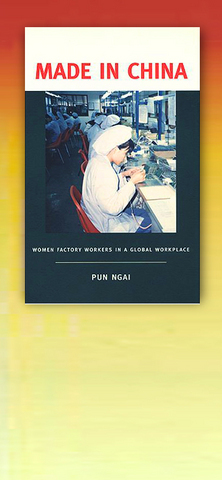
To be accurate, Pun Ngai wasn't a professor when she enrolled as a worker in an electronics factory in Shenzhen in November 1995. But she is today, an Assistant Professor at the Hong Kong University of Science and Technology. This book, though, could well make her into a world figure.
She worked 11 to 12 hours a day, six days a week, for seven months on the production line of a Hong Kong-owned business. The company director was a personal friend and agreed to the project, though thinking it would be better if she chose to work in the offices and live in an apartment with some of the mostly Hong Kong office staff. Most of her co-workers believed she was planning to write lurid fictional narratives based on their life-stories.
As part of her project, the author positions herself among the conflicting theories that stir modern academic sociologists. These sections of her book will not be of much interest to ordinary readers, but for the record she aligns herself with E.P. Thompson's 1963 classic The Making of the English Working Class and in so doing rejects the more stringent Marxists who insist on the dominant power of materialist historical forces. The specifics of the situation in one place and time and the initiatives of individuals all play their part in Pun Ngai's analysis.
The book, though frequently academic in tone and perspective, nevertheless gives a vivid idea of life in the factory. There are details of the cumulative lack of sufficient sleep (all the workers spend the first half of their one day off a week sleeping), company pay stoppages for infringements of the rules, issues between workforce and management over such things as the radio, attempts by workers to slow down the production line due to exhaustion, and so on. The monotony of the work is so extreme that even reading about it induced in me a sense of fatigue and disgust.
But the real shock comes with the rates of pay. The average wages of these young female factory workers in 1996 were almost unbelievably low. I will quote the relevant sentence in case you think I have mis-read the text. "With overtime pay and the production bonus the line workers could have an average pay of around 500 to 600 yuan a month" (page 125). The men on average earned some 30 percent more. Even at the most favorable exchange rate this woman's rate only equals some NT$2,500. This is not per day but per month for working 12 hours a day, six days a week in repetitive, demeaning, cramp-inducing, eye-sight-damaging work, with no talking allowed and the radio only occasionally on in the day for a short time.
The standard response is that people don't have to do this work if they don't want to, and that when the company is hiring (normally immediately after Lunar New Year) security guards are needed to control the crowds of applicants. Even so, advanced countries have minimum wages, specifically in order to prevent this kind of exploitation.
But increase pay levels and the masters of capital will go elsewhere, critics will say. Of course this is true. So what is the answer? Worker power, with decent levels of pay everywhere, is the only solution. Perhaps one day it will come, but China is supposed to be the country of the people already. This problematic interface between socialist state power and international capital lies at the heart of the author's more strenuous analytical passages.
The factory Pun Ngai studied made navigational aids for car drivers, but the reality is that every pair of jeans or CD player we buy is likely to have been made under comparable conditions.
Shenzhen is an emblem for Pun Ngai of the whole of China. Selected areas of the country have undergone a transformation over the last 15 years, but in Shenzen the changes have been more thorough than anywhere else. It's a lurid, hyper-real fantasy town that stands for China as a whole.
This book could have the influence of Charles Dickens's Hard Times or Rachel Carson's Silent Spring. It's moving and shocking, and presents a world that won't easily be changed. But perhaps a more popular edition ought to be prepared containing only the author's personal experiences, though extensive interviews and media coverage will probably bring the fruits of her embedded fly-on-the-wall reportage to a wider public than just the academy.
There is one final point. The author is under no illusions as to her own motivation, or the minimal effect her book is likely to have. "The search for identification with the female workers helps to prop up my intellectual and `radical' fantasy of `resisting the irresistible' rise of global capitalism," she writes.
The inverted commas round "radical," and "resisting the irresistible" show how clear-sighted this author is. The fact that she went ahead with this book nevertheless is perhaps the main reason why anyone who cares about East Asia today, and tomorrow, should read it.

Sept.16 to Sept. 22 The “anti-communist train” with then-president Chiang Kai-shek’s (蔣介石) face plastered on the engine puffed along the “sugar railway” (糖業鐵路) in May 1955, drawing enthusiastic crowds at 103 stops covering nearly 1,200km. An estimated 1.58 million spectators were treated to propaganda films, plays and received free sugar products. By this time, the state-run Taiwan Sugar Corporation (台糖, Taisugar) had managed to connect the previously separate east-west lines established by Japanese-era sugar factories, allowing the anti-communist train to travel easily from Taichung to Pingtung’s Donggang Township (東港). Last Sunday’s feature (Taiwan in Time: The sugar express) covered the inauguration of the

The corruption cases surrounding former Taipei Mayor and Taiwan People’s Party (TPP) head Ko Wen-je (柯文哲) are just one item in the endless cycle of noise and fuss obscuring Taiwan’s deep and urgent structural and social problems. Even the case itself, as James Baron observed in an excellent piece at the Diplomat last week, is only one manifestation of the greater problem of deep-rooted corruption in land development. Last week the government announced a program to permit 25,000 foreign university students, primarily from the Philippines, Indonesia and Malaysia, to work in Taiwan after graduation for 2-4 years. That number is a
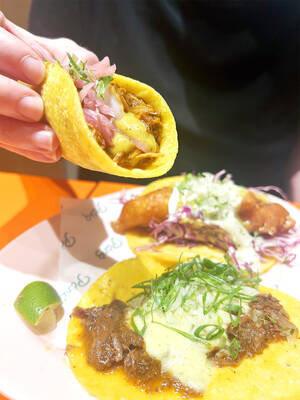
This year’s Michelin Gourmand Bib sported 16 new entries in the 126-strong Taiwan directory. The fight for the best braised pork rice and the crispiest scallion pancake painstakingly continued, but what stood out in the lineup this year? Pang Taqueria (胖塔可利亞); Taiwan’s first Michelin-recommended Mexican restaurant. Chef Charles Chen (陳治宇) is a self-confessed Americophile, earning his chef whites at a fine-dining Latin-American fusion restaurant. But what makes this Xinyi (信義) spot stand head and shoulders above Taipei’s existing Mexican offerings? The authenticity. The produce. The care. AUTHENTIC EATS In my time on the island, I have caved too many times to

In a stark demonstration of how award-winning breakthroughs can come from the most unlikely directions, researchers have won an Ig Nobel prize for discovering that mammals can breathe through their anuses. After a series of tests on mice, rats and pigs, Japanese scientists found the animals absorb oxygen delivered through the rectum, work that underpins a clinical trial to see whether the procedure can treat respiratory failure. The team is among 10 recognized in this year’s Ig Nobel awards (see below for more), the irreverent accolades given for achievements that “first make people laugh, and then make them think.” They are not


 RSS
RSS