


The travel publicity of the Socialist Republic of Vietnam refers to the country as a destination for the new millennium. For once this piece of self-promotion is spot on. Whereas Thailand and Bali have been offering tropical vacations -- beach-side relaxation with some historical sights -- for more than two decades, Vietnam is a newcomer with what is in effect the same deal. And in both its unwearied attitude toward its new visitors and its sheer value for the money, this newness on the scene shows and scores highly.
Formerly named Saigon, meaning "gift to the foreigner," Ho Chi Minh City was built by the French as their imperial capital in what they called Indochina. What is remarkable is that so little has changed since those days. The city suffered less damage in the Vietnam War than might be supposed, and since the Communist takeover in 1975 not much has been altered.
As a result you have some of that laid-back era with the wide boulevards, resplendent public buildings and hotels, and low pollution levels, now coexisting with several affluent new commercial facades adorning the central area. The city center now has the best of two worlds: old-fashioned charm and modern glitter with little of the concrete-block ugliness of the decades that lay between them.
Traditional marvels include the extraordinary post office with its vaulted roof and exotic murals, the red-brick cathedral, and old colonial hotels such as the Continental (central to Graham Greene's novel The Quiet American), the Rex, and the riverside Majestic. Among the shining modern constructions are the Hong Kong Bank and Caravelle Hotel towers. At night much of this central area is floodlit, giving an impression, reinforced by the many pavement cafes, of central Paris.
It wasn't for nothing that Ho Chi Minh City was dubbed the "Paris of the East." Shanghai shared the same flattering moniker, but whereas much of traditional Shanghai has fallen victim to the constructor's jackhammer, old Ho Chi Minh City is still lying back perfecting its tan in the tropical sunshine.
And there are tourists everywhere. Swedes, Britons, French and Japanese are especially common, and whether it's young backpackers or their more affluent seniors, Ho Chi Minh City is currently awash with international visitors. It's a tourist destination whose time has come.
There's no shortage of places to stay. Indeed, the problem is where to choose, so spacious is even the cheapest accommodation and so magnificent a wide range of the more up-market places. Incidentally, take US dollars with you. Exchange rates for Taiwan dollars are never displayed, and US cash is invariably accepted as an alternative to the Vietnamese dong. Take plenty of US$1 bills.
The backpacker area of Pham Ngu Lao is very close to the city center. It's Ho Chi Minh City's equivalent of Bangkok's Khaosarn Road, but more congenial and a much better value. The area may be only a handful of streets based around Duong De Tham, but it offers a huge range of cheap and spacious hotels, typically with rooms at between US$10 and US$15 a night. There's little inducement to spend more when such cleanliness and friendliness is so readily available. At US$12 per night, the Chau Long Hotel (tel 848-8369667) with air-conditioned rooms, multi-channel TV and bathrooms with hot water is as good as any. But there are many similar places to choose from.
This area also boasts about 30 excellent small restaurants offering Western and Vietnamese food. An elaborate dinner at any of these will set you back a mere US$5 -- breakfast is around US$2. There's a good Internet center (opposite the Good Morning Ho Chi Minh City restaurant), an excellent grocery and general store, and street-traders and touts in abundance.
Few things are nicer than to sit in a pavement cafe on Duong De Tham in 30℃ and order a pizza and a bottle of Vietnamese wine for little more than US$2 a bottle. Coffee is typically US$0.50.
If you want to stay in an up-market Ho Chi Minh City hotel, the choices are amazing. Graham Greene's Continental is centrally situated but less than up to the best modern mark. Much better would be to stay at either the Windsor Plaza (tel: 8336688) or the Sofitel Plaza Ho Chi Minh City (tel: 8241555). Both these luxurious places have a wealth of comfort and style to offer, and each boasts a rooftop swimming pool.
The Windsor Plaza, in the Chinese "Cholon" district, only opened its doors in January and is awash with the finest modern furniture and art from China. It has banqueting suites for weddings that seat 1,000, a top-class Chinese restaurant (the Ngan Dinh) and KTV and massage facilities. Walking its corridors makes you wonder whether the best the modern world has to offer is really happening in the bastions of capitalism. Several very remarkable places are sprouting up here in the heart of one of the world's few remaining Marxist economies.
Fine dining is also on offer in the heart of the city, in the area around the opera house. The Sofitel has a five-star French restaurant, L'Olivier, while traditional Vietnamese food can be eaten in charmingly old-fashioned surroundings at the Tan Nam Restaurant, 60-62 Dong Du (tel: 8298634).
Tourists and locals generally eat and drink in different places. This is mostly because few Vietnamese can afford the prices foreigners are more than happy to pay. The prices charged to tourists occupy a middle ground: expensive for Vietnamese, often absurdly cheap for the visitors. As a result you see everywhere crowds of Vietnamese sitting on low plastic stools drinking beer and eating snacks, often until well after midnight. No tourists join them, however. Instead they eat at places that cater to foreign taste buds, enjoying a plate of steak and fries for around US$2.
Taxis are cheap, too. You can get downtown from the backpacker area for US$1, and this is the best way to travel after dark. Cyclos (bicycle rickshaws) are cheaper still -- you negotiate a price before setting off -- and give a strong sense of the local scene with their slow pace. But everywhere you go you see warnings against taking them at night, and it's best to follow this advice.
Ho Chi Minh City is attractive to view by bicycle or motorbike. You can rent either by the day very cheaply -- a bike is US$1. It's flat everywhere, and as there aren't many cars you quickly find yourself one of a tide of fellow travelers on two wheels. The locals park their transport in guarded parking lots, and you should do the same. The price is about US$0.07.
As for what to see, recommended are the traditional culture shows at the opera house (entrance US$4), an hour-long massage by a blind masseuse (US$2, at 185 Cong Quynh; the blind are said to have a better touch), and the coffee shops, restaurants and night clubs clustered around Duong Dong Khoi. For night life, try Apocalypse Now on Duong Thi Sach. Cheap clothes can be bought in Ben Thanh market; for jeans try Xuan Trang, kiosk 14-16, by Gate 2.
Day trips out of town are popular and a good value. The Mekong Delta is only two hours away by coach, and a round trip including lunch is a mere US$6. You get to see fish and fruit markets, visit a bee farm, travel on two different kinds of boat, and play with thieving monkeys in a riverside garden. Also popular are the wartime tunnels at Chu Chui and the center of the eclectic Caodai religion at Tay Ninh.
You can also take the trip to Vung Tau, a peninsula and the nearest seaside place to Ho Chi Minh City. Locals get there in crowded buses, but the easy way is by Greenlines hovercraft. These ancient but efficient vessels leave from a pier in central Ho Chi Minh City every hour until 5pm. The trip is just over an hour and the price is US$10 each way.
They roar you down the coiled snakes' nest of rivers between Ho Chi Minh City and the ocean in air-conditioned comfort, albeit with the windows crudely whitewashed over against the sun. The scene from the roof -- mangroves, blue water, the occasional thatched hut -- is far wilder and more picturesque than anything you'll see on a one-day Mekong Delta trip.
Whether you'll like Vung Tau when you get there is another matter. It was an elegant resort under the French, and is still, from a distance, reminiscent of Macau. But the main beach (known as the "Back Beach") is a mass of shabby umbrellas and wonky chairs on weekends. Few Vietnamese go in for swimming trunks, so instead you see fully clad people venturing into the waves supported on inflated black inner tubes. Mass poverty can be a shock, and it's unlikely you'll want to stay later than 5pm when the last hovercraft leaves for Ho Chi Minh City.
Flight and visa information:
Flights to Ho Chi Minh City from Taipei are operated by EVA Airlines and Vietnam Airlines. The trip takes three and a half hours, and the price is NT$14,500 on EVA, NT$13,000 on Vietnam Airlines.
Tourist visas are issued for one month, extendible for another month. The office for this in Taipei is at 65 Sung Chiang Road, 3F; tel: (02) 25166626. Visa processing takes four working days and the charge is NT$1,240. US$1 = 15,750 Vietnamese dong, but expect to be offered 15,000 dong in small transactions.

Sept.16 to Sept. 22 The “anti-communist train” with then-president Chiang Kai-shek’s (蔣介石) face plastered on the engine puffed along the “sugar railway” (糖業鐵路) in May 1955, drawing enthusiastic crowds at 103 stops covering nearly 1,200km. An estimated 1.58 million spectators were treated to propaganda films, plays and received free sugar products. By this time, the state-run Taiwan Sugar Corporation (台糖, Taisugar) had managed to connect the previously separate east-west lines established by Japanese-era sugar factories, allowing the anti-communist train to travel easily from Taichung to Pingtung’s Donggang Township (東港). Last Sunday’s feature (Taiwan in Time: The sugar express) covered the inauguration of the

The corruption cases surrounding former Taipei Mayor and Taiwan People’s Party (TPP) head Ko Wen-je (柯文哲) are just one item in the endless cycle of noise and fuss obscuring Taiwan’s deep and urgent structural and social problems. Even the case itself, as James Baron observed in an excellent piece at the Diplomat last week, is only one manifestation of the greater problem of deep-rooted corruption in land development. Last week the government announced a program to permit 25,000 foreign university students, primarily from the Philippines, Indonesia and Malaysia, to work in Taiwan after graduation for 2-4 years. That number is a
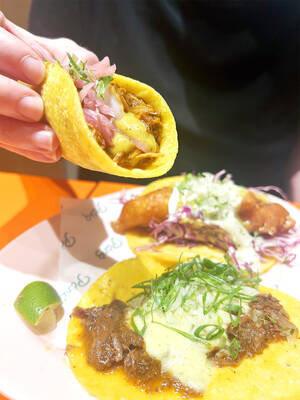
This year’s Michelin Gourmand Bib sported 16 new entries in the 126-strong Taiwan directory. The fight for the best braised pork rice and the crispiest scallion pancake painstakingly continued, but what stood out in the lineup this year? Pang Taqueria (胖塔可利亞); Taiwan’s first Michelin-recommended Mexican restaurant. Chef Charles Chen (陳治宇) is a self-confessed Americophile, earning his chef whites at a fine-dining Latin-American fusion restaurant. But what makes this Xinyi (信義) spot stand head and shoulders above Taipei’s existing Mexican offerings? The authenticity. The produce. The care. AUTHENTIC EATS In my time on the island, I have caved too many times to

In a stark demonstration of how award-winning breakthroughs can come from the most unlikely directions, researchers have won an Ig Nobel prize for discovering that mammals can breathe through their anuses. After a series of tests on mice, rats and pigs, Japanese scientists found the animals absorb oxygen delivered through the rectum, work that underpins a clinical trial to see whether the procedure can treat respiratory failure. The team is among 10 recognized in this year’s Ig Nobel awards (see below for more), the irreverent accolades given for achievements that “first make people laugh, and then make them think.” They are not


 RSS
RSS