


Occasionally a nonfiction book comes along that renders the seemingly familiar in a brilliantly conceived new way.
So much has been published about John F. Kennedy, Lyndon B. Johnson and Richard Nixon that a downright fresh new book about any of them -- much less all three of them -- seemed unlikely circa 2005.
Well, Lance Morrow has accomplished the unlikely. In an extended essay containing little new factual information but brimming with insights, Morrow examines how the personal histories of the three men, combined with national and international events occurring during 1948, set the stage for future presidents of the US.
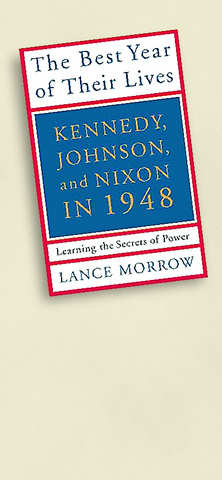
Unlike many presidential biographers, Morrow does not focus on the trio because he thinks they are great men. He makes it clear that each suffered from at least one of the seven deadly sins cataloged in ancient times -- lust, gluttony, avarice, anger, pride, envy and sloth.
"Richard Nixon's defining deadly sin was surely anger -- or envy," Morrow writes, while demonstrating that hypothesis throughout the text. "Kennedy's deadly sin was lust. Johnson's deadly sin was greed -- for power, for money."
The sins eventually caused harm to each man during the 1960s, two decades after the focus of Morrow's book. On the escalator up to power, however, the men masked their sins well enough to achieve a home in the White House.
Morrow combines journalism and intellectualism about as skillfully as anybody writing in the US today. Evidence of that combination can be found in his previous books (a philosophical rumination on evil, plus two memoirs), his cover stories for Time magazine, and his in-depth features for other periodicals.
In this new book, Morrow's original thinking is given additional power by clear, compelling writing. His intellectualism allows him to define 1948 as the decision year for future presidential quests among men who seemingly had almost nothing in common.
What happened during 1948 to seed the presidential aspirations of Nixon and Johnson was exceedingly public. What happened during 1948 to Kennedy was exceedingly private.
Nixon, a first-term, socially inept, brainy congressman from California, became recognized as a Cold War Communist hunter, with a civil servant named Alger Hiss as his primary quarry. Johnson, a veteran but largely unknown congressman from Texas, ascended to the US Senate by defeating a popular down-home former governor in a nearly dead-even race -- 87 votes' difference -- that almost certainly involved ballot fraud.
Kennedy, a first-term congressman, spent 1948 doing damage control to his reputation by building a myth that few non-family outsiders penetrated until long after his assassination. One part of the myth assured voters that Kennedy enjoyed good health, when in fact he was suffering from a debilitating disease requiring heavy medication. Another part of the myth involved sexual predation rampant within the Kennedy clan. In 1948, Kennedy's beloved sister Kathleen died in an overseas plane crash while with her married lover. The Kennedy clan lied about the circumstances of Kathleen's death, and got away with the lie. John F. Kennedy learned that he could get away with lies about his own sexual improprieties -- and did so for the remaining 15 years of his life.
Morrow's extended essay would pack intellectual power if all he had done was chronicle the biographical turning points of Kennedy, Johnson and Nixon during 1948, then outline their divergent paths to the presidency in 1960, 1963 and 1968.
Instead, Morrow sets a much higher bar for the book. He is determined to demonstrate how the varied geographic and socioeconomic upbringings of the three men led to the development of their outsized, flawed, ultimately dominant characters. Simultaneously, Morrow is determined to link the three distinct character types with alternate visions of the US circa 1948.
The intellectual tour de force arises in a chapter titled "Ellis Island, the Frontier, and the Taft-Hartley Act."
Morrow theorizes how the birthplaces and gravesites of Kennedy, Johnson and Nixon, scattered as they are across America, "represent an American triangulation."
"The meanings can be approached by looking at basic poles of American experience: Ellis Island and the frontier. ... Americans tend to be attracted, like iron filings, to one or the other of the national narratives, with its attendant attitudes and sympathies. ... But it remains useful to study the interplay between Ellis Island and the frontier, useful to measure the political distance between them, and the frequent hostility between them as organizing metaphors."
The Ellis Island metaphor, Morrow explains, is essentially urban, noisy and ethnic. The frontier metaphor is essentially spacious, silent and homogeneous. The metaphors collided over a piece of legislation called Taft-Hartley, after its congressional sponsors. As the metaphors collided, so did the three future presidents. The proposed legislation carried a pro-business label, as it made organizing and maintaining labor unions more difficult.
US Representative Kennedy opposed passage of the legislation, thus putting himself at odds with the wealthy businessman father who bankrolled the son's political ambitions.
US Representative Nixon, who favored the legislation, "located himself farther to the right, on what might be called the Chamber of Commerce Frontier."
As for Johnson, hoping to win a Senate seat or suffer the near-certain death of his career in politics, he tried to embody both the Ellis Island and Frontier metaphors while misrepresenting his election opponent's stance on Taft-Hartley.
Morrow's book is filled with such original thinking leading to reader epiphanies. It might never become the conventional wisdom for the Kennedy-Johnson-Nixon era of American history, but it ought to.

Sept.16 to Sept. 22 The “anti-communist train” with then-president Chiang Kai-shek’s (蔣介石) face plastered on the engine puffed along the “sugar railway” (糖業鐵路) in May 1955, drawing enthusiastic crowds at 103 stops covering nearly 1,200km. An estimated 1.58 million spectators were treated to propaganda films, plays and received free sugar products. By this time, the state-run Taiwan Sugar Corporation (台糖, Taisugar) had managed to connect the previously separate east-west lines established by Japanese-era sugar factories, allowing the anti-communist train to travel easily from Taichung to Pingtung’s Donggang Township (東港). Last Sunday’s feature (Taiwan in Time: The sugar express) covered the inauguration of the

The corruption cases surrounding former Taipei Mayor and Taiwan People’s Party (TPP) head Ko Wen-je (柯文哲) are just one item in the endless cycle of noise and fuss obscuring Taiwan’s deep and urgent structural and social problems. Even the case itself, as James Baron observed in an excellent piece at the Diplomat last week, is only one manifestation of the greater problem of deep-rooted corruption in land development. Last week the government announced a program to permit 25,000 foreign university students, primarily from the Philippines, Indonesia and Malaysia, to work in Taiwan after graduation for 2-4 years. That number is a
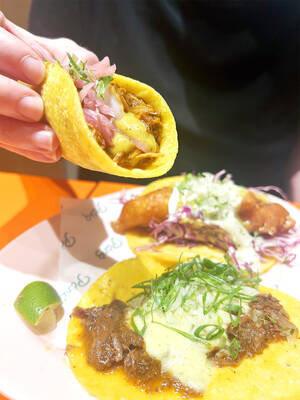
This year’s Michelin Gourmand Bib sported 16 new entries in the 126-strong Taiwan directory. The fight for the best braised pork rice and the crispiest scallion pancake painstakingly continued, but what stood out in the lineup this year? Pang Taqueria (胖塔可利亞); Taiwan’s first Michelin-recommended Mexican restaurant. Chef Charles Chen (陳治宇) is a self-confessed Americophile, earning his chef whites at a fine-dining Latin-American fusion restaurant. But what makes this Xinyi (信義) spot stand head and shoulders above Taipei’s existing Mexican offerings? The authenticity. The produce. The care. AUTHENTIC EATS In my time on the island, I have caved too many times to

In a stark demonstration of how award-winning breakthroughs can come from the most unlikely directions, researchers have won an Ig Nobel prize for discovering that mammals can breathe through their anuses. After a series of tests on mice, rats and pigs, Japanese scientists found the animals absorb oxygen delivered through the rectum, work that underpins a clinical trial to see whether the procedure can treat respiratory failure. The team is among 10 recognized in this year’s Ig Nobel awards (see below for more), the irreverent accolades given for achievements that “first make people laugh, and then make them think.” They are not


 RSS
RSS