


It takes 15 minutes to climb 3,962m above Fentress Airpark, Texas, in a Twin Super Otter. That's plenty of time to think good and hard about the meaning of life.
But this group of a dozen sky divers doesn't seem worried. They're happily chewing gum and chatting while the propellers buzz like an army of oversized mosquitos. Out the window, the airstrip below looks Lilliputian, and the gravel target they'll try to hit is the size of a pinhead.
"Two minutes," the pilot calls out.
PHOTOS: NY TIMES
That sends the group into a flurry of activity -- yanking on helmets, straightening goggles, adjusting altimeters fastened to their wrists. A few touch hands for luck, to remind each other not to do anything stupid. Then they shuffle forward, eager to get to the door that has just rolled open, letting in a blast of icy air.
One by one, they grab the rail above the door. They swing a few times, then lurch into the great beyond.
"The truth is, the type of people who sky-dive on a regular basis are the type of people who enjoy jumping out of airplanes," says Scott "Douva" Lewis, a sky diver and sky surfer with 850 jumps to his name.
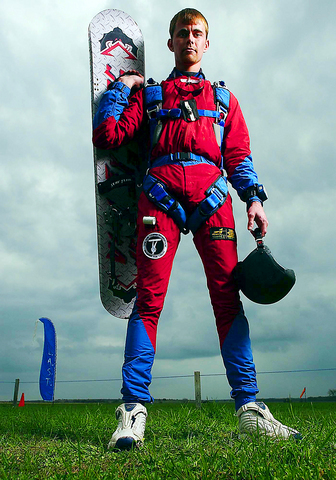
And a lot of them live in central Texas, too. Any weekend the skies dawn blue, Skydive San Marcos in Fentress bustles with people packing parachutes, cheering as sky divers land or watching the jump videos that stream across a television on the covered patio.
This sky-diving center -- or drop zone, as the regulars call it -- sees roughly 27,000 sky dives a year, according to owner Deb Chappell. Of those, about 4,500 annually are first-time jumpers. The rest are made by sky-dive junkies, the "fun jumpers" who return over and over to get their fill of falling out of the sky.
Sky diving is the closest you'll come to really flying, they say. And flying is what it's all about.
"That's how a struggling artist, a corporate executive, an erotic dancer and a minister all end up hanging out on a Saturday night," Lewis says. "They share the indescribable bond that only comes from leaping out of a plane together and hurtling toward the ground at the speed of a NASCAR race."
First comes nearly a minute of free falling. The ground screams toward them at 193kph. Then, just 1,046m from Earth, they tug a cord that sends out a pilot chute. That chute, the size of a garbage can lid, catches air and pulls out the main chute, the much larger rectangular canopy that floats the sky diver to the ground at a soothing 48kph or 64kph.
Occasionally, things don't go as planned. According to the United States Parachute Association, 21 people died while sky diving last year. That's down from 25 in 2003 and 33 in 2002. Since Skydive San Marcos opened in 1984, two people -- both experienced sky divers -- have died in accidents.
But that's why there are reserve chutes, the carefully packed backups that deploy in case of emergency. Every sky diver hopes he never has to use one, but jump long enough and he will.
Standing at ground zero at Skydive San Marcos, this is what you see and hear: the buzz of a plane engine high overhead, then silence as its engine cuts. Bits of what looks like confetti dropping from the aircraft. In another minute, colorful canopies, drifting across the sky. And finally, the hard flap of nylon and the gleeful whoops of the sky divers.
The jumpers swoop toward the gravel landing pad one at a time, their orange and green and turquoise canopies rippling, then flaring at the last minute to ease them gently to the ground.
"Yeah, baby," one yells as he zooms in.
These sky divers have hundreds -- sometimes thousands -- of jumps in the bag. They live for blue-sky days, when they converge at the drop zone. They go up over and over, sometimes making 10 or 20 dives in a single day.
When it's warm, they lounge in a swimming pool between loads. They relax under the covered patio in front of the landing strip, gobbling burgers and watching videos of their mid-flight antics. And when the figurative "beer light" comes on, signaling the sky diving is done for the day, they drink beer and relive their adventures. They build roaring bonfires when the sun sets. Some stay overnight, crashing in the no-frills bunkroom.
Today, one wears a T-shirt emblazoned with the slogan "Trust me, I do this all the time." Others wear real closing pins -- the 2-inch, comma-shaped piece of metal that keeps a parachute closed -- on chains around their necks. A car in the parking lot bears a telling bumper sticker: "Fear is temporary. Regret is permanent."
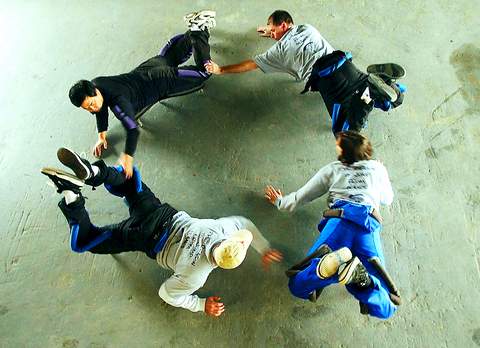
For now, though, the clouds have rolled in and the planes are temporarily grounded. It's the perfect time for Team 4 Fun, a group of competition formation sky divers who link up to create patterns during free falls, to practice their airborne maneuvers without even leaving the ground. They lie on creepers, small wheeled carts similar to what automechanics use, and roll through their routine while rain pounds on the roof above.
Kevin Mitchell is your typical adrenaline junkie: long blond hair, tanned face, mirrored sunglasses, tight nylon jumpsuit in purple, blue and white. He looks just like Fabio, if Fabio liked to jump out of airplanes.
He talks about his passion for sky diving like it's an addiction. And maybe it is. He's racked up 6,000 jumps since he first leaped out of a plane in Michigan 13 years ago. He's floated home on a reserve chute about 25 times.
"I needed some kind of form of excitement that was legal," says Mitchell, 40. "It's almost like a fix, a state of euphoria. If you haven't jumped in a couple of weeks, you start getting antsy -- kind of like a smoker who needs a cigarette."
Mitchell works as an instructor, videographer and senior rigger at Skydive San Marcos. He's here almost every weekend. Right now, he's sipping a Mountain Dew and relaxing at a picnic table under the awning.
"Basically, sky diving changed my life," he says. "It's been nothing but good for me."
He struggles to put his passion into words: "It's pure adrenaline. All your senses are heightened," he tries. "You see more, you hear more. It's three-dimensional. Fast and furious. And noisy, like sticking your head out the window when you're driving 193kph."
It's such a rush that sky-diving junkies like Mitchell will hang out for hours on a cloudy day waiting for the skies to open up. Even on days they can't jump, they go out to eat or see a movie together.
"Whatever drop zone you frequent, you become family," says Laurie Bucci, Mitchell's girlfriend. "We all care about each other and look out for each other."
Bucci, 41, jumped for the first time seven years ago. She'd signed up to do it with a friend. The friend backed out. Bucci did not. "It was something I needed to do," she says. "I knew if I could do this, I could do anything. It gives you a feeling there are no boundaries."
She wasn't scared.
"Even when I got to the door, I was completely focused," she says. "When I very first jumped out, I remember it took my breath away for just a second. Then the feeling of floating, like not even going anywhere -- suspended animation. Then there was a lot of screaming and yelling."
It takes a special type to want to skydive over and over. The ones who don't stick with it, Bucci says, are the ones who do it the first time for someone else.
Bucci stuck with it. She's made 270 jumps. In that time, she's had to ride her reserve chute home just once.
"To me, it was an eye-opener in how fast something can go wrong up there. It is a dangerous sport. You have to keep that in mind. There is absolutely no room for panic -- if you panic you could end up dead."
Carene Garrison, 28, knows the risk. As a parachute packer at Skydive San Marcos, she earns US$5 for every main chute she packs. Right now, she's sorting the lines of a chute that belongs to someone who landed 30 minutes ago. She carefully arranges the canopy, then compresses the bundle to squeeze out the air. It's precise work, and it can't be rushed.
"It's like putting a duvet in a wallet," she says. "And you want to get it right."
If you don't like getting creamed with a pie, doused with beer or tossed to the winds when you die, you might not want to take up sky diving. There's a tradition, it seems, for everything. And a lot of them are messy.
Numbers are significant in this sport. Whenever a sky diver reaches 100 or 1,000 jumps, fellow sky divers mark the occasion by pelting her with whipped cream pies.
"The pies normally only include whipped cream, but if a jumper makes an effort to conceal his or her jump numbers to avoid being pied, these pies may also include anything from mustard to cat food," says Lewis, the sky surfer.
Then there's the beer rule. Sky divers who tired of hearing comments such as, "That was my first jump from a DC-3," or "That was the first time I've landed in the center of the target," decided that a sky diver who admits doing something for the first time has to buy a case of beer for the others. (Some clever sky divers get around the rule by using the term "pre-second" instead of first.)
Another rite of passage is the Bob Buquor Memorial Star Crest Award, named for a free-fall photographer who died in the 1960s. Sky divers get the award after completing their first eight-person free-fall formation. The ceremony involves kneeling in the center of the landing target while your buddies slosh beer on you.
And the traditions continue, even in death. When a sky diver dies, whether from accident or natural causes, his or her body is cremated. Sky divers jump in a "missing man" formation and release the ashes in free fall.
The skies aren't going to clear this afternoon. The sky diving is done for the day. But the fun jumpers linger, talking about how they had to dodge mud puddles when they landed this morning or how they missed the landing target and had to get a ride back to the airport from the pasture down the way.
They laugh at a video that's playing now, of a couple of guys in free fall, sitting in an inflatable raft. That raft could come in handy right now.
They know they'll be back in the sky when the clouds part. Nothing can keep them grounded.
"Everyone should try it at least once," Mitchell says. "Everyone from 18 to 80 years old. It definitely changes your life."

Sept.16 to Sept. 22 The “anti-communist train” with then-president Chiang Kai-shek’s (蔣介石) face plastered on the engine puffed along the “sugar railway” (糖業鐵路) in May 1955, drawing enthusiastic crowds at 103 stops covering nearly 1,200km. An estimated 1.58 million spectators were treated to propaganda films, plays and received free sugar products. By this time, the state-run Taiwan Sugar Corporation (台糖, Taisugar) had managed to connect the previously separate east-west lines established by Japanese-era sugar factories, allowing the anti-communist train to travel easily from Taichung to Pingtung’s Donggang Township (東港). Last Sunday’s feature (Taiwan in Time: The sugar express) covered the inauguration of the

The corruption cases surrounding former Taipei Mayor and Taiwan People’s Party (TPP) head Ko Wen-je (柯文哲) are just one item in the endless cycle of noise and fuss obscuring Taiwan’s deep and urgent structural and social problems. Even the case itself, as James Baron observed in an excellent piece at the Diplomat last week, is only one manifestation of the greater problem of deep-rooted corruption in land development. Last week the government announced a program to permit 25,000 foreign university students, primarily from the Philippines, Indonesia and Malaysia, to work in Taiwan after graduation for 2-4 years. That number is a

This year’s Michelin Gourmand Bib sported 16 new entries in the 126-strong Taiwan directory. The fight for the best braised pork rice and the crispiest scallion pancake painstakingly continued, but what stood out in the lineup this year? Pang Taqueria (胖塔可利亞); Taiwan’s first Michelin-recommended Mexican restaurant. Chef Charles Chen (陳治宇) is a self-confessed Americophile, earning his chef whites at a fine-dining Latin-American fusion restaurant. But what makes this Xinyi (信義) spot stand head and shoulders above Taipei’s existing Mexican offerings? The authenticity. The produce. The care. AUTHENTIC EATS In my time on the island, I have caved too many times to

In a stark demonstration of how award-winning breakthroughs can come from the most unlikely directions, researchers have won an Ig Nobel prize for discovering that mammals can breathe through their anuses. After a series of tests on mice, rats and pigs, Japanese scientists found the animals absorb oxygen delivered through the rectum, work that underpins a clinical trial to see whether the procedure can treat respiratory failure. The team is among 10 recognized in this year’s Ig Nobel awards (see below for more), the irreverent accolades given for achievements that “first make people laugh, and then make them think.” They are not


 RSS
RSS