


Three Kings may not be the only movie about the Gulf War, but it can still claim to be the first movie that tried to present Operation Desert Storm for what it was: an exercise in confused motivations, undecided objectives and media-fuelled political paranoia. And since director David Russell spent some US$48 million dollars of Warner Bros' money bringing Three Kings into existence, the movie also has some claim to being the most anti-American studio movie of its generation.
At first sight, Russell cuts an unlikely figure as the standard-bearer of Hollywood agit-prop. He's the kind of person who thinks before he speaks, who's wary of being dragged into much-ploughed side-issues. He's also the very model of concise expression when a point demands it.
This last quality, clearly, is what persuaded Warner Bros that Russell could hack it in the big leagues when he took on the project.
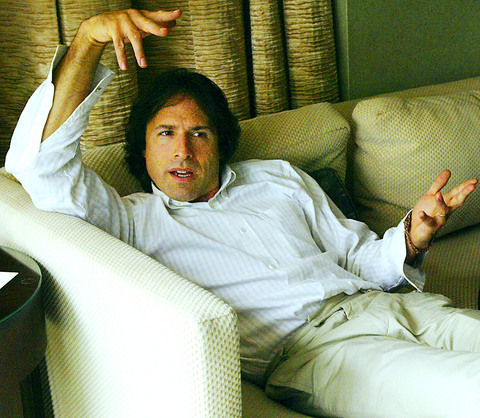
PHOTO: AP
"When they welcomed me, I couldn't believe they would let me do anything," he recalled. "You may remember Warner Bros had just had a terrible two years. They'd done all these franchise movies -- Lethal Weapon 4 and Batman and Robin -- and all their movies had a certain flavor to them. The New York Times business section ran a piece that encouraged them to step up and start using more independent filmmakers. Three Kings is now perceived as a new archetype: an independent-minded studio picture. I think it's seen as a hybrid. It was way too big to be a boutique independent film; it's not exactly the paint-by-numbers commercial film; it's somewhere in the middle."
Three Kings was undoubtedly a unique proposition. Russell harnessed all the slash-and-burn tropes of the modern war movie, creating expansive firefights, injecting pitch-black humor wherever feasible, and unleashing unambiguous disapproval of presidential foreign policy in the wake of Operation Desert Storm.
As it happens, the political content of Three Kings was perfectly in keeping with Russell's pre-filmmaking career. A literature and political-science student in the early 1980s, Russell spent four months teaching in Nicaragua as the Contra insurgency gathered steam. Back in the US, he continued working with immigrants before turning to documentary-making at the Smithsonian
Institute.
Russell isn't a firebrand, exactly -- just an astute observer of American society in action. "I think the war smelled a little funny to people at the time, and they'd just as soon not think about it," he said.
Russell went about researching the Gulf War meticulously, soaking himself in the plentiful documentary material from this most media-infiltrated of conflicts. The complex torture techniques Three Kings shows were drawn from actual photographs and the testimony of US and British prisoners of war.
There were well-documented troubles on the shoot. The studio shaved US$10 million off the budget Russell had requested, resulting in a schedule truncated by 12 days. The pressure got to the whole crew, with Clooney and his director facing off towards the end of their arduous stint in the desert -- Arizona, as it happens, rather than the Middle East. Clooney remained outspoken in his praise for Russell's talent. "We had about three good screaming matches. Never a fist fight. We had some good arguments. It was a much bigger film than David had ever been involved in, and we were having to trust that. I was in over my head, too.
"David is really brilliant at this. His idea was to resensitize people to violence. He didn't just want to show the effect of the gunshot, he wanted to show it literally."
For his part, Russell remained grateful to Clooney -- a real Hollywood liberal, if ever there was one -- for sticking his neck out for the project.
"The main proposition," said Russell, with finality, "is to have a cinematic experience that grabs you and doesn't let go of you until the end, and constantly surprises you. And then at the end you realize -- jeez, there was this historical-political expose along the way. You want to put people in spin cycle. Because if it doesn't work at that level, then you've made a boring film."

Sept.16 to Sept. 22 The “anti-communist train” with then-president Chiang Kai-shek’s (蔣介石) face plastered on the engine puffed along the “sugar railway” (糖業鐵路) in May 1955, drawing enthusiastic crowds at 103 stops covering nearly 1,200km. An estimated 1.58 million spectators were treated to propaganda films, plays and received free sugar products. By this time, the state-run Taiwan Sugar Corporation (台糖, Taisugar) had managed to connect the previously separate east-west lines established by Japanese-era sugar factories, allowing the anti-communist train to travel easily from Taichung to Pingtung’s Donggang Township (東港). Last Sunday’s feature (Taiwan in Time: The sugar express) covered the inauguration of the

The corruption cases surrounding former Taipei Mayor and Taiwan People’s Party (TPP) head Ko Wen-je (柯文哲) are just one item in the endless cycle of noise and fuss obscuring Taiwan’s deep and urgent structural and social problems. Even the case itself, as James Baron observed in an excellent piece at the Diplomat last week, is only one manifestation of the greater problem of deep-rooted corruption in land development. Last week the government announced a program to permit 25,000 foreign university students, primarily from the Philippines, Indonesia and Malaysia, to work in Taiwan after graduation for 2-4 years. That number is a

This year’s Michelin Gourmand Bib sported 16 new entries in the 126-strong Taiwan directory. The fight for the best braised pork rice and the crispiest scallion pancake painstakingly continued, but what stood out in the lineup this year? Pang Taqueria (胖塔可利亞); Taiwan’s first Michelin-recommended Mexican restaurant. Chef Charles Chen (陳治宇) is a self-confessed Americophile, earning his chef whites at a fine-dining Latin-American fusion restaurant. But what makes this Xinyi (信義) spot stand head and shoulders above Taipei’s existing Mexican offerings? The authenticity. The produce. The care. AUTHENTIC EATS In my time on the island, I have caved too many times to

Many Taiwanese have a favorable opinion of Japan, in part because Taiwan’s former colonial master is seen as having contributed a great deal to the development of local industries, transportation networks and institutions of education. Of course, the island’s people were never asked if they wanted to be ruled by Tokyo or participate in its modernization plans. From their arrival in 1895 until at least 1902, the Japanese faced widespread and violent antagonism. Things then calmed down, relatively speaking. Even so, between 1907 and 1916 there were eleven anti-Japanese revolts. A map in the National Museum of Taiwan History (國立臺灣歷史博物館)


 RSS
RSS