


Until recently, Taiwan's skin-cream options were few, perfume options were fewer, and apart from a narrow range of lipstick shades, makeup was rarely visible. Now many cosmetics counters and bathroom cabinets are saturated with a selection of beauty products. The increase in sales is a reflection of both marketing strategies and new products launched exclusively for Asian consumers.
The Taiwan cosmetics industry was valued at NT$65 billion last year. While skin care products account for nearly half of the total sales, it's the steady five percent annual growth in makeup and perfume sales that pleases cosmetic industrialists.
"The growth in the market is not only attributable to older women. Researchers are witnessing a trend among younger women to wear makeup and the shopping potential of teenage girls is getting stronger. So we are now exploring this market," said the sales director of Elea Cosmetics International Corp, Allen Yen (

PHOTO COURTESY OF ELEA COSMETICS INTERNATIONAL CORP
The Asian niche
The perception that Japanese skin care products were more suitable for Asian women held sway over the Taiwanese market for nearly 10 years until European and US brands began introducing their own skin-whitening creams. In the late 1980s, Elizabeth Arden was one of the first import companies to combine an anti-age ointment with a skin-lightening toner. Now every high-end and mid-range import brand offers its own extensive line of whitening concoctions.
More recently, brands have expanded their "Asian only" whitening creams to include makeup. Next month Chanel will introduce six new shades available only in Japan and Taiwan to its Aqualumiere lipstick line.

Chanel leads cosmetic sales in Taiwan, and Chanel communication manager, Jessie Lee (
"Before, most people thought Chanel was for mature, older women and that it was too expensive?. Then we presented campaigns to give Chanel a new image that would appeal and attract younger costumers," Lee said, citing the example of "Chance," a light floral-based perfume marketed to teenage girls a few years ago. The scent departs from Chanel's trademark pungent perfumes.
Chanel's success with its fragrance line is a major achievement in a market that has never made much of an impact in Taiwan until now. East Asia (South Korea, Japan, Taiwan and China) records the lowest fragrance sales according to Yen, who is also a representative for the US cosmetics company Elizabeth Arden.
Arden, which is most widely recognized for its perfume line, is testing the market with an entire line of 40 green-tea-scent products that it intends to introduce over the next year. To commemorate the launch of its Green Tea perfume, Arden's spokes model, Catherine Zeta-Jones, was flown to Japan and dressed in a kimono
The allure of celebrity
Celebrity endorsements are nothing new to the cosmetics industry but their increased potential is being registered.
Following Chanel's extravagant advertisements last year starring Nicole Kidman, the brand's No. 5 perfume became the best-selling fragrance in Taiwan. It also lured in new and curious customers, Lee said.
"Normally fragrance doesn't get much attention, but this commercial brought a lot of people to our counters who saw the ad and wanted to smell the perfume. Even those who felt [No. 5] was too mature for them, would have an opportunity to try other perfumes."
Likewise, Japan's and Taiwan's brand names have also realized the potential of product endorsement and have begun using local celebrities in their ads.
SKII's economy line for young women, Maxfactor, uses Hong Kong pop idol Karen Mok (
Given the global recognition of both Kidman and Zeta-Jones, representatives at both Chanel and Arden said there were no immediate plans to follow suit and hire local celebrities.
Expert advice
A tactic that both import and local brands are employing is hiring experts behind the counter to instruct women on how to apply their purchases. Public workshops on makeup application are becoming commonplace in locations ranging from Watsons to department stores.
Samson Hsiao (
He said the key issue for most women is learning how to select and apply makeup so that they get the best results. During an appointment he determines a costumer's skin type and chooses appropriate makeup shades.
"People are spending more money on their appearance but they must also spend a little time on learning how to use their new products," Hsiao said.

Sept.16 to Sept. 22 The “anti-communist train” with then-president Chiang Kai-shek’s (蔣介石) face plastered on the engine puffed along the “sugar railway” (糖業鐵路) in May 1955, drawing enthusiastic crowds at 103 stops covering nearly 1,200km. An estimated 1.58 million spectators were treated to propaganda films, plays and received free sugar products. By this time, the state-run Taiwan Sugar Corporation (台糖, Taisugar) had managed to connect the previously separate east-west lines established by Japanese-era sugar factories, allowing the anti-communist train to travel easily from Taichung to Pingtung’s Donggang Township (東港). Last Sunday’s feature (Taiwan in Time: The sugar express) covered the inauguration of the

The corruption cases surrounding former Taipei Mayor and Taiwan People’s Party (TPP) head Ko Wen-je (柯文哲) are just one item in the endless cycle of noise and fuss obscuring Taiwan’s deep and urgent structural and social problems. Even the case itself, as James Baron observed in an excellent piece at the Diplomat last week, is only one manifestation of the greater problem of deep-rooted corruption in land development. Last week the government announced a program to permit 25,000 foreign university students, primarily from the Philippines, Indonesia and Malaysia, to work in Taiwan after graduation for 2-4 years. That number is a
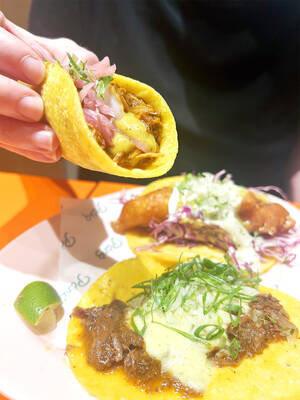
This year’s Michelin Gourmand Bib sported 16 new entries in the 126-strong Taiwan directory. The fight for the best braised pork rice and the crispiest scallion pancake painstakingly continued, but what stood out in the lineup this year? Pang Taqueria (胖塔可利亞); Taiwan’s first Michelin-recommended Mexican restaurant. Chef Charles Chen (陳治宇) is a self-confessed Americophile, earning his chef whites at a fine-dining Latin-American fusion restaurant. But what makes this Xinyi (信義) spot stand head and shoulders above Taipei’s existing Mexican offerings? The authenticity. The produce. The care. AUTHENTIC EATS In my time on the island, I have caved too many times to

In the aftermath of the 2020 general elections the Chinese Nationalist Party (KMT) was demoralized. The Democratic Progressive Party (DPP) had crushed them in a second landslide in a row, with their presidential candidate Tsai Ing-wen (蔡英文) winning more votes than any in Taiwan’s history. The KMT did pick up three legislative seats, but the DPP retained an outright majority. To take responsibility for that catastrophic loss, as is customary, party chairman Wu Den-yih (吳敦義) resigned. This would mark the end of an era of how the party operated and the beginning of a new effort at reform, first under


 RSS
RSS