


Faces will brighten with news that the nation's Department of Health (DOH) has recently revised its criteria for inspecting whitening skin-care creams. The DOH used to be responsible only for the effectiveness of whitening products but has now switched its concern to focus on the safety of the products.
In the past, if cosmetics manufacturers intended to feature their whitening products, the product would have to contain one of the following ingredients: Mg-L-Ascorbyl-Z-PHOSPHATE (MAP, stabilized magnesium ascorbyl phosphate), ascorbyl Glycoside, sodium ascorbyl phosphate, arbutin or kojic acid. Cosmetic manufacturers still could not advertise or feature the "whitening effects" the product could produce, but claims that the whitening cream could prevent freckles and dark spots from emerging were legal.
To become a certified skin-whitening product, though, the concentration of whitening ingredients had to reach the criteria established by the DOH.
Whether or not the skin whitening cream is effective has become a minor issue, as whitening products are doubtlessly getting increasingly popular, especially among Asian consumers.
To vie for a larger share of the local market, internationally renowned cosmetic brands are sure to vary their line of whitening products. The business is going to be so brisk that various channels of sales including hypermarkets, Internet outlets, open-shelves, and even convenience stores are all-set to throw their hat in the ring.
While consumers may be delighted to know that they will have more to choose from and that the overall price is going to dive, how to get the right whitening product is still a question with a variety of answers.
Last year, people spent a whopping NT$16 billion on skin-care products, NT$7.4 billion of which were generated from the revenue of whitening products.
In view of the lucrativeness of this "whitening" business, foreign brands have vowed to not be foreign anymore to the market in Taiwan.
To woo Asian consumers, renowned Western cosmetic brands such as Estee Lauder, Christian Dior, Chanel, Givenchy and Guerlain have all launched new products aimed specially at Asian consumers.
Estee Lauder launched a series of whitening creams containing a super-refined green tea extract, rice bran extract and resveratrol, which can lift away dulling, deal skin cells and speed away dirt, excess oil and makeup.
Christian Dior's newly launched products feature a powerful enzyme that can smooth wrinkles and fine lines. More importantly, the new products also contain edelweiss complex that can eliminate dullness and fight free radicals.
Chanel's latest whitening items have incorporated extract of daffodil bulb that can revitalize the beauty and translucency of the complexion so that the skin will look supple, bright and hydrated.
Givenchy has recently transformed Tarragon herb, widely used in Chinese medicine, into a whitening ingredient that can discourage the production of melanin and leave the skin clear, smooth and luminous.
Guerlain has added flavonoids extract to its latest whitening creams that can perfectly moisturize the skin and discourage the production of melanin.
As these Asian ingredients seem to have become the mainstream in the skin-care market, international brands one after another are launching new products featuring natural and unique ingredients.
In addition, the newly launched whitening creams do not only target consumers with deep pockets. Items range from roughly NT$1,000 to NT$3,000.
-- Translated by Daniel Cheng

Sept.16 to Sept. 22 The “anti-communist train” with then-president Chiang Kai-shek’s (蔣介石) face plastered on the engine puffed along the “sugar railway” (糖業鐵路) in May 1955, drawing enthusiastic crowds at 103 stops covering nearly 1,200km. An estimated 1.58 million spectators were treated to propaganda films, plays and received free sugar products. By this time, the state-run Taiwan Sugar Corporation (台糖, Taisugar) had managed to connect the previously separate east-west lines established by Japanese-era sugar factories, allowing the anti-communist train to travel easily from Taichung to Pingtung’s Donggang Township (東港). Last Sunday’s feature (Taiwan in Time: The sugar express) covered the inauguration of the

The corruption cases surrounding former Taipei Mayor and Taiwan People’s Party (TPP) head Ko Wen-je (柯文哲) are just one item in the endless cycle of noise and fuss obscuring Taiwan’s deep and urgent structural and social problems. Even the case itself, as James Baron observed in an excellent piece at the Diplomat last week, is only one manifestation of the greater problem of deep-rooted corruption in land development. Last week the government announced a program to permit 25,000 foreign university students, primarily from the Philippines, Indonesia and Malaysia, to work in Taiwan after graduation for 2-4 years. That number is a
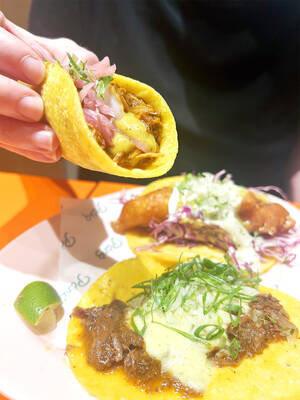
This year’s Michelin Gourmand Bib sported 16 new entries in the 126-strong Taiwan directory. The fight for the best braised pork rice and the crispiest scallion pancake painstakingly continued, but what stood out in the lineup this year? Pang Taqueria (胖塔可利亞); Taiwan’s first Michelin-recommended Mexican restaurant. Chef Charles Chen (陳治宇) is a self-confessed Americophile, earning his chef whites at a fine-dining Latin-American fusion restaurant. But what makes this Xinyi (信義) spot stand head and shoulders above Taipei’s existing Mexican offerings? The authenticity. The produce. The care. AUTHENTIC EATS In my time on the island, I have caved too many times to

In a stark demonstration of how award-winning breakthroughs can come from the most unlikely directions, researchers have won an Ig Nobel prize for discovering that mammals can breathe through their anuses. After a series of tests on mice, rats and pigs, Japanese scientists found the animals absorb oxygen delivered through the rectum, work that underpins a clinical trial to see whether the procedure can treat respiratory failure. The team is among 10 recognized in this year’s Ig Nobel awards (see below for more), the irreverent accolades given for achievements that “first make people laugh, and then make them think.” They are not


 RSS
RSS