


What was the best book on Asia encountered by this reviewer in 2004? The answer isn't, in fact, hard to decide, but we'll reserve the announcement until a little later. Instead, we'll look first at some of the most promising contenders for the title.
What has to be said right away is that, book-wise, 2004 has been an outstandingly good year for Taiwan. No less than 13 titles featuring the island have been reviewed in the Taipei Times, together with another two that refer to Taiwan in various ways. This is, by any standard, a huge increase from preceding years. Most of these books have focused on social analysis -- universities, especially in the US, appear to be swarming with writers eager to put on paper their thoughts on all aspects of Taiwanese life, past and present. English-language fiction set in Taiwan has, by contrast, remained something of a fledgling genre.
Beginning with fiction set in Asia, War Trash, by Ha Jin (
Next-best on this year's fiction list was K: The Art of Love by Hong Ying, which re-created the love-affair between Bloomsbury off-shoot Julian Bell and a famous Chinese beauty in 1930s Wuhan and Beijing. Intensely readable, no stronger contrast to the grim brutalities of War Trash could be imagined.
For the rest, The Noodle Maker, by Ma Jian (
Our Bones are Scattered, by Andrew Ward, was a long novel based on the author's life-long preoccupation with the Indian Mutiny of 1857, while Village of Stone, by Xiaolu Guo, looked at child abuse in a remote coastal village in southern China in a way that managed to be sensational and light-weight.
Non-fiction books on the Asian region were dominated by Theodore Friend's Indonesian Destinies, a superb account of Indonesia from independence to the present. Friend, a retired senior American diplomat, blended interview material with accounts of his own travels to produce a markedly reader-friendly narrative. This book is one in a thousand.
Also highly notable was Narcotic Culture: A History of Drugs in China, by Frank Dikotter, with his researchers Lars Laamann and Zhou Xun. This provocative and wide-ranging book claimed that opium was far less harmful to China than had previously been believed. The fact that the author is an early-to-bed professor rather than a proselytizing drug-user made this original piece of historical research all the more remarkable and persuasive.
Life Along the Silk Road by Susan Whitfield (Murray) illuminated the world of Central Asia via 12 short stories, all based on the ancient manuscript evidence she deciphered during her work as a librarian at the British Library.
Also notable was Charles Allen's Duel in the Snows, a blow-by-blow account of the British invasion of Tibet in 1904; Robert Harvey's Comrades, a trenchantly anti-Communist survey of the history of Marxist revolutions worldwide; Philip Short's thorough and judicious Pol Pot; and Jon Latimer's Burma: The Forgotten War, a thoughtful treatment of the British World War II campaigns in that still-suffering country.
Gweilo, by Martin Booth, recalled the author's life as a child in 1950s Hong Kong. Though well-written, it managed to end up not a little depressing, mostly on account of the author's portrait of his father, who he admits to detesting.
Lastly, Falun Gong, by Maria Hsia Chang, was an exceptionally cogent and balanced analysis of the eccentric doctrines promulgated by this organization, and the equally bizarre strategies adopted by the Beijing authorities to silence them.
Gay-themed books on Asia were few. Global Divas, by Martin F. Manalansan IV, looked at the lives of gay Filipinos in New York, while Mobile Cultures, edited by Berry, Martin and Yue, researched the way gays have been quick to benefit from fast networking facilitated by cellphones and the Internet.
Turning to Taiwan, The Minor Arts of Daily Life was a collection of academics examining a wide range of Taiwanese phenomena, from the often harsh treatment of foreign domestic helpers to yang-sucking she-demons in ghost movies. By contrast, Scott Simon's Sweet and Sour took a markedly upbeat look at Taiwan's female entrepreneurs and, in the process, went a long way to explain why Taiwan can be such a congenial place to live.
Shattering the Myths by Taipei Times' Laurence Eyton rallied the greens with trenchant pre-presidential-election rhetoric in this English and Chinese bilingual edition.
Two new books contributed to the mini-genre of Taiwan fiction in English. Black King, by Eleanor B. Morris Wu, challenged all skeptics with a soap opera-like story of life in the bars of Taipei's Combat Zone, while The Trumpeter of Bull Mountain, by W. Martyn McClave, told of the real-life adventures of an American busker in the Taipei of the 1990s.
In the miscellaneous category, 2004 witnessed the arrival of The Pretended Asian, by Taiwan National University's Michael Keevak. This book is an entertaining study of the man who took 18th-century London by storm when he arrived and claimed he was a native of Formosa. Probably from south-western France, in reality he'd never been farther east than Prussia.
Also in 2004, Taipei City Government issued Reflections on Taipei, the reminiscences of 16 high-profile expatriates, while the Central News Agency came up with an album of photos entitled Sixty Years in Taiwan. The album stretched back to the days when bullocks hauled carts along Taipei's boulevards, a phenomenon also at the fore of the memories of several of the previous volume's authors.
Lastly, a new literary magazine was launched in Taichung this year by Jason Tomassini. Titled Pressed, it is currently inviting contributions for its up-coming issues, plus stories under 250 words for a fiction-in-miniature contest.
So, who gets the prizes? The books I valued most, and continue to value, are as follows. Best novel on Asia: Ha Jin's War Trash, with Hong Ying's K: The Art of Love a fairly close second. Most eye-opening new book on China: Frank Dikotter's Narcotic Culture: A History of Drugs in China. Finest book on the Asia region: Theodore Friend's Indonesian Destinies. This last volume also wins my private "big prize" for Best Book on Asia Published in 2004.

Sept.16 to Sept. 22 The “anti-communist train” with then-president Chiang Kai-shek’s (蔣介石) face plastered on the engine puffed along the “sugar railway” (糖業鐵路) in May 1955, drawing enthusiastic crowds at 103 stops covering nearly 1,200km. An estimated 1.58 million spectators were treated to propaganda films, plays and received free sugar products. By this time, the state-run Taiwan Sugar Corporation (台糖, Taisugar) had managed to connect the previously separate east-west lines established by Japanese-era sugar factories, allowing the anti-communist train to travel easily from Taichung to Pingtung’s Donggang Township (東港). Last Sunday’s feature (Taiwan in Time: The sugar express) covered the inauguration of the

The corruption cases surrounding former Taipei Mayor and Taiwan People’s Party (TPP) head Ko Wen-je (柯文哲) are just one item in the endless cycle of noise and fuss obscuring Taiwan’s deep and urgent structural and social problems. Even the case itself, as James Baron observed in an excellent piece at the Diplomat last week, is only one manifestation of the greater problem of deep-rooted corruption in land development. Last week the government announced a program to permit 25,000 foreign university students, primarily from the Philippines, Indonesia and Malaysia, to work in Taiwan after graduation for 2-4 years. That number is a
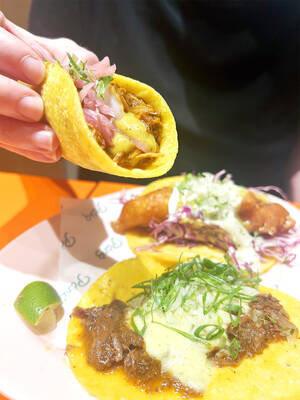
This year’s Michelin Gourmand Bib sported 16 new entries in the 126-strong Taiwan directory. The fight for the best braised pork rice and the crispiest scallion pancake painstakingly continued, but what stood out in the lineup this year? Pang Taqueria (胖塔可利亞); Taiwan’s first Michelin-recommended Mexican restaurant. Chef Charles Chen (陳治宇) is a self-confessed Americophile, earning his chef whites at a fine-dining Latin-American fusion restaurant. But what makes this Xinyi (信義) spot stand head and shoulders above Taipei’s existing Mexican offerings? The authenticity. The produce. The care. AUTHENTIC EATS In my time on the island, I have caved too many times to

In a stark demonstration of how award-winning breakthroughs can come from the most unlikely directions, researchers have won an Ig Nobel prize for discovering that mammals can breathe through their anuses. After a series of tests on mice, rats and pigs, Japanese scientists found the animals absorb oxygen delivered through the rectum, work that underpins a clinical trial to see whether the procedure can treat respiratory failure. The team is among 10 recognized in this year’s Ig Nobel awards (see below for more), the irreverent accolades given for achievements that “first make people laugh, and then make them think.” They are not


 RSS
RSS