


For years Taiwan has attempted to gain membership to the UN, to no avail, but it does manage to get its foot in the back door via cultural organizations of the United Nations Educational, Scientific and Cultural Organization (UNESCO) such as the International Association of Art Critics (AICA, a French acronym) which held its annual international meeting, the AICA 2004 World Congress, in Taiwan recently.
Headquartered in Paris, AICA comprises 76 national and regional chapters, including Taiwan. In the past, the local chapter was called AICA Taiwan/Free Section, UNESCO, UN (
President Chen Shui-bian (
Chen talked about the importance of culture and the cultural institutions he established as Taipei mayor, such as the Hakka Cultural Foundation, the Taipei Film Festival and the Lantern Festival.
Pre-congress events included group tours to the National Palace Museum, the Huashan Cultural and Creative Industry Center, Yingge Ceramics Museum, the Museum of Contemporary Art, the Juming Museum, the Taipei Fine Arts Museum and several art galleries. These tours gave the art critics from around the world a glimpse into Taiwan's art culture.
On AICA's Web site, one of the main objectives of the organization is to contribute to the shared knowledge and closer understanding of differing cultures.
However, as it takes a long time to understand a culture different from one's own, it seems unlikely that this aim was achieved during the 10-day congress packed with visits to art sites and day-long symposiums that were simultaneously translated in Chinese, English, Spanish and French.
Topics of the symposium held in Taipei included: The Establishment of Regional Dialogues among Art Critics, Art Criticism and the End of History, The Changing Role of Art Criticism, and Interdisciplinary Cooperation in Art Criticism.
Symposium 2, held in Kaohsiung, included: Spatial Interference of Art Criticism, Art Criticism and the State of the Humanities, and Historical Buildings versus Art Space.
Speakers included Tosi Lee, president of AICA Taiwan; Lin Mun-lee, an AICA Taiwan trustee; Joan Stanley Baker, contributing writer to the Taipei Times; Naoki Sakai, Cornell professor of Asian Studies; Domenique Nahas, NY curator; Yacouba Konate, philosophy professor at University of Abidjan, Ivory Coast; and Niilofur Farrukh, Pakistan-based critic.
A heated question-and-answer session ended the Taipei meeting on a contentious note since some members were perceived as arrogant, assuming the Western model was no doubt the ideal to impart on the rest of the world. This issue was not addressed directly in most of the presented papers but is the most pressing issue that AICA, as an international group, must address.
The issue wasn't presented as the main topic but rather remained as an underlying antagonistic tension throughout the several days of panel talks.
However, AICA Taiwan was responsible for choosing the papers with the main emphasis on Western modernism -- as seen through the eyes of art historians. Instead of choosing papers that had more relevance to current politics, rapid changes in global society, contemporary art and issues pertaining to Asia, or even trying to address Samuel Huntington's notion of the clash of cultures, the focus seemed more on 20th century artmaking and North (privileged) vs. South (developing) dichotomies. One thing the AICA World Congress did prove, but in a very subtle way, is that culture and art is extremely political.
One thing the AICA World Congress did prove is that culture and art is extremely political.

Sept.16 to Sept. 22 The “anti-communist train” with then-president Chiang Kai-shek’s (蔣介石) face plastered on the engine puffed along the “sugar railway” (糖業鐵路) in May 1955, drawing enthusiastic crowds at 103 stops covering nearly 1,200km. An estimated 1.58 million spectators were treated to propaganda films, plays and received free sugar products. By this time, the state-run Taiwan Sugar Corporation (台糖, Taisugar) had managed to connect the previously separate east-west lines established by Japanese-era sugar factories, allowing the anti-communist train to travel easily from Taichung to Pingtung’s Donggang Township (東港). Last Sunday’s feature (Taiwan in Time: The sugar express) covered the inauguration of the

The corruption cases surrounding former Taipei Mayor and Taiwan People’s Party (TPP) head Ko Wen-je (柯文哲) are just one item in the endless cycle of noise and fuss obscuring Taiwan’s deep and urgent structural and social problems. Even the case itself, as James Baron observed in an excellent piece at the Diplomat last week, is only one manifestation of the greater problem of deep-rooted corruption in land development. Last week the government announced a program to permit 25,000 foreign university students, primarily from the Philippines, Indonesia and Malaysia, to work in Taiwan after graduation for 2-4 years. That number is a
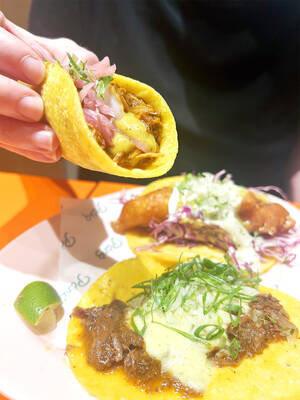
This year’s Michelin Gourmand Bib sported 16 new entries in the 126-strong Taiwan directory. The fight for the best braised pork rice and the crispiest scallion pancake painstakingly continued, but what stood out in the lineup this year? Pang Taqueria (胖塔可利亞); Taiwan’s first Michelin-recommended Mexican restaurant. Chef Charles Chen (陳治宇) is a self-confessed Americophile, earning his chef whites at a fine-dining Latin-American fusion restaurant. But what makes this Xinyi (信義) spot stand head and shoulders above Taipei’s existing Mexican offerings? The authenticity. The produce. The care. AUTHENTIC EATS In my time on the island, I have caved too many times to

In a stark demonstration of how award-winning breakthroughs can come from the most unlikely directions, researchers have won an Ig Nobel prize for discovering that mammals can breathe through their anuses. After a series of tests on mice, rats and pigs, Japanese scientists found the animals absorb oxygen delivered through the rectum, work that underpins a clinical trial to see whether the procedure can treat respiratory failure. The team is among 10 recognized in this year’s Ig Nobel awards (see below for more), the irreverent accolades given for achievements that “first make people laugh, and then make them think.” They are not


 RSS
RSS