


From the air, Kinmen airport looks like a military installation. There are bunkers, pillboxes and anti-aircraft gun emplacements dotted around the airfield. And it is this association with Taiwan's "battle against communism" that first made the island notorious -- and now manages to attract a moderate number of tourists.
Fortunately, defunct military installations are not all that Kinmen has to offer. The island has a long history and its position as a front-line military district from the middle of last century has done much to mitigate the effects of rampant modernization, preserving pockets of community life which remain similar in some respects to what they where over a century ago.
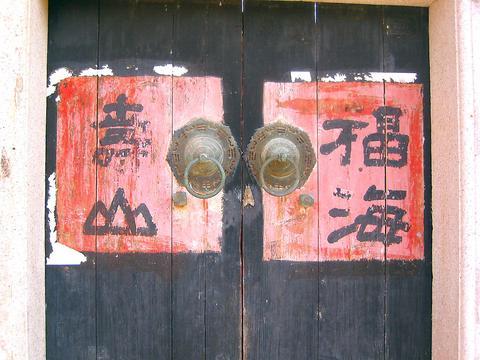
PHOTO: IAN BARTHOLOMEW
This makes Kinmen an ideal spot for the culturally, architecturally and historically inclined tourist. It certainly pays to have a good guide, whether a book or a person, for Kinmen's monuments are not obviously magnificent, and without knowing something of the story behind them, you are likely to be disappointed.
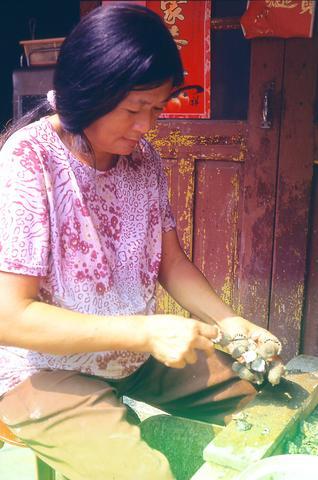
PHOTO: IAN BARTHOLOMEW
Kinmen Model Street is as good a place as any, even though attempts at preservation and exploitation of its commercial potential have largely destroyed any period atmosphere. But even here, housewives will sit out front of their homes opening oysters, a local staple. Also on view is the local red brick architecture, which is more austere than anything to be found elsewhere in Taiwan. It is only a short scooter ride from this urban scene to something more redolent of Kinmen's frontier history.
This is De-yue Tower (得月樓), or Moon Plucking Tower, a fairytale castle of a building that was designed for the very serious business of holding off attacks by pirates in the town of Shuitou (水頭). The tower and the attached house were built by Huang Huei-huang (黃輝煌), a dry-goods merchant based out of Indonesia. The tower was designed with an eye for the protection of the town of Shuitou, which contains many other Western-style homes, mostly built by other members of the Huang family -- all integral members of a financial, trading and kinship organization that emanated from Kinmen and spanned much of Southeast Asia. The battlements and grills for dumping burning coals on attackers seem almost medieval.

PHOTO: IAN BARTHOLOMEW
It is this kind of detail that makes Kinmen a delight, with its memories of a largely forgotten history. Some of this has been recreated in the Overseas Chinese Exhibition Center (
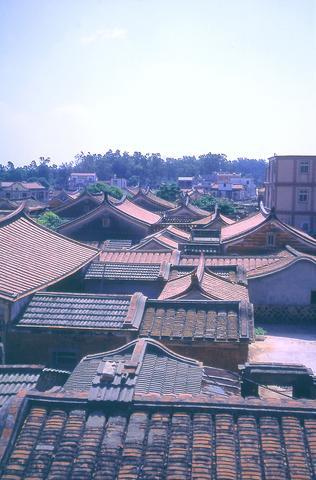
PHOTO: IAN BARTHOLOMEW
You can also hear some of the stories they brought back from their travels at the Travelers' Story House (
While Shuitou is renowned for the relics of southern emigration, the village of Chionglin (
This is the sort of place that makes one do a double take on the relative positions of Kinmen and Taiwan in history -- Kinmen youngsters were serving at the highest level of the Chinese government 400 years before Taiwan was even a viable concern. It is no real surprise that with all this historical baggage, quite apart from geographical proximity, Kinmen people are not developing their Taiwanese consciousness as rapidly as some would like.
After all, if you are taking a trip to Little Kinmen (
"Because of over-development in Xiamen and along the coast, more and more migratory birds are now stopping over in Kinmen instead," he said. Probably the best place to get an introduction to the island's ecological resources is the Kuningtou Ecology Center (
Kinmen:
GETTING THERE: Flights to Kinmen are available from Taipei, Taichung, Chiayi, Tainan, Makung and Kaohsiung. The flight is around 45 minutes and costs just under NT$2,000 one-way. An irregular boat service is also available out of Kaohsiung, which takes around 10 hours. Enquires can be made at Kinmen Express (
GETTING AROUND: The majority of tourists who visit are part of group tours, but scooters are available for around NT$500 a day and provide the best means of getting around. A free bicycle rent service is available on Little Kinmen courtesy of the Kinmen National Park. Enquiries can be made at (082) 364 403 or 364 411.
The Kinmen National Park Web site is http://www.kmnp.gov.tw.
The tourism section for Kinmen is (082) 324 174.

Sept.16 to Sept. 22 The “anti-communist train” with then-president Chiang Kai-shek’s (蔣介石) face plastered on the engine puffed along the “sugar railway” (糖業鐵路) in May 1955, drawing enthusiastic crowds at 103 stops covering nearly 1,200km. An estimated 1.58 million spectators were treated to propaganda films, plays and received free sugar products. By this time, the state-run Taiwan Sugar Corporation (台糖, Taisugar) had managed to connect the previously separate east-west lines established by Japanese-era sugar factories, allowing the anti-communist train to travel easily from Taichung to Pingtung’s Donggang Township (東港). Last Sunday’s feature (Taiwan in Time: The sugar express) covered the inauguration of the

The corruption cases surrounding former Taipei Mayor and Taiwan People’s Party (TPP) head Ko Wen-je (柯文哲) are just one item in the endless cycle of noise and fuss obscuring Taiwan’s deep and urgent structural and social problems. Even the case itself, as James Baron observed in an excellent piece at the Diplomat last week, is only one manifestation of the greater problem of deep-rooted corruption in land development. Last week the government announced a program to permit 25,000 foreign university students, primarily from the Philippines, Indonesia and Malaysia, to work in Taiwan after graduation for 2-4 years. That number is a
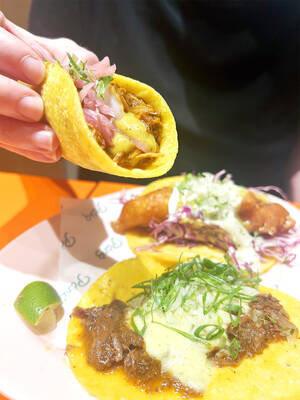
This year’s Michelin Gourmand Bib sported 16 new entries in the 126-strong Taiwan directory. The fight for the best braised pork rice and the crispiest scallion pancake painstakingly continued, but what stood out in the lineup this year? Pang Taqueria (胖塔可利亞); Taiwan’s first Michelin-recommended Mexican restaurant. Chef Charles Chen (陳治宇) is a self-confessed Americophile, earning his chef whites at a fine-dining Latin-American fusion restaurant. But what makes this Xinyi (信義) spot stand head and shoulders above Taipei’s existing Mexican offerings? The authenticity. The produce. The care. AUTHENTIC EATS In my time on the island, I have caved too many times to

In the aftermath of the 2020 general elections the Chinese Nationalist Party (KMT) was demoralized. The Democratic Progressive Party (DPP) had crushed them in a second landslide in a row, with their presidential candidate Tsai Ing-wen (蔡英文) winning more votes than any in Taiwan’s history. The KMT did pick up three legislative seats, but the DPP retained an outright majority. To take responsibility for that catastrophic loss, as is customary, party chairman Wu Den-yih (吳敦義) resigned. This would mark the end of an era of how the party operated and the beginning of a new effort at reform, first under


 RSS
RSS