


The brightly-colored koi fish that can be found swimming in many fresh-water ponds and park lakes, hotel gardens or shopping center pools is not a naturally occurring species. Called nishikigoi in Japan, where it is the national fish, it has been selectively bred from the common carp for over 160 years.
It is believed the common carp was introduced from Asia Minor (a broad peninsula that lies between the Black and Mediterranean seas) to China before being exported to Japan from China during the Tang or Song dynasty. Between 1804 and 1829, Japanese living in the mountainous area of Niigata Prefecture (
It wasn't until 1948, however, when the Kinginrin koi (
The Niigata area gradually established itself as the international center for koi breeding in Japan, but it was shaken recently by a disastrous earthquake last month that registered as seven on the Richter scale, followed by a series of lesser quakes. These temblors have inflicted heavy damage on the koi industry, which may take many years to recuperate.
A koi can live as long as humans and can reach a length of up to 40cm in its first year. Thereafter, it can grow an average of 10cm per year, up to its third year, when the koi matures and can achieve lengths of up to 80cm. Koi are omnivorous and breed during the months from February to June each year in Taiwan. Each female koi can lay as many as 200,000 eggs. Of these, less than 10 may be selected for future cultivation at a koi farm.
A high-quality mature koi from a respected breeder can fetch more than NT$1 million in Taiwan. The price for a mid-sized two-year-old Koi with a length of between 40cm and 50cm can vary in price from several thousand to NT$20,000.
An "average" quality koi can be bought for a few thousand NT dollars.
Chan Ming-te (
In contrast to Japan, Taiwan's koi breeding industry is relatively young. Lien Fwu-jinn (
pioneers of koi breeding and he has made many trips to Japan, beginning in the 1970s, to learn from the Japanese. Lien has teamed up with his son son Lien Chun-chieh (
"Koi in Taiwan used to be a symbol of wealth and were kept only by rich and powerful families. Koi are now very common and easy to breed, due to technological advances, given suitable weather conditions. For one thing, we do not have to worry about below-zero temperatures like our Japanese counterparts," Lien said.
With such an advantage, it is cheaper and less troublesome for the Taiwanese to cultivate koi, often in their backyard ponds.
Chung Ying-che (鍾英哲), chairman of the Nishikigoi Keepers Society (中華愛鯉協會) and the owner of a farm with half-a-million koi, said there are pet hotels in most parts of the US, Europe and Japan that can accommodate koi during the winter, providing a comfortable and temperate environment for them. Otherwise, the breeder needs to heat the water so that its temperature stays between 00C and 350C. A koi can sometimes do without food for a month, but a lack of oxygen and freezing temperatures will almost certainly kill it.
Chung, who is in his early 50s, is known as the engine of Taiwan's koi industry. He said he has invested more than NT$20 million over the last 18 years in order to master his koi-breeding techniques. His philosophy is to spend money to buy time in the hope of catching up with the Japanese. He has collected more than 200 international awards at koi competitions in the past. This year alone, Chung has won eight awards at koi competitions held in Netherland and is preparing to hold an international koi contest in Yunlin County (
Chung has traveled abroad nearly every month in the past three years to expand Taiwan's influence in international koi business circles, without getting any assistance from government agencies. Although he fights alone, the rewards are many. His business is booming from overseas sales.
He said that Japan is the biggest exporter of koi, but Taiwan is catching up fast, with some fish surpassing the Japanese varieties in terms of quality and price. International koi breeders are taking notice and the future of the koi industry in Taiwan looks bright indeed, just like the fish themselves.
Ten classes of koi
After more than one-and-a-half centuries of breeding, the Japanese have set up 10 basic classes for koi identification, based on markings, coloration and scale type:
1. Kohaku (紅白), can be seen at every koi-breeding site. It is a white fish with red marks in different patterns. The red markings on the body, however, should not spread down past the lateral line.
2. Taisho Sanshoku (大正三色) or Sanke (三色) is a three-colored koi, with red and white as its basic colors, plus black markings. Its pectoral fins must carry black stripes and the head should be free of black markings.
3. Showa Sanshoku (昭和三色) is another three-colored Koi like the Sanke. However, it has larger black markings on the head. Darker and shinier black markings make the koi more precious. Its pectoral fins have large black spots. Showa, Sanke and Kohaku are also known as "The Three Royal Families" (御三家) to indicate their importance and popularity among koi lovers.
4. Asagi (淺黃) is predominantly gray and blue in color above the lateral line and red and orange below. Its pectoral fins have an orange marking at their base.
5. Bekko (別光) normally has white, yellow or red colors, with distinctive black markings all over its body, but not on its head. The white-colored koi are known as Shiro Bekko (白別光). Yellow fish are called Ki Bekko (黃別光) and red fish are known as Aka Bekko (紅別光).
6. Utsurimono (寫類) is considered to be a black koi, with white, yellow or red markings. It differs from the Bekko because of its black markings, which wrap around the body and extend from the head to the tail. Shiro Utsuri (白寫) is black with white markings, Ki Utsuri (黃寫) is black with yellow, and Hi Utsuri (紅寫) is black and red.
7. Koromo (衣) is the result of crossing the Kohaku and Asagi. It contains the basic pattern of the Kohaku, with a well-defined scale pattern within the red areas.
8. Shusui (秋翠) is a cross between the Asagi and Doitusgoi (
9. Hikari Utsurimono or Ogon (光無地) is a single-colored koi. The shape, color and clarity of the head is the major distinction between a high-quality Ogon and a low-quality one.
10. Tancho (丹頂) koi borrows its name from the beloved Japanese Tancho crane. It distinguishes itself by a single red spot on the top of its head. The red area can be found only on its head and nowhere else. If it has the Bekko's black markings on its body, the koi is called Tancho Sanke (丹頂三色). If its body contains Shiro Utsuri's black markings, it is called Tancho Showa (丹頂昭和).

Sept.16 to Sept. 22 The “anti-communist train” with then-president Chiang Kai-shek’s (蔣介石) face plastered on the engine puffed along the “sugar railway” (糖業鐵路) in May 1955, drawing enthusiastic crowds at 103 stops covering nearly 1,200km. An estimated 1.58 million spectators were treated to propaganda films, plays and received free sugar products. By this time, the state-run Taiwan Sugar Corporation (台糖, Taisugar) had managed to connect the previously separate east-west lines established by Japanese-era sugar factories, allowing the anti-communist train to travel easily from Taichung to Pingtung’s Donggang Township (東港). Last Sunday’s feature (Taiwan in Time: The sugar express) covered the inauguration of the

The corruption cases surrounding former Taipei Mayor and Taiwan People’s Party (TPP) head Ko Wen-je (柯文哲) are just one item in the endless cycle of noise and fuss obscuring Taiwan’s deep and urgent structural and social problems. Even the case itself, as James Baron observed in an excellent piece at the Diplomat last week, is only one manifestation of the greater problem of deep-rooted corruption in land development. Last week the government announced a program to permit 25,000 foreign university students, primarily from the Philippines, Indonesia and Malaysia, to work in Taiwan after graduation for 2-4 years. That number is a
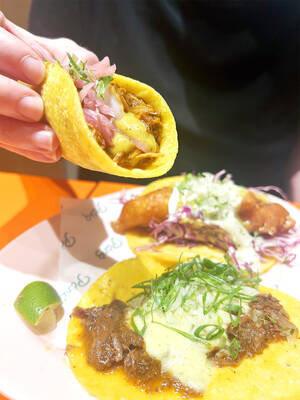
This year’s Michelin Gourmand Bib sported 16 new entries in the 126-strong Taiwan directory. The fight for the best braised pork rice and the crispiest scallion pancake painstakingly continued, but what stood out in the lineup this year? Pang Taqueria (胖塔可利亞); Taiwan’s first Michelin-recommended Mexican restaurant. Chef Charles Chen (陳治宇) is a self-confessed Americophile, earning his chef whites at a fine-dining Latin-American fusion restaurant. But what makes this Xinyi (信義) spot stand head and shoulders above Taipei’s existing Mexican offerings? The authenticity. The produce. The care. AUTHENTIC EATS In my time on the island, I have caved too many times to

In the aftermath of the 2020 general elections the Chinese Nationalist Party (KMT) was demoralized. The Democratic Progressive Party (DPP) had crushed them in a second landslide in a row, with their presidential candidate Tsai Ing-wen (蔡英文) winning more votes than any in Taiwan’s history. The KMT did pick up three legislative seats, but the DPP retained an outright majority. To take responsibility for that catastrophic loss, as is customary, party chairman Wu Den-yih (吳敦義) resigned. This would mark the end of an era of how the party operated and the beginning of a new effort at reform, first under


 RSS
RSS